Identification
Yellowjacket nest: how to recognize it and assess the risk
Learn how ground entrances, concealed cavities, aerial nests, and worker traffic can help you identify a likely yellowjacket colony and decide when it needs professional attention.
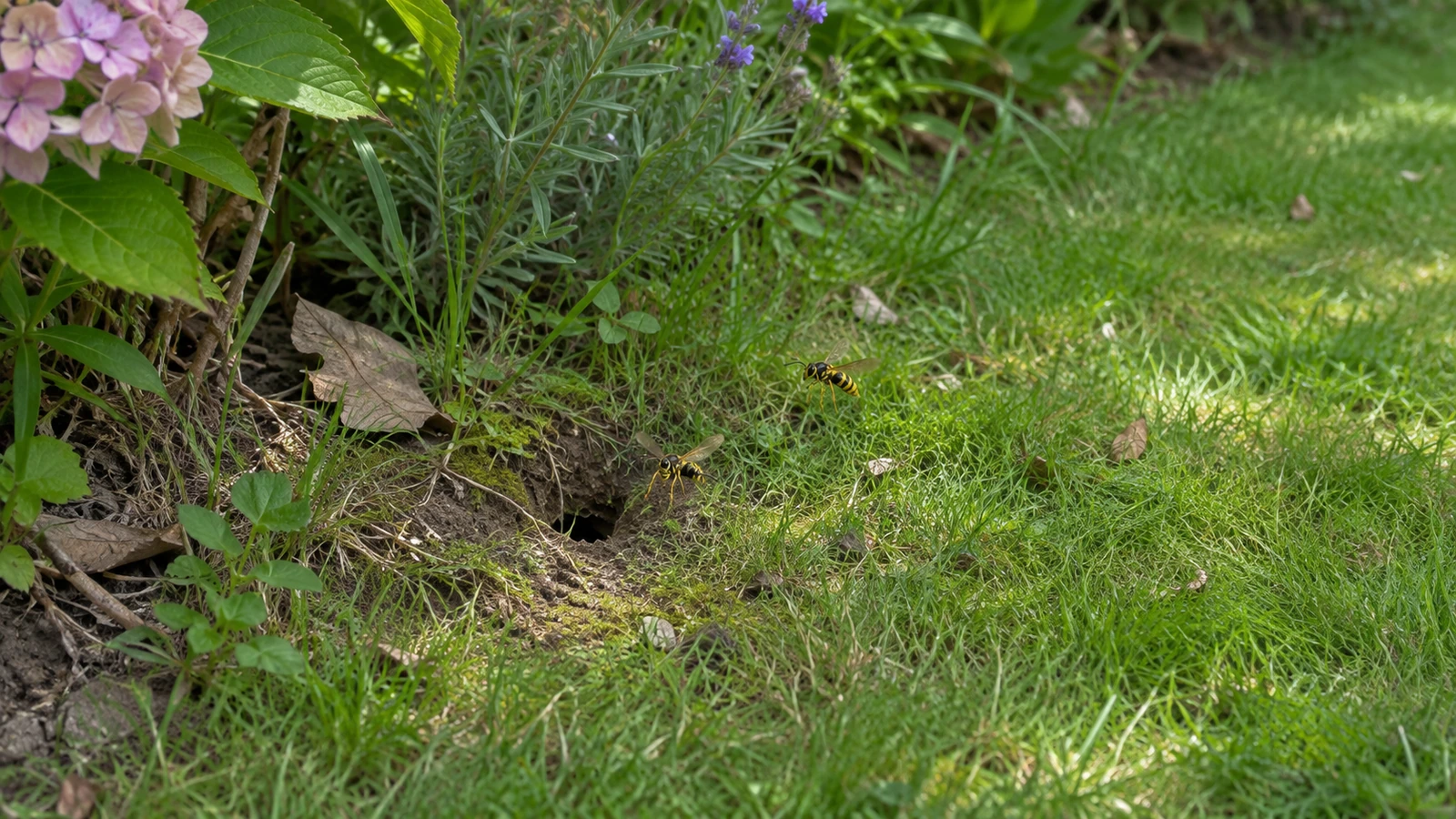
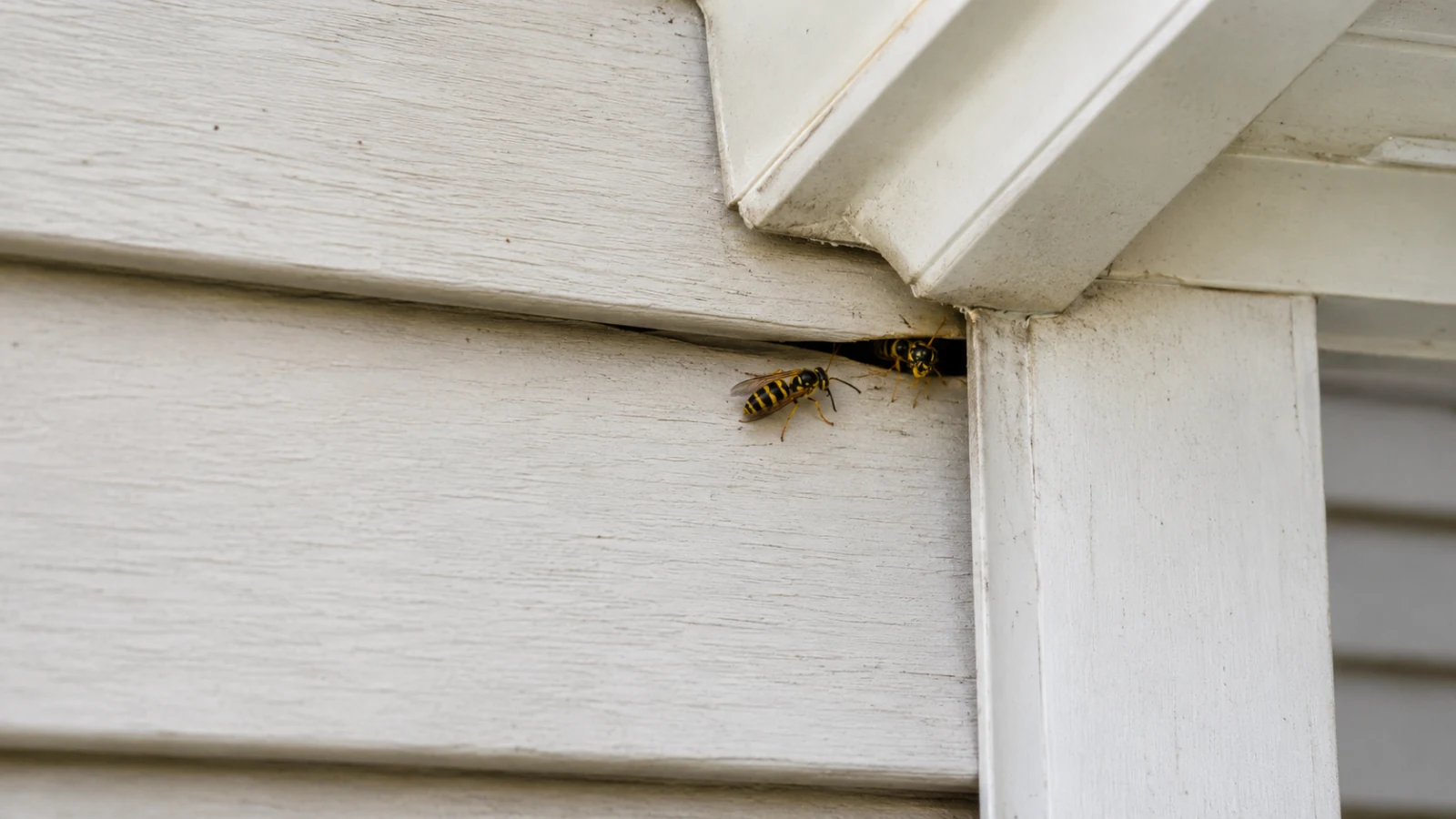
You may notice a few striped wasps disappearing beneath a clump of grass while mowing the lawn, or see insects repeatedly entering a gap in your siding. In either situation, the nest itself may be completely out of sight.
A yellowjacket nest can be identified provisionally by combining the appearance of the insects, their movements, and the location they keep returning to. The goal is to recognize an occupied site before anyone accidentally disturbs it, not to get close enough to examine the nest.
What does a yellowjacket nest look like?
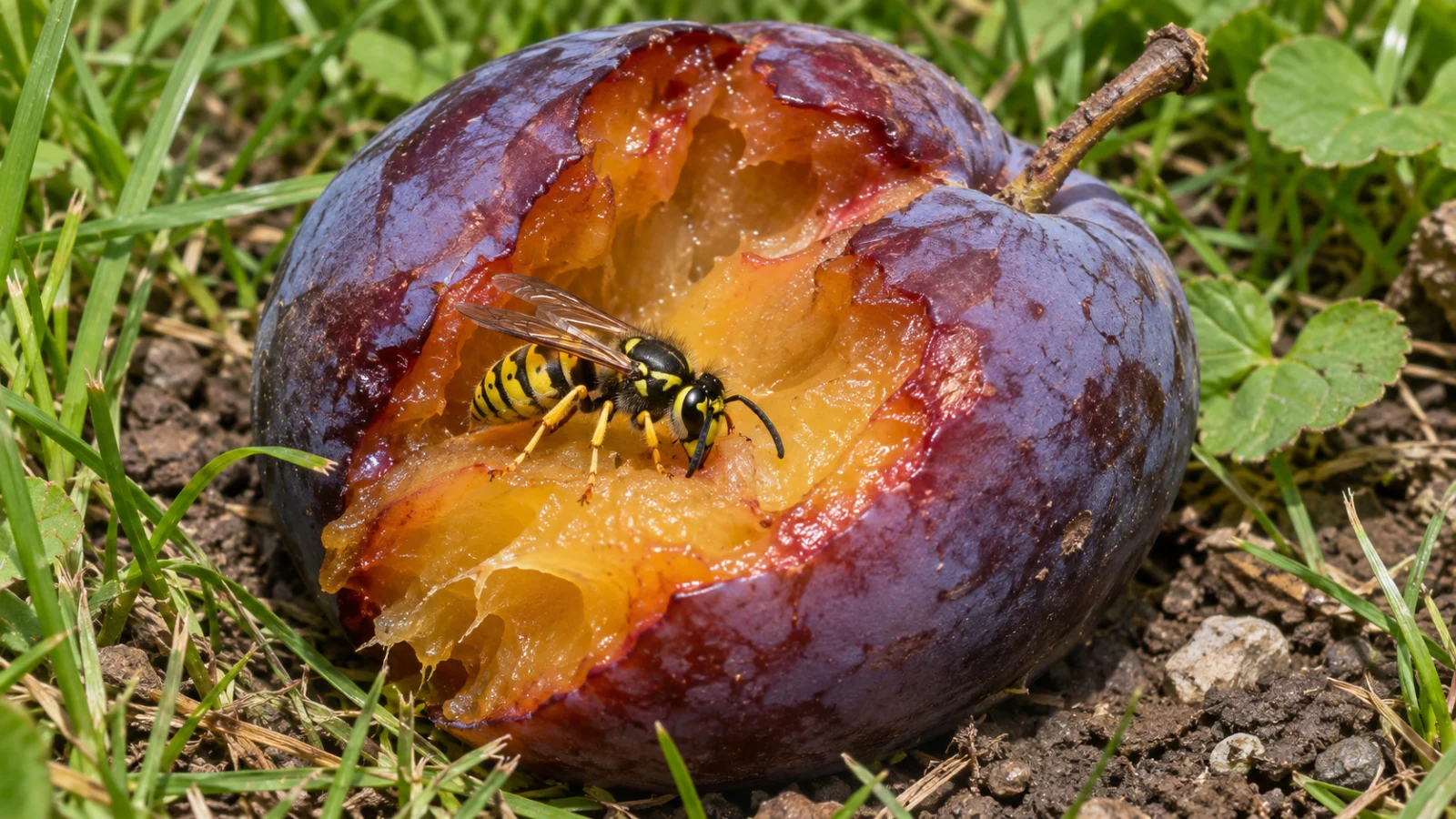
Most familiar yellowjacket workers have a compact, relatively smooth body with sharply defined black-and-yellow markings. Many are around half an inch long. Their nests are made of chewed plant fibers, with several layers of comb enclosed in a papery covering. In a ground or wall nest, however, you may see only the entrance.
Identification in 30 Seconds
- Compact black-and-yellow wasps repeatedly entering and leaving a ground opening: a yellowjacket colony is a strong possibility.
- Similar insects using a gap in siding or under a roof edge: suspect a concealed nest.
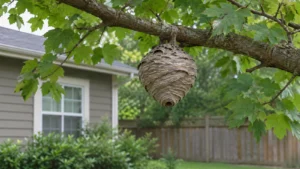
- Wasps entering a closed papery nest hanging from a branch: consider an aerial yellowjacket.
- Insects scattered over flowers or food without a shared destination: foraging alone does not locate a nest.
Yellowjacket nests in the ground
Several species in the genus Vespula use existing cavities in the ground, such as abandoned rodent burrows. Eastern yellowjackets (Vespula maculifrons) and western yellowjackets (Vespula pensylvanica) are familiar examples in different parts of the country.
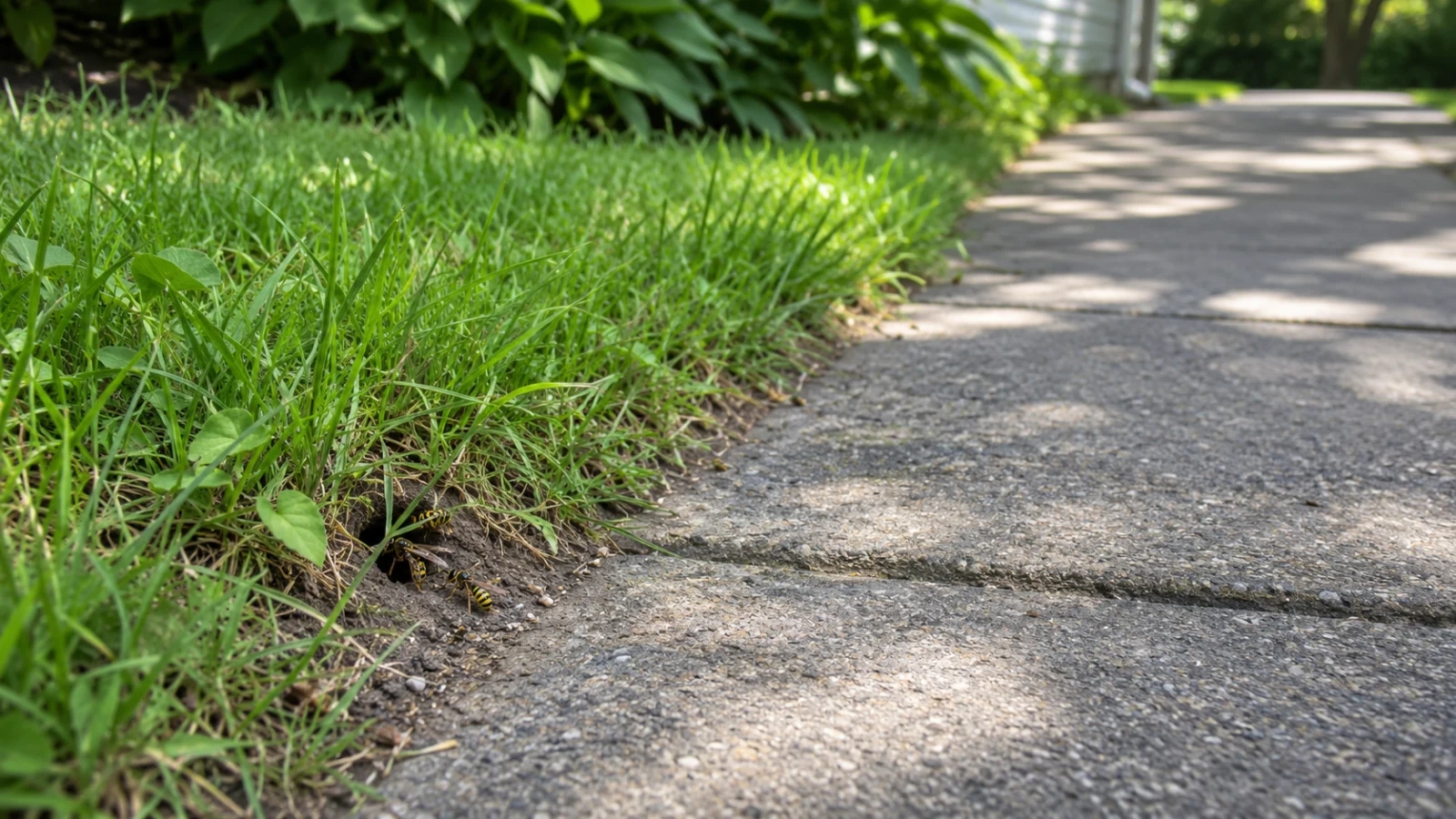
An entrance can be as inconspicuous as a dark opening beneath grass, roots, or a stone. The paper nest may sit farther along the burrow, so its position and size cannot be determined from the opening.
German yellowjacket nests in buildings
The German yellowjacket (Vespula germanica) frequently nests in building cavities in North America, although it can also nest underground. It is an introduced species established across much of the northern United States, with a more limited distribution in the Southeast.
Repeated traffic at a siding joint, soffit, or other exterior gap fits this nesting pattern. The location alone is insufficient to identify the German yellowjacket specifically because other species also use cavities.
Aerial yellowjacket nests
Species such as the aerial yellowjacket (Dolichovespula arenaria) can build enclosed paper nests above ground, in trees or shrubs and sometimes on buildings. The black-and-white insects known as bald-faced hornets are also members of Dolichovespula, despite their common name.
A hanging paper envelope is therefore compatible with a yellowjacket nest even when the insects are not the familiar black-and-yellow ground-nesting type.
How to locate a likely nest entrance safely
Watch from indoors through a closed window or from a place already well away from the suspected nest and flight path. Look for insects arriving at one opening, disappearing inside, and later leaving again. There is no need to follow individual wasps or walk closer to find out where the passage leads.
If the insects disappear behind siding, a low retaining wall, or the edge of a shed, note the location you can see. That may be enough information for a professional to assess the site even if the paper nest remains hidden.
A camera’s zoom can help document the opening or the insects from your existing safe position. If you cannot establish a safe vantage point, stop the observation there.
Identification Mistakes
- Assuming that every hole in a lawn contains a yellowjacket colony.
- Treating wasps gathered at a trash can as proof of a nest beneath it.
- Trying to flush insects out to confirm what is inside an opening.
Key Clue
Several similar wasps repeatedly using the same entrance in both directions is much stronger evidence of a colony than a large number of insects flying around an attractive food source.
What to Watch For
Yellowjackets may defend a nest that is barely visible. A quiet patch of grass or a small siding gap can be hazardous to disturb even when only a few workers are outside.
Is it a yellowjacket colony or something else?
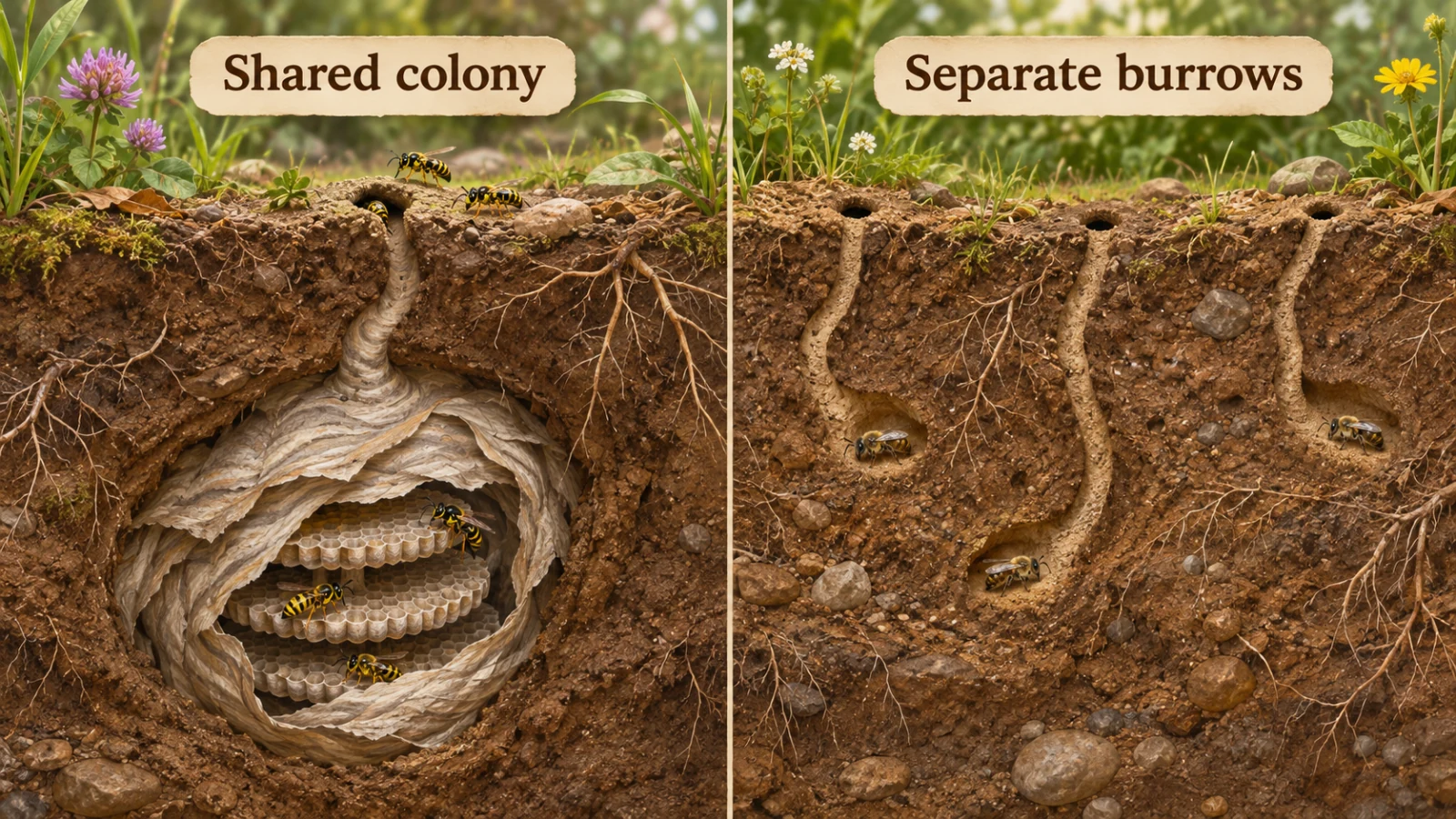
One shared entrance versus separate burrows
Mining bees and solitary digger wasps may nest in groups in the same patch of soil. Each female generally has her own burrow, so the activity can look busy even without a shared social colony. Cicada killers are another example of solitary wasps that can create conspicuous burrows.
When several compact wasps converge on one common opening, yellowjackets become more likely. A cluster of separate entrances, each with occasional activity, is more consistent with solitary nesting. Some yellowjacket colonies have more than one entrance, and bumble bees can also share an underground nest, so use the insect’s appearance as supporting evidence.
When the nest is visible above ground
An open, exposed comb beneath an eave favors paper wasps. An enclosed paper structure fits aerial social wasps, including yellowjackets. The body shape and markings help refine the identification, especially when distinguishing paper wasps from yellowjackets.
When you only see insects at food
Yellowjackets may travel from their colony to ripe fruit, garbage, or outdoor meals. A busy feeding spot may be some distance from the nest. If their movements do not converge on a particular opening, you have identified a place where they forage, not the location of their colony.
How serious is the nest activity?
The location can matter more than the number of wasps visible. An underground nest next to a walkway or a regularly mowed lawn creates a risk of accidental disturbance that an isolated colony in an unused corner of the yard may not.
Yellowjackets can react defensively to vibration and disturbance near the nest. A mower, string trimmer, or ordinary foot traffic can bring people much closer to a concealed colony than they realize.
How many yellowjackets can live in a nest?
A young colony begins with a queen and expands as workers emerge during the warmer months. Depending on the species and stage of development, a mature colony may contain hundreds or thousands of workers. German yellowjacket colonies, for example, commonly contain around 1,000 to 3,000 workers in the fall.
Counting insects visible at the entrance cannot establish the size of the colony. Activity changes with weather, time of day, and the stage of the colony’s development.
Does less activity mean the nest is empty?
In much of the United States, colonies decline when cold weather arrives, and newly mated queens overwinter elsewhere. Some colonies can persist in mild climates or sheltered, warm structures.
A drop in visible activity is therefore useful context, but not clearance to disturb the site. Even an entrance that seems quiet deserves caution if there has been recent traffic.