Guide
Different types of wasps and hornets in the U.S.
Compare paper wasps, yellowjackets, true hornets, mud daubers and lookalikes using body shape, behavior and safe nest observations.

A striped insect hovering over a soda can might be a yellowjacket, a paper wasp, or a harmless fly that looks like one. A large wasp near the lawn raises a different question from several wasps repeatedly entering a gap beside the porch.
You can usually narrow down the group without getting close. Look at the insect’s body shape, how it moves, where it spends time, and any nest you can already see from a safe position. That is more useful than relying on yellow-and-black coloring or a familiar name.
What is the difference between a wasp and a hornet?
“Wasp” is a broad term. Paper wasps, yellowjackets, hornets, mud daubers, and cicada killers are all wasps. A true hornet belongs to the genus Vespa. In parts of the United States, the European hornet is one example. The black-and-white insect commonly called the bald-faced hornet is not a true hornet; it belongs to a group of yellowjackets.
There is another useful distinction: social versus solitary wasps. Paper wasps, yellowjackets, and true hornets usually form colonies with a queen, workers, and developing young inside a shared nest. Mud daubers and cicada killers generally provision their own brood cells or burrows rather than maintaining a large worker colony. This difference often matters more to a homeowner than the wasp’s size.
Adult wasps may visit flowers for nectar, catch other insects, or seek sugary food. Many help control garden pests, and some transfer pollen as they feed. Their larvae develop in protected cells; the familiar flying insects are adults.
Key Takeaways
- Use shape, leg position, behavior, and location together. Black-and-yellow stripes alone are unreliable.
- A hornet is a kind of wasp, but the bald-faced “hornet” is actually a yellowjacket.
- An isolated forager and repeated traffic into a nest opening call for different decisions.
- Never approach or open an active nest just to improve an identification.
Recognize the main kinds of wasps around homes
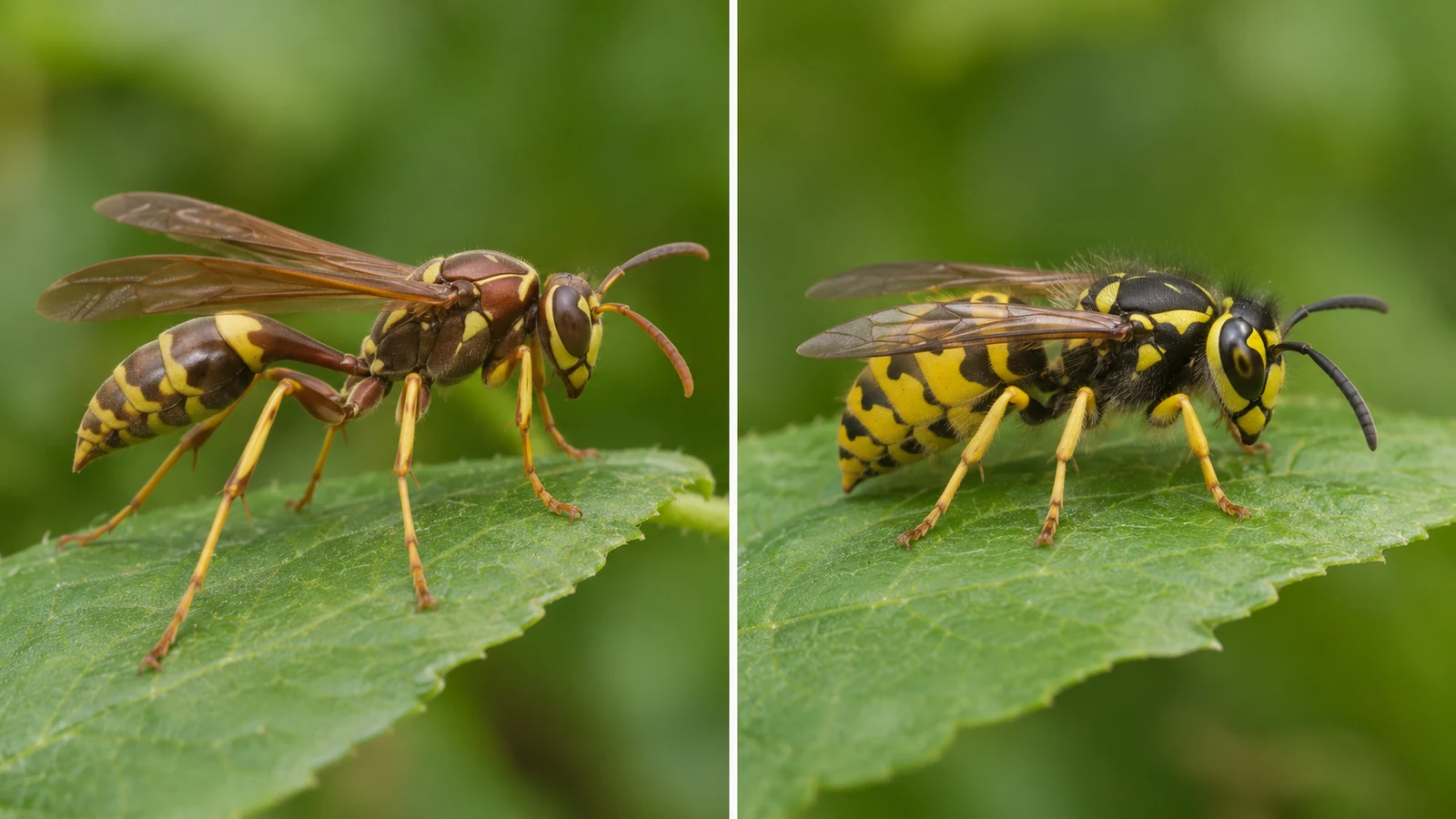
Paper wasps often look slim and long-legged, while many yellowjackets have a more compact build. Other wasps have strikingly narrow waists or are much larger than the insects at a picnic table. These are starting points, not guarantees from a distant photo.
Compare the adult with what it was doing. An insect collecting prey, a group feeding on spilled soda, and repeated traffic into one cavity provide different clues. A nest’s shape can help too, but only when you can observe it without moving closer.
Paper wasps: slim bodies and dangling legs
Paper wasps (Polistes) tend to have a narrow, elongated build, with long legs that often trail below them in flight. Colors range from rusty brown to black and yellow. Some species look surprisingly like yellowjackets.
Paper wasp identification is stronger when the body shape matches an exposed, umbrella-like comb of paper cells visible from a safe distance. Their specialized species and nest details belong in a closer identification guide.
Yellowjackets: compact social wasps
Yellowjackets are often stockier, with sharply patterned, relatively smooth bodies. Many show up around outdoor meals and trash, although foraging location alone is not an identification. Yellowjacket identification also considers flight, nest traffic, and region.
Some species nest underground, while others use wall cavities or enclosed nests above ground. For the full distinction from insects loosely called “wasps,” see our wasp vs. yellow jacket comparison.
True hornets: members of Vespa
True hornets are wasps in the genus Vespa, not simply any unusually large wasp. The European hornet has a relatively robust body, reddish-brown areas on the head and thorax, and a yellow abdomen with darker markings. Its range is not uniform across the country.
The invasive yellow-legged hornet is another Vespa species reported from limited U.S. areas. It should not be assumed from size, dark coloring, or the word “hornet” alone.
Bald-faced hornets: a misleading name
The bald-faced hornet is a large black-and-white social wasp, Dolichovespula maculata. Despite its common name, it is an aerial-nesting yellowjacket rather than a true Vespa hornet.
Bald-faced hornet identification starts with the black body, pale facial and abdominal markings, and appropriate geographic context. Its often-visible enclosed paper nest is a clue, not an invitation to approach.
Mud daubers and cicada killers: solitary builders
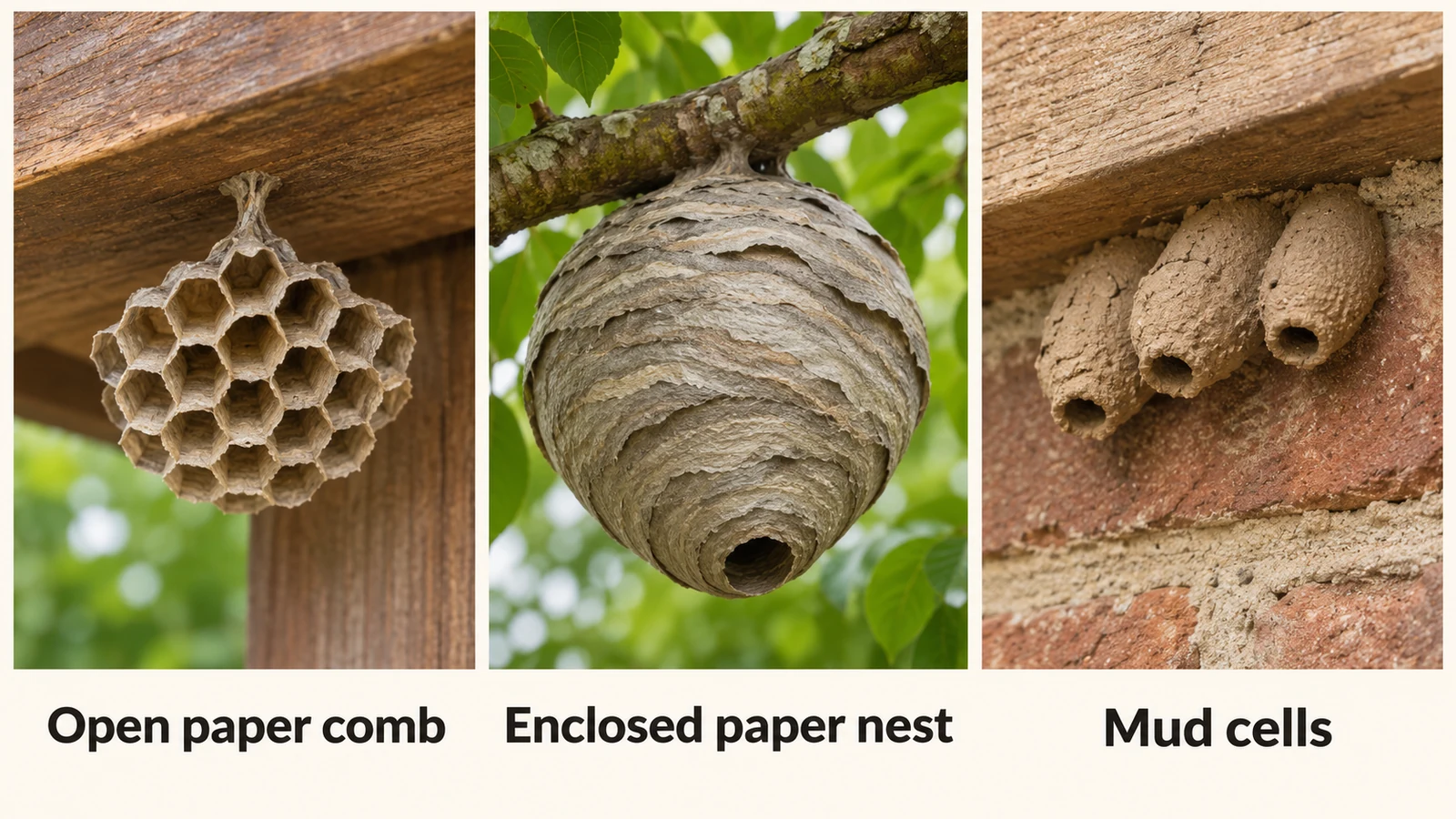
Many mud daubers have long, threadlike waists and may be black-and-yellow or metallic blue-black. Their attached mud dauber nests consist of clay cells or tubes, often under sheltered building surfaces. These are not the same as burrows in lawn soil.
Cicada killers are large, robust, often black-and-yellow solitary wasps that use underground burrows. A big wasp over a patch of bare soil is not automatically a hornet or a social yellowjacket. Our cicada killer wasp guide covers that particular identification question.
Bees and hoverflies: common lookalikes
Many bees have noticeably hairier bodies than typical social wasps, and some carry visible pollen on their legs. Hoverflies can imitate wasp bands but are flies, with one pair of functional wings and often very large eyes. Neither a smooth-looking bee nor a striped fly should be classified from color alone.
Why their behavior and nests differ
A social-wasp queen starts a colony and workers later gather food, protect the nest, and provision developing larvae. Social nests are made from chewed plant fibers that dry into a paper-like material. Depending on the group, the cells may be open below a sheltered ledge or enclosed within an outer paper envelope.
A solitary mud dauber instead makes and provisions individual mud cells, often with spiders. Cicada killers provision burrows with cicadas. Several solitary wasps working in the same patch of soil can make the area look busy, but each may have a separate nest rather than sharing one worker-filled colony.
In much of the temperate U.S., social-wasp colonies expand through the warmer season and old nests are not reused by the same colony the following year. Activity dates and colony behavior vary with climate and species. An empty old paper nest and an actively guarded entrance are not the same situation.
How to narrow down an identification safely
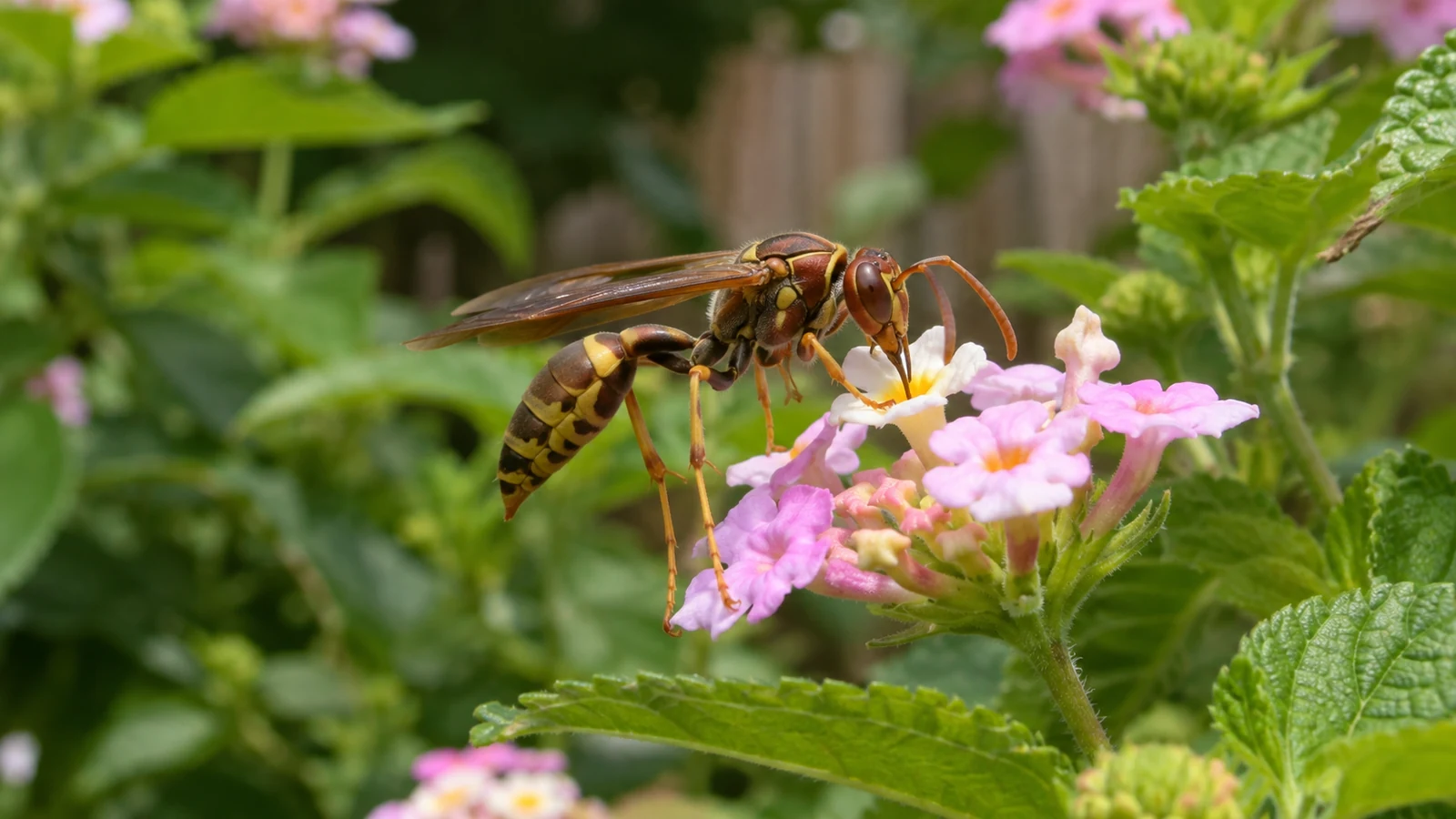
Start with what you can observe from where you already are. Notice whether the insect is on flowers, visiting food, or repeatedly flying to one opening. If a clear picture is possible without entering the flight path, capture the body’s proportions and leg position rather than chasing it for a closer shot.
From a safe distance, note the location and apparent material of any nest: exposed paper cells, an enclosed papery structure, attached clay cells, or a ground opening. You do not need to look inside, touch the structure, climb toward it, or test whether the insects react.
Treat location as supporting evidence rather than an exact species label. A ground hole could belong to a solitary digger wasp or a social yellowjacket, and similar-looking paper nests can belong to different groups. Repeated traffic into a single opening is more meaningful for deciding whether that spot needs to be avoided.
Practical Tip
When identification is uncertain, photograph an insect resting away from the nest and note its build, leg position, and location. A useful record beats a risky close-up.
Watch For
Steady wasp traffic into a wall gap, ground opening, or nest beside a busy doorway deserves extra distance. Do not block the entrance or test the colony by disturbing it.
Choose the right next step
A single wasp collecting nectar or hunting other insects generally needs no intervention. Leave it room to move and avoid swatting it. Identification should help you decide whether there is an actual household problem, not create one.
When wasps are gathering around outdoor dining areas, cover drinks and food, clean sticky spills, and close trash lids. If you are considering a trap, our wasp trap comparison explains which types target which insects and why trapping is not the same as controlling an active nest.

An active nest near a doorway, play area, or frequently used path deserves a location-specific safety decision. Our professional wasp nest removal guide explains when help may be justified and what to clarify before arranging a service. This identification hub does not provide nest-spraying or removal steps.
Prevent unnecessary encounters
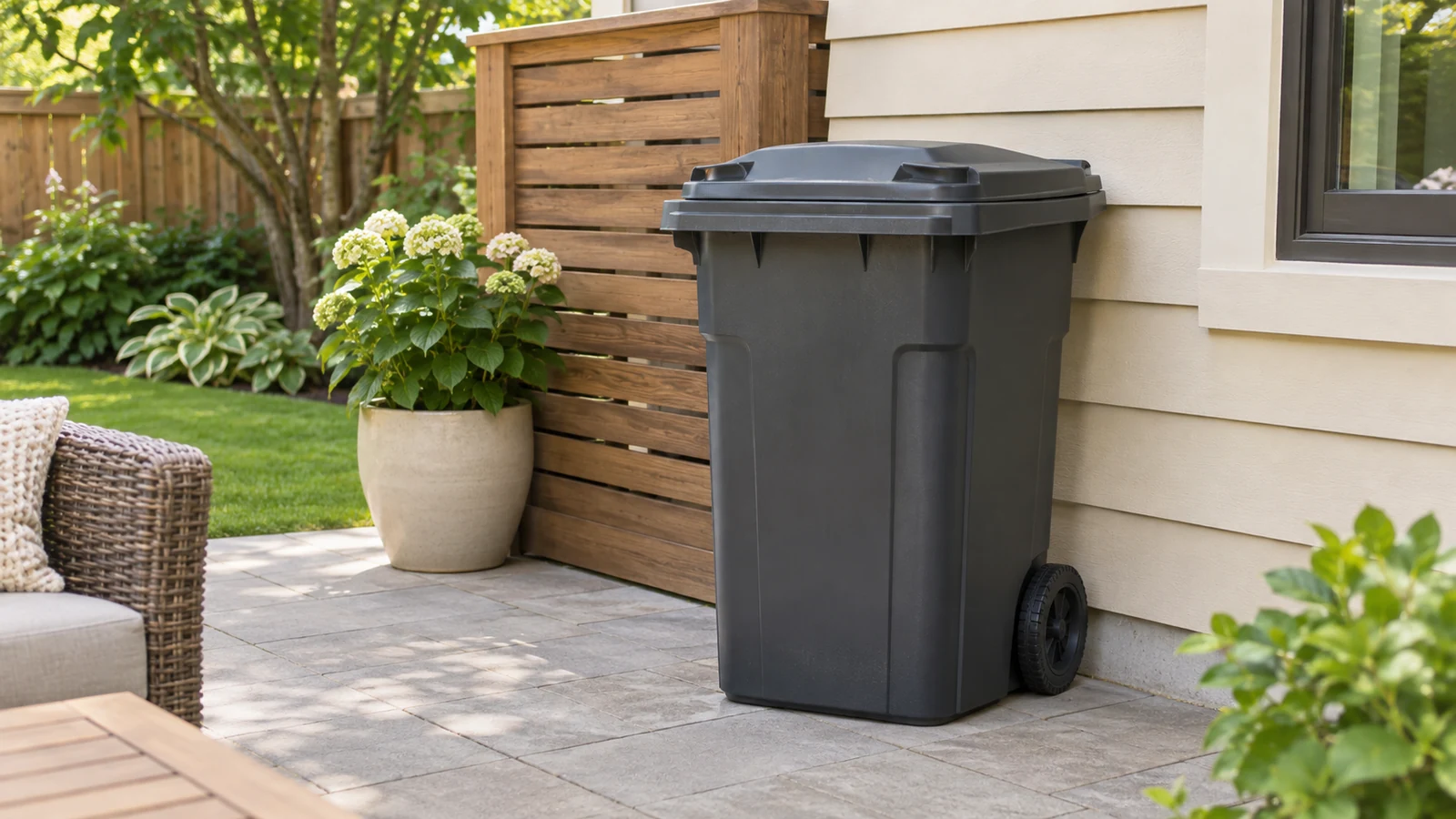
Reduce food attractants around patios and trash storage: seal garbage, clear sugary residues, and collect fallen fruit where practical. Those changes can reduce feeding visits but will not remove an established colony.
Watch nest activity from a distance before changing anything around a suspected entrance. Do not seal a cavity or pull down an occupied structure. If the insects are simply passing through a garden, tolerating their normal foraging may be the most appropriate choice.
Good to Know
The invasive yellow-legged hornet (Vespa velutina) has confirmed detections in Georgia, South Carolina, and North Carolina as of the federal August 2026 update. If you suspect one, keep your distance and use the official state reporting instructions.
Explore this topic further: