Identification
Wasp and Hornet Nests: What the Shape and Location Tell You
An open comb, a layered paper ball, a ground entrance, or clay cells can point to different nest types. Learn what you can safely observe before deciding what to do.

A gray, papery ball hangs from a tree branch. Elsewhere, wasps keep disappearing into a gap beside a porch. Both sightings may involve a nest, but only one shows the actual structure.
You can narrow down the possibilities without moving closer. Look at the material and shape from a place that is already safe to occupy, then consider where the insects are entering and whether the site lies in someone’s path.
Recognize the main wasp nest shapes
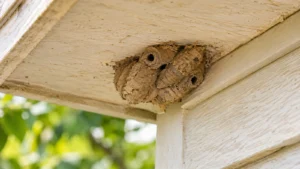
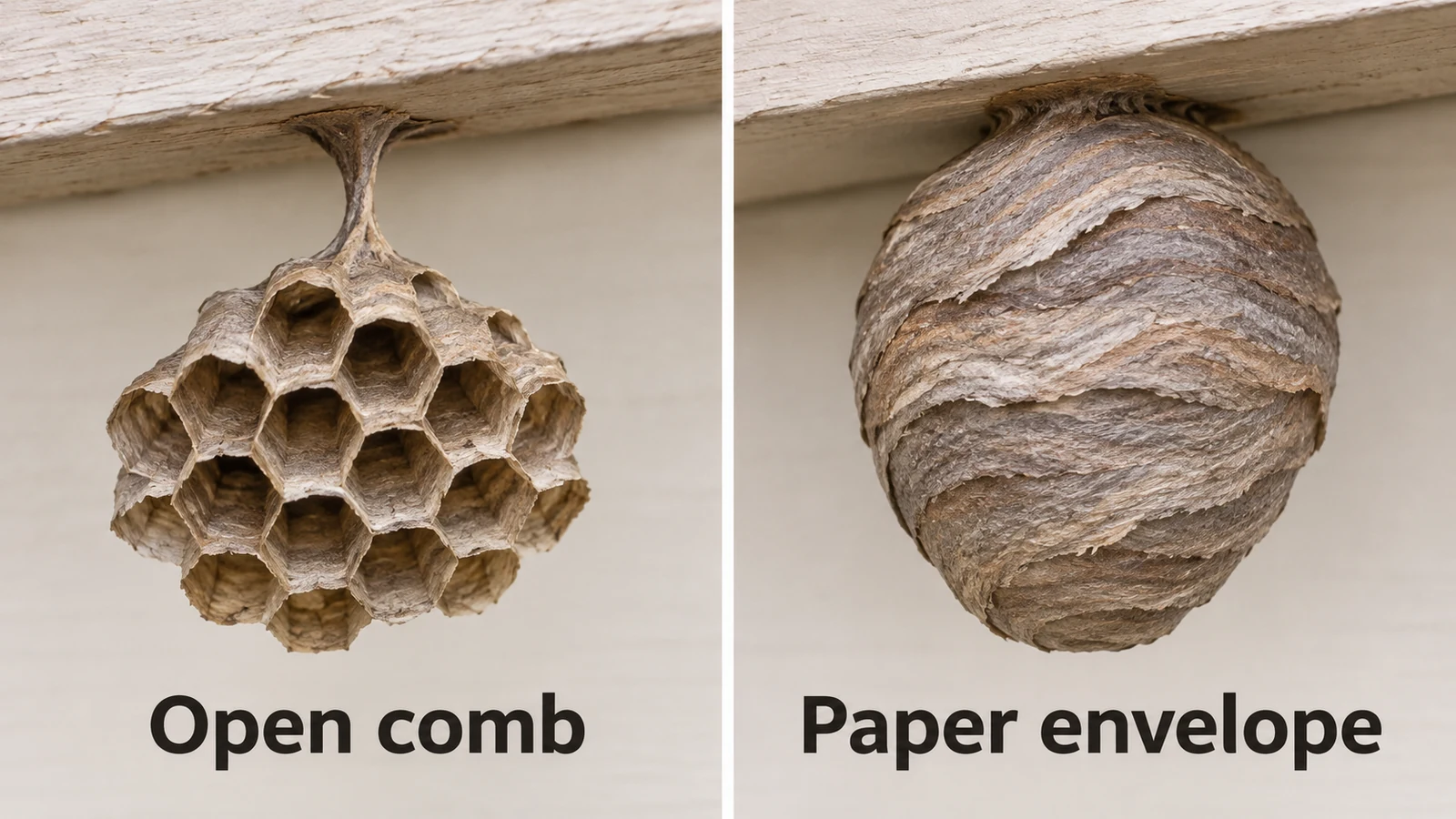
An exposed paper comb with open, hexagonal cells, often hanging by a short stalk beneath an eave or beam, points toward paper wasps. You can see the cells from below because there is no enclosing outer shell.
An oval or rounded nest wrapped in layers of gray or brown paper may belong to aerial yellowjackets, including insects commonly called bald-faced hornets. Other social wasps build inside trees, walls, or underground cavities, where the nest itself may be hidden.
Identification in 30 Seconds
- Open paper cells visible underneath: A paper wasp nest is a likely match.
- Enclosed, layered paper ball or oval: Think of an aerial social-wasp nest, not one certain hornet species.
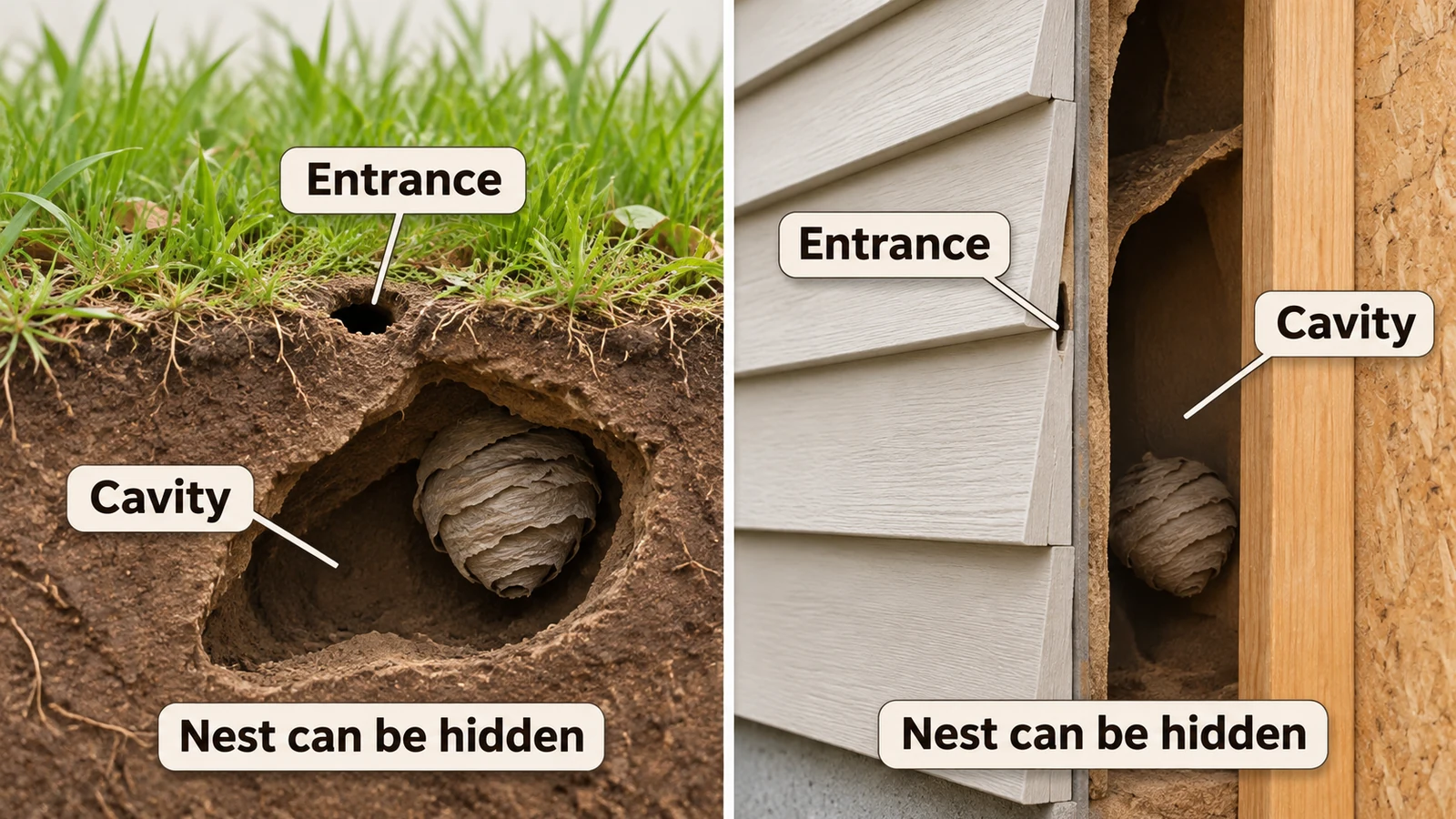
- Wasps repeatedly entering a ground hole or building gap: A concealed nest is possible; the entrance is not the nest itself.
- Hard clay tubes or mud lumps stuck to a surface: Consider solitary mud daubers rather than a paper-wasp colony.
The materials explain some of these differences. Social wasps make their papery nests from chewed wood fibers, while mud daubers form cells from gathered mud. And the name hornet is not a nest shape: bald-faced hornets are actually aerial yellowjackets, while true hornets such as European hornets can nest inside sheltered cavities.
Check the location and activity without approaching

Start from a window or another position well away from the suspected nest and its flight path. If you cannot see it clearly without walking closer, skip the close look. A zoomed photo is useful only when it can be taken from that safe position.
Watch whether several wasps repeatedly enter and leave the same opening. That pattern is stronger evidence of a nest entrance than a single insect passing nearby. The colony may be concealed farther inside soil, a hollow tree, or a building cavity.
Look for these clues only where they are already visible:
- Under an eave or beam: Note whether you can see open comb cells or a covering paper envelope. Do not stand directly beneath the structure.
- In a tree or shrub: A suspended paper nest may be visible among branches. Do not shake or clear vegetation to expose it.
- At a ground or siding opening: Repeated traffic suggests a possible occupied site, but a hole alone could be used by solitary wasps or bees.
- On a sheltered wall or garage surface: Hardened mud cells differ from paper combs. Leave them intact while identifying the structure.
Identification Mistakes
- Calling every enclosed gray paper nest a true hornet nest.
- Assuming any hole in the lawn must contain yellowjackets.
- Treating solitary mud-dauber cells as a large social-wasp colony.
Key Clue
The distinction between a visible nest and an entrance matters most. A paper comb reveals part of the structure; a ground hole or wall gap may reveal nothing about the nest hidden beyond it.
What to Watch For
Seeing one or two wasps near a structure does not show how many insects use it or how defensive they may be. Do not test the answer by tapping, shaking, blocking, or spraying the site.
What the nest clues can and cannot identify
Shape and location help you sort likely nest types, not identify every species. A visible open comb suggests paper wasps; a paper envelope suggests an enclosed social nest. Many yellowjackets nest underground or in cavities, while some build exposed aerial nests. The common name hornet nest does not settle which insect built it.
A ground entrance is particularly easy to misread. Yellowjackets may use an old animal burrow, but solitary ground-nesting wasps and some bees also use soil openings. Similarly, a gap in siding may be an entrance to a concealed nest, not an indication of its size or exact position. Leave any suspected occupied opening unsealed.
Use the structure, site, and observations together:
| What you see | What it may suggest | What remains uncertain |
|---|---|---|
| Open paper comb under a sheltered overhang | Paper wasp nesting pattern | Exact species and whether the nest is currently occupied |
| Enclosed gray or brown paper nest hanging in a tree or on a building | Aerial yellowjackets, including bald-faced hornets | The builder’s exact identity and activity without further evidence |
| Repeated wasp traffic at a hole in the ground | A concealed social nest, possibly yellowjackets | Whether the insects are social wasps, solitary wasps, or bees |
| Repeated traffic through siding, a soffit, or a tree hollow | A concealed cavity nest | The nest’s location within the cavity, size, and occupants |
| Clay tubes or compact mud cells attached to a wall or beam | Solitary mud-dauber-type nesting | The exact builder and whether the cells are occupied |
Is the nest active, and does its location create a risk?
Regular wasp traffic through a particular opening supports current use. A nest with no visible movement during one glance is harder to assess: weather, time of day, and season all affect activity. The appearance of the structure alone cannot establish that it is vacant.
Location matters as much as the suspected nest type. A structure high in a tree away from routine activity presents a different exposure concern from a nest above an entry door or a busy walkway. Ground entrances near play areas, decks, or areas that need mowing deserve particular caution.

If wasps are using an entrance beside a door or inside an occupied wall, keep people and pets away from that route and arrange professional evaluation. Do not open the wall, plug the opening, or attempt to disturb a colony to identify it. A nest well away from people may not require intervention.
Good to Know
In much of the United States, common social wasps use their nests for a single season, and old paper structures can remain visible afterward. In milder regions, seasonal patterns can differ, so favor safe observations of activity over an assumption based on the apparent age of the paper.