
Identification
Mud dauber nests: How to identify the clay cells
Identify the clay cells and tubes built by mud dauber wasps, distinguish them from paper nests, and assess what the location and activity mean.
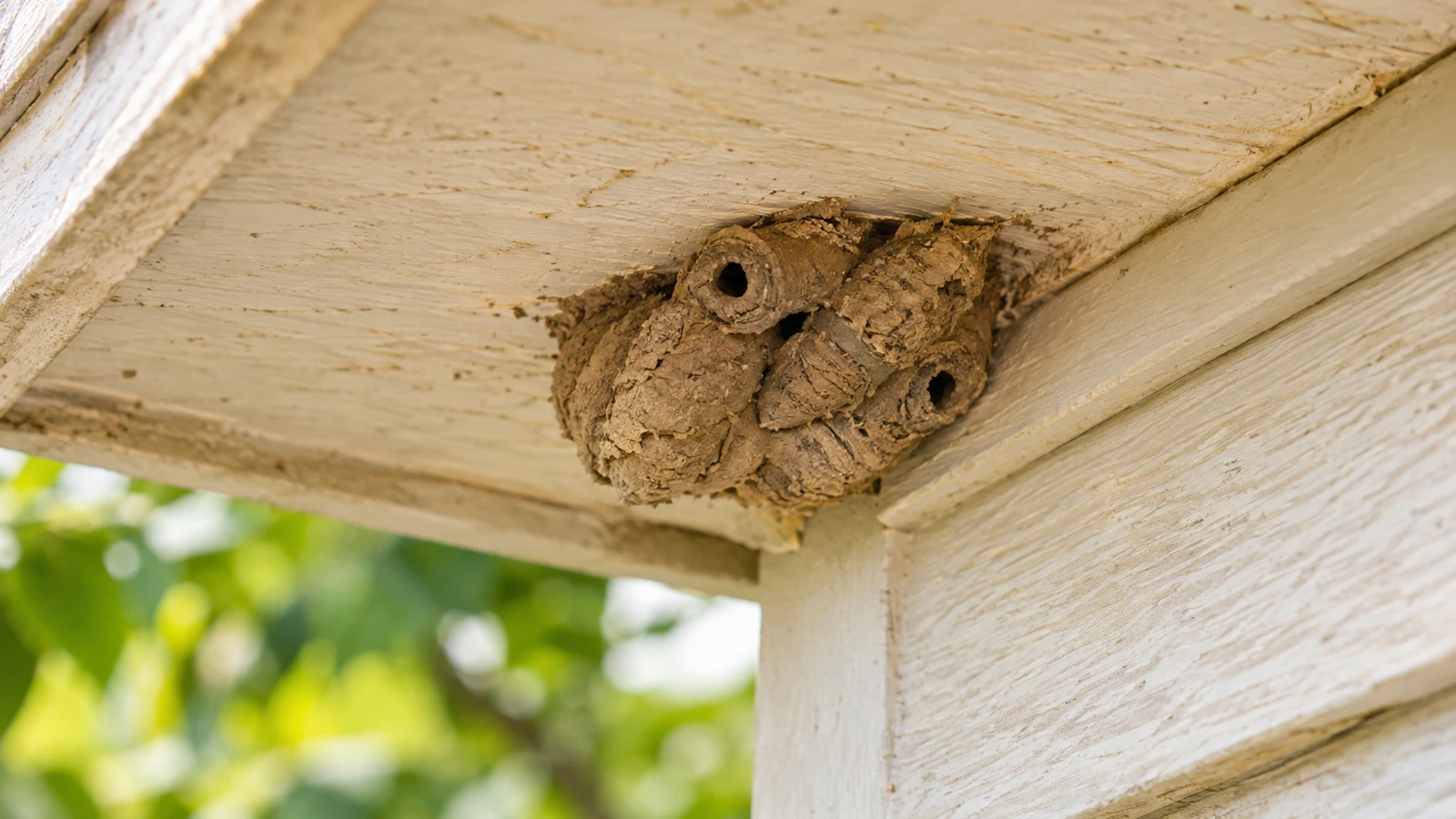
That rough lump beneath your roof overhang may look like dried dirt splashed onto the siding. But if it consists of clay chambers attached to the surface, you may be looking at a mud dauber nest rather than a paper wasp colony.
The shape, material, and location provide the best starting clues. You can learn quite a bit by observing from a distance, without opening a cell or approaching the wasps.
What a mud dauber nest looks like
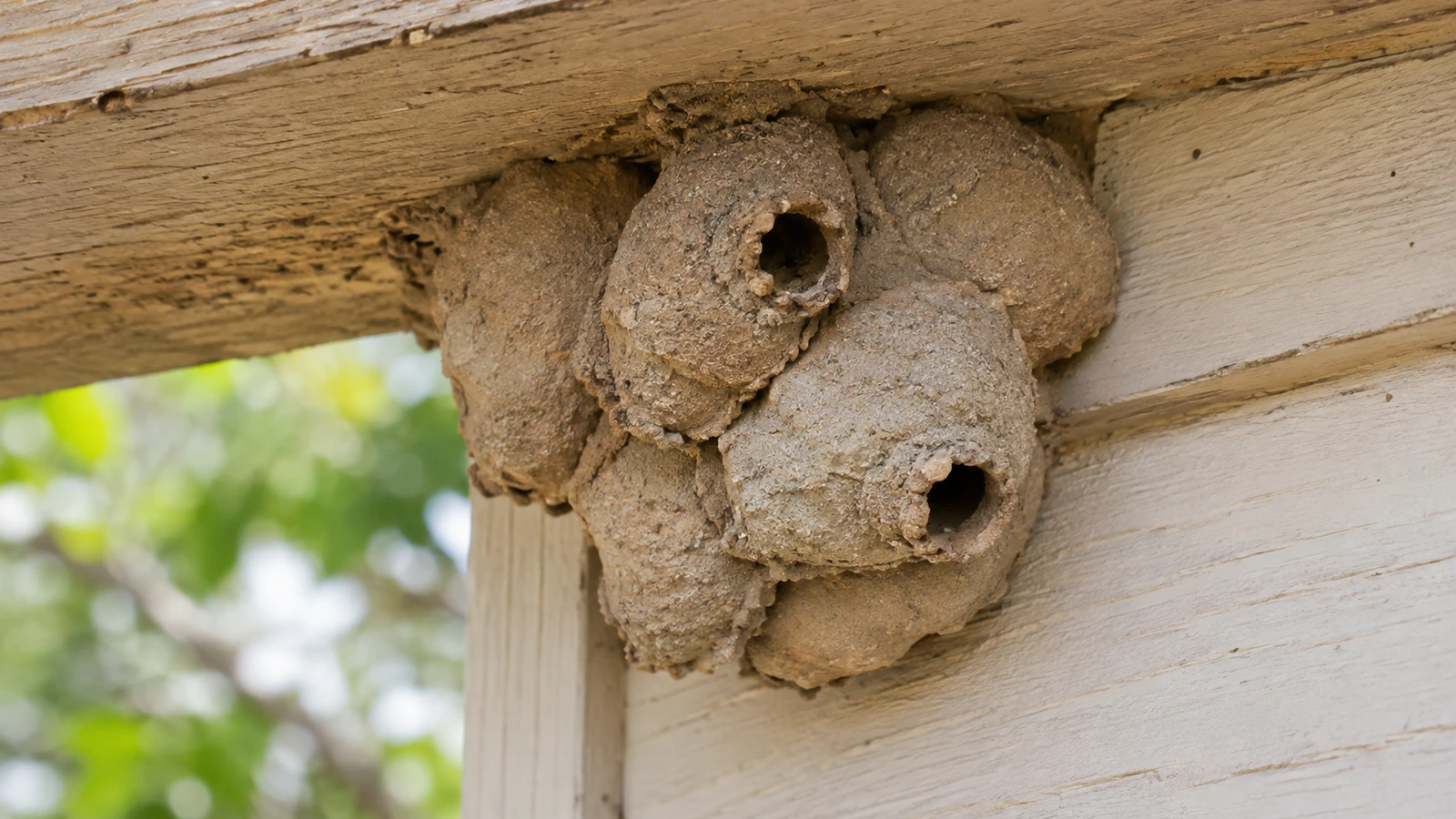
Mud dauber nests are made from mud or clay that hardens into a solid structure. They are commonly attached to protected surfaces, including exterior walls, roof eaves, porch ceilings, beams, and rafters. Some look like irregular lumps of dried earth; others resemble long, narrow tubes placed side by side.
The material is the important distinction. Mud cells have an earthy, compact appearance, often with visible ridges where the wasp added mud. Their color can range from pale tan to gray or brown, depending partly on the soil used.
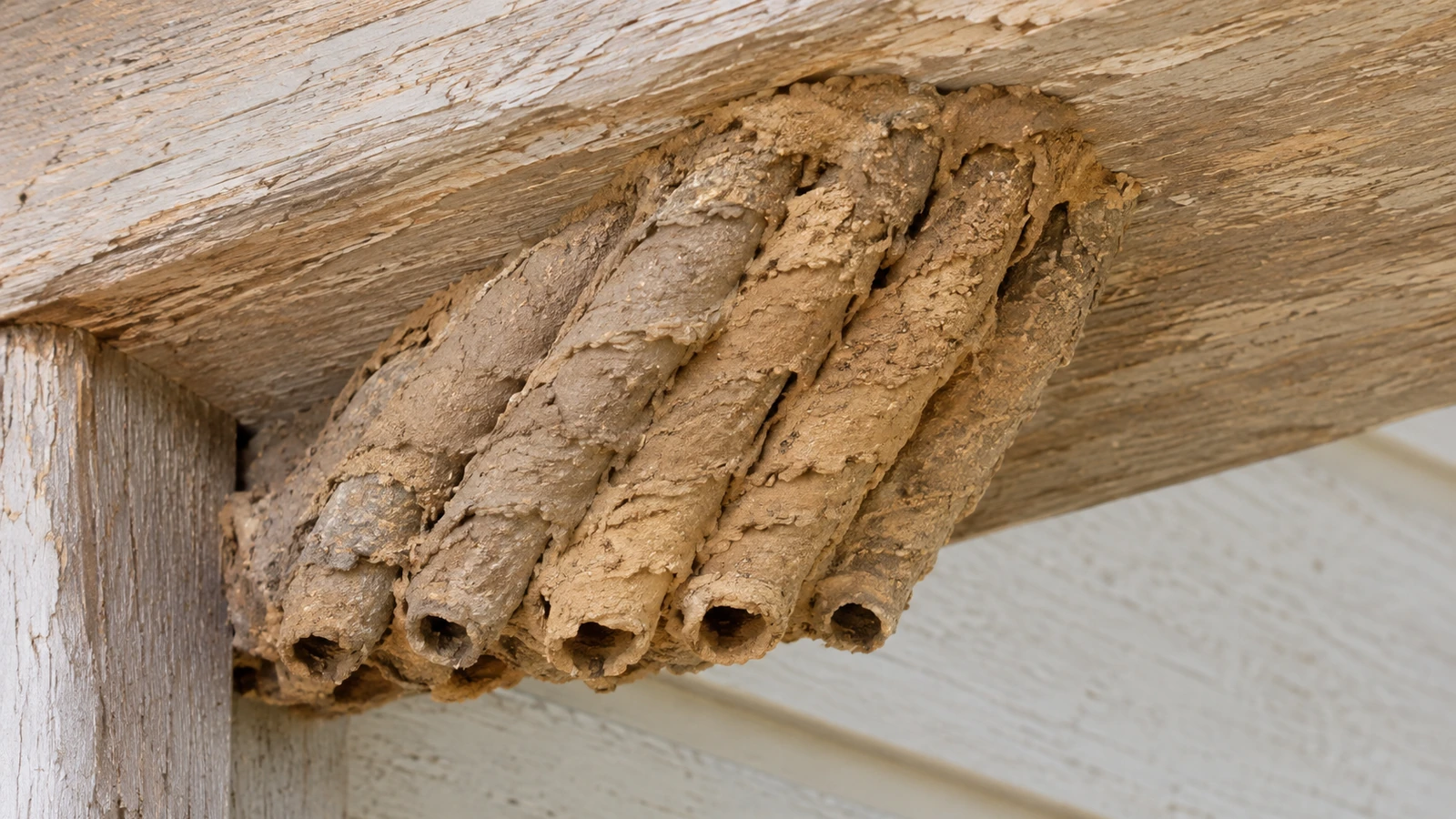
Identification in 30 Seconds
- Material: Hardened mud or clay, rather than gray, layered paper.
- Shape: An irregular cluster of cells or several narrow tubes arranged together.
- Location: Attached to a sheltered wall, beam, eave, or similar surface.
- Nest structure: No exposed, hanging comb of open hexagonal paper cells.
Black-and-yellow mud daubers build individual tubular brood cells, often adding an outer layer of mud that makes the finished nest look like a compact, uneven mass. The separate cells may be difficult to distinguish from outside.
Organ-pipe mud daubers produce a different structure: long, parallel mud tubes that resemble a small set of organ pipes. Several tubes may be grouped together on a wall or underneath an overhang.
The adult wasps are usually slender, with a notably narrow waist. Depending on the species, they may be black and yellow, mostly black, or metallic blue-black. Seeing a wasp at the nest can help, but nest shape and body color alone may not identify the exact species.
How to tell mud cells from other wasp nests
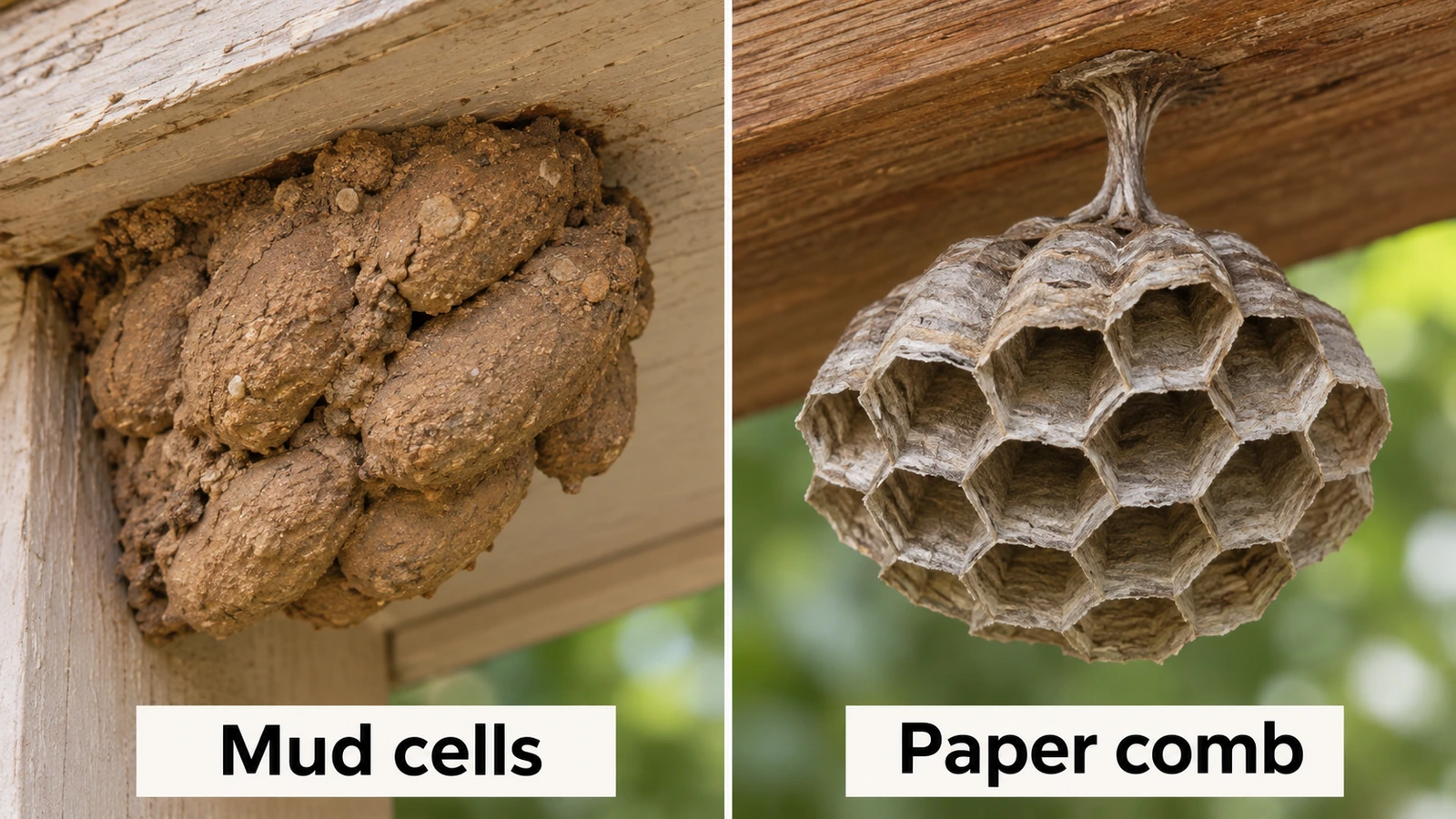
The main lookalike is a nest made from paper. Paper wasp nests typically have an exposed comb of six-sided cells suspended from a small stalk. The material is made from chewed plant fibers and looks papery, not like solid clay. These nests can hang under the same kinds of eaves where mud daubers build.
Other social-wasp nests may be enclosed within layered, grayish paper. Some yellowjacket nests are concealed in the ground or inside wall cavities, where only an entrance is visible. A hole in soil or a wall is not the same structure as attached mud dauber cells.
Observe from an unobstructed spot where you can see the structure without getting closer. Do not climb a ladder, tap the nest, or scrape its surface to check the material.
Other solitary wasps can also use mud. Potter wasps, for example, may build small, jug-shaped cells with narrow necks. Solitary digger wasps can nest in underground burrows. If the structure does not match the clay-cell patterns described here, a broader comparison of wasp and hornet nests can help narrow it down.
From a safe viewing position, check:
- Attachment: Is the structure fixed to a wall, beam, or overhang, rather than an entrance in bare soil?
- Construction: Can you distinguish hardened mud cells from an exposed comb or layered paper envelope?
- Visible activity: If wasps are present, do you see an individual slender wasp visiting the mud structure, or numerous wasps moving through a shared entrance?
Identification Mistakes
- Calling an underground wasp burrow a mud dauber nest because both involve soil.
- Identifying the nest from a wasp’s black-and-yellow coloring without checking its construction.
- Assuming every nest under the eaves is made by the same kind of wasp.
Key Clue
A hardened clay structure fixed to a sheltered surface, especially an irregular cell cluster or a set of parallel tubes, strongly favors a mud dauber nest over a paper wasp nest.
What to Watch For
Repeated traffic by numerous wasps entering a concealed opening is not typical evidence of an individual mud dauber nest. Keep clear until the occupants are identified.
What the cells and wasp activity mean
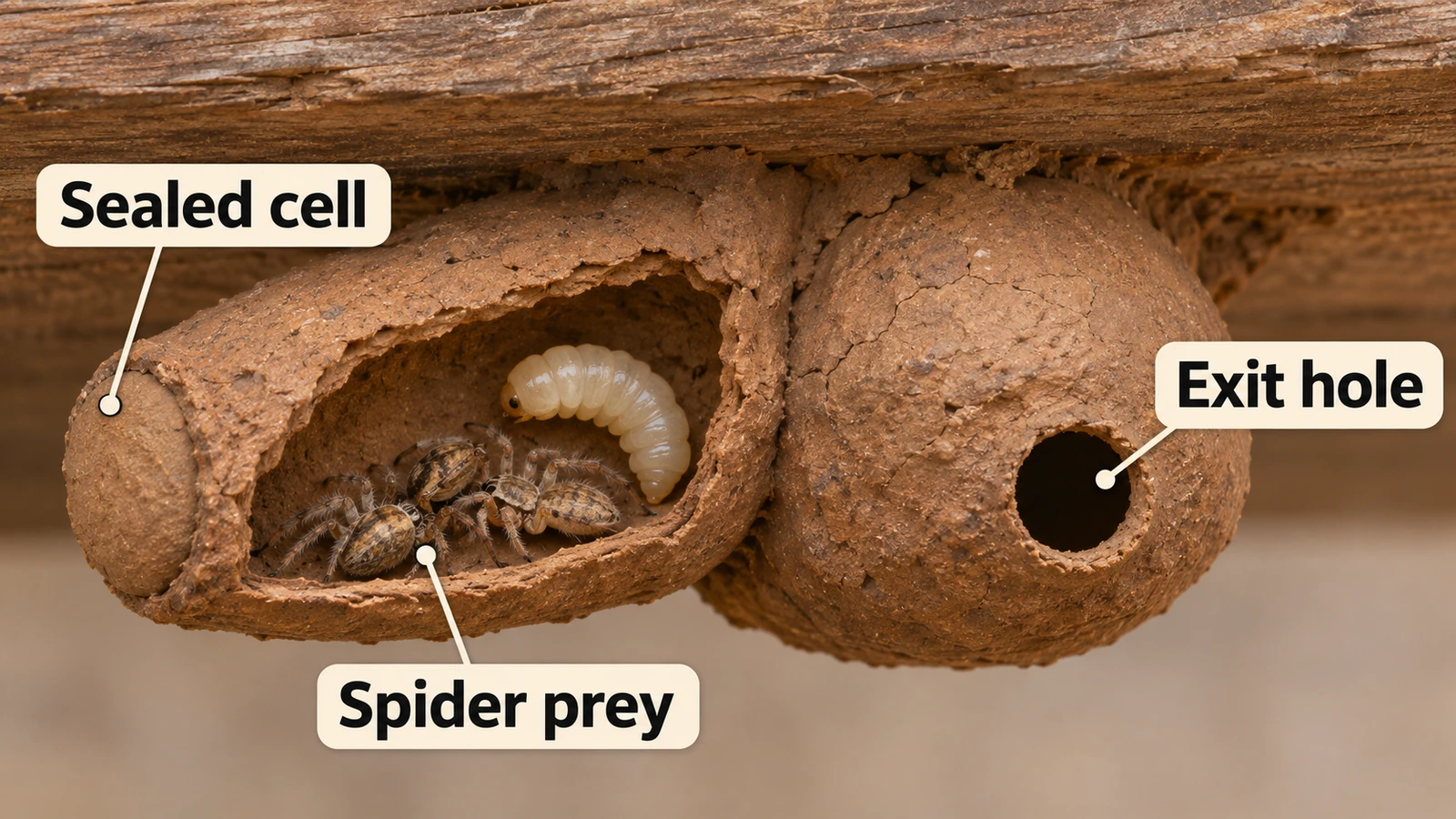
Mud daubers are solitary wasps. A female constructs and provisions brood cells, placing paralyzed spiders inside as food for her developing young. Several adjoining cells do not mean there is a large social colony with workers defending a shared nest.
An adult carrying wet mud or spiders to the structure is strong evidence that at least part of it is being built or provisioned. An intact, sealed cell may contain developing offspring even when no adult is visible during your observation.
Round holes in old mud cells often indicate that adult wasps have emerged. Other cells in the same structure may still be sealed, and some mud daubers reuse existing nests. A hole in one cell does not establish that the entire nest is empty.
Use the structure and activity together to decide what you may have found:
| What you observe | What it suggests | Appropriate next step |
|---|---|---|
| A compact, irregular clay cluster attached beneath an eave | Consistent with a black-and-yellow mud dauber nest | Observe the material and any adult activity from a distance |
| Long, parallel mud tubes attached to a wall or beam | Characteristic of an organ-pipe mud dauber nest | Check the overall structure without approaching or touching the tubes |
| An exposed comb of hexagonal paper cells | More consistent with a paper wasp nest | Keep clear of occupied cells and identify the social wasp separately |
| A layered paper envelope or repeated wasp traffic into a concealed cavity | A different social-wasp nesting situation may be involved | Avoid disturbing the entrance and seek identification if necessary |
| A solitary hole in bare soil without attached clay cells | A ground-nesting wasp or another burrowing insect may be responsible | Do not classify the burrow as a mud dauber nest |
| Round openings in an attached mud structure | Adults may have emerged from those particular cells | Treat remaining sealed cells as potentially occupied until assessed |
Is the nest active, and does it need attention?
A wasp repeatedly bringing mud or spiders to the cells is a useful sign of current activity. In contrast, a dry nest with several round exit holes may contain older chambers. Neither the absence of visible wasps nor the presence of exit holes proves that every cell is empty.
Location matters as much as activity. A nest high on a shed wall, away from regular foot traffic, is usually a different concern from one beside a frequently used doorway or somewhere a child might touch it. Mud daubers are generally not aggressive defenders of their nests, but they can sting if handled or trapped against the body.
Mud dauber species and their seasonal activity vary across the United States. Nest appearance can also vary with the species, local soil, and whether older cells have been reused. The safest judgment is based on what you can actually observe: the structure, its location, and any visible activity.
Good to Know
Metallic blue mud daubers can reuse and refurbish clay cells originally made by other mud daubers. The adult wasp you see visiting a nest may not be the species that built its original structure.