Identification
Cockroach eggs: how to identify roach egg cases
Found a small brown capsule and wondering whether it contains cockroach eggs? Most household roaches keep their eggs inside a protective case rather than leaving individual eggs scattered around. Learn how to recognize that case, check whether it may have opened, and understand what the discovery actually means for your home.

By


You notice a tiny brown object behind the refrigerator, inside a cabinet, or among the contents of a cardboard box. It resembles a dried bean or seed, but its shape makes you wonder whether it came from a cockroach.
The difficulty is that several unrelated objects can look similar, especially in a blurry close-up photo. A convincing identification depends on the capsule’s structure and size, while its significance depends on where you found it and what other evidence is present. Start with the object itself before deciding whether you have an active roach problem.
What Do Cockroach Eggs Look Like?
What people usually call roach eggs is actually a small capsule called an ootheca (pronounced oh-oh-THEE-kuh). It protects multiple developing eggs inside a single case. A typical cockroach egg case is firm, somewhat purse-shaped, and tan, brown, reddish-brown, or nearly black. Many have a distinctive raised ridge running lengthwise along one edge, sometimes with fine grooves across the sides. You are looking for this organized capsule structure, not a cluster of loose eggs.
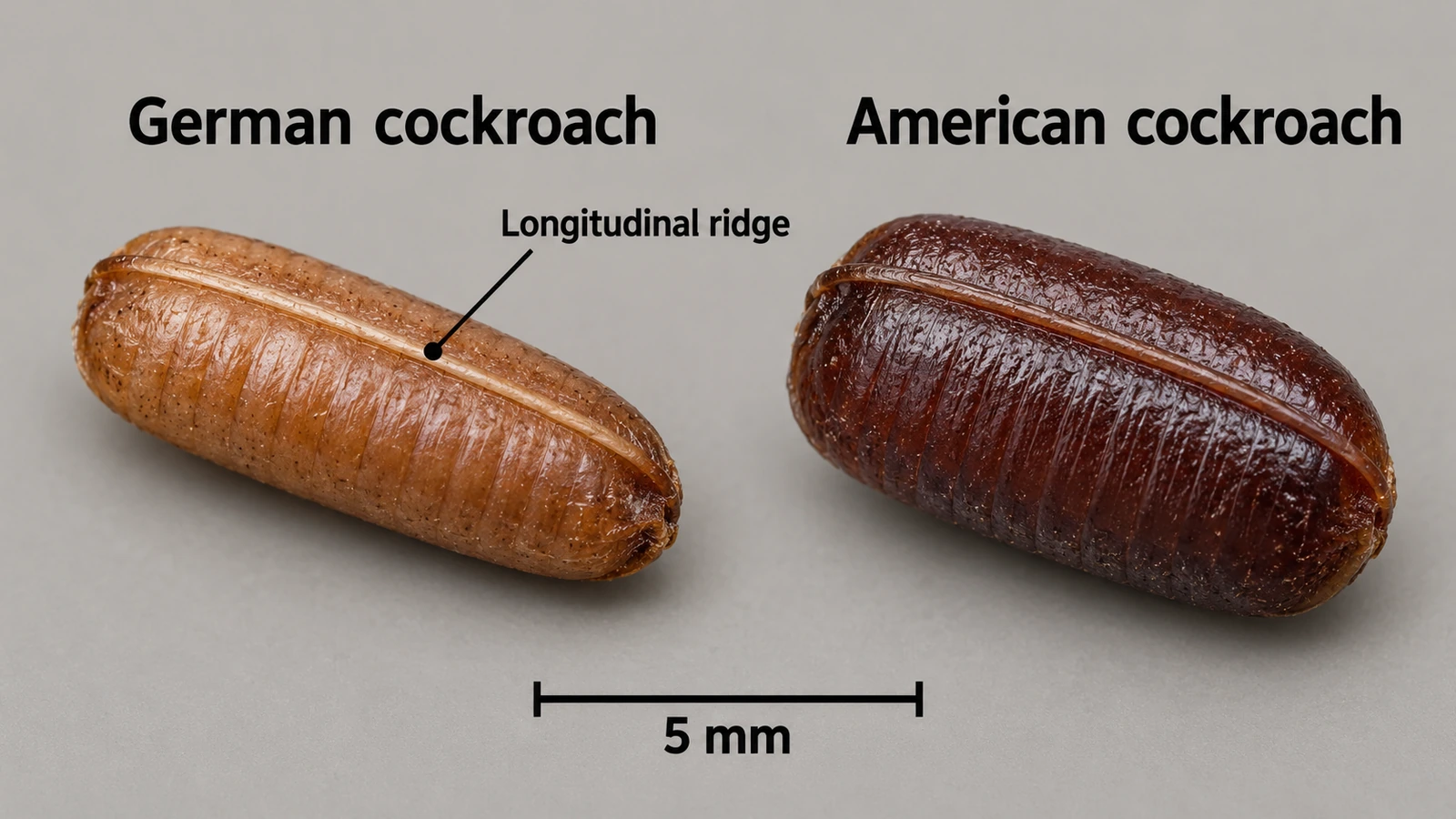
The cases of several common household pest species are only about 1/6 to 3/8 inch (4–10 mm) long. Their exact dimensions and appearance vary by species. A close-up photograph can make an 8 mm capsule appear much larger than it really is, so always compare it with a reliable scale.
You may also hear the term “roach egg sack,” but egg case is more accurate. The eggs are enclosed within a protective structure rather than collected inside a soft, open sack.
How Egg Cases Differ Among Common U.S. Cockroaches
Several cockroach species found in the United States produce recognizable egg cases. These characteristics help narrow the possibilities:
- German cockroach: The capsule is approximately 5/16 inch (8 mm) long, relatively narrow, and usually tan to medium brown, with noticeable divisions along its sides. Females typically carry the case protruding from the rear of the abdomen until shortly before hatching. One case commonly contains about 30–40 eggs.
- American cockroach: The egg case is generally around 5/16 to 3/8 inch (8–10 mm) long, broader than a German cockroach case, and dark reddish-brown to almost black. Females deposit or attach it in sheltered locations.
- Oriental cockroach: The capsule is approximately 3/8 inch (9–10 mm) long, dark reddish-brown, and relatively broad. Cases are typically left in protected places, often associated with damp surroundings.
- Brown-banded cockroach: The case is smaller, approximately 1/6 to 1/4 inch (4–6 mm) long, and yellowish to reddish-brown. Females often fasten it to protected surfaces, including the undersides of furniture and elevated hiding places.
These descriptions are useful comparisons, not a definitive species identification test. Dimensions overlap, colors change as cases age, and photographs rarely capture every distinguishing feature. Finding an adult or nymph nearby can make species identification much more reliable.
What Can Be Mistaken for a Roach Egg Case?
Fly pupae are among the most convincing lookalikes. Their brown, barrel-like coverings may show transverse rings, but they generally lack the characteristic raised longitudinal ridge seen on many cockroach oothecae.
Seeds, dried plant material, insect droppings, and other small debris can also resemble capsules at first glance. A cockroach’s shed skin is different: it retains recognizable insect features such as legs, antennae, and body segments.
Bed bug eggs look different again. They are tiny, whitish individual eggs rather than firm brown capsules.
How to Check a Suspected Roach Egg Case

Examine the object without crushing it. Use a flashlight to illuminate its edges and take clear photographs from above and from the side. Include a small ruler or another reliable scale beside it. The side view matters because a raised seam can be difficult to see in a photograph taken directly from above. If the object can be handled safely and is clearly an insect capsule, you can place it in a transparent, closed container for closer observation.
A few targeted checks will help you decide whether the object is consistent with an ootheca:
- Structure: Look for a firm capsule with a distinct longitudinal ridge and, on some species, regularly spaced grooves. If these features are absent or impossible to see, avoid a confident identification.
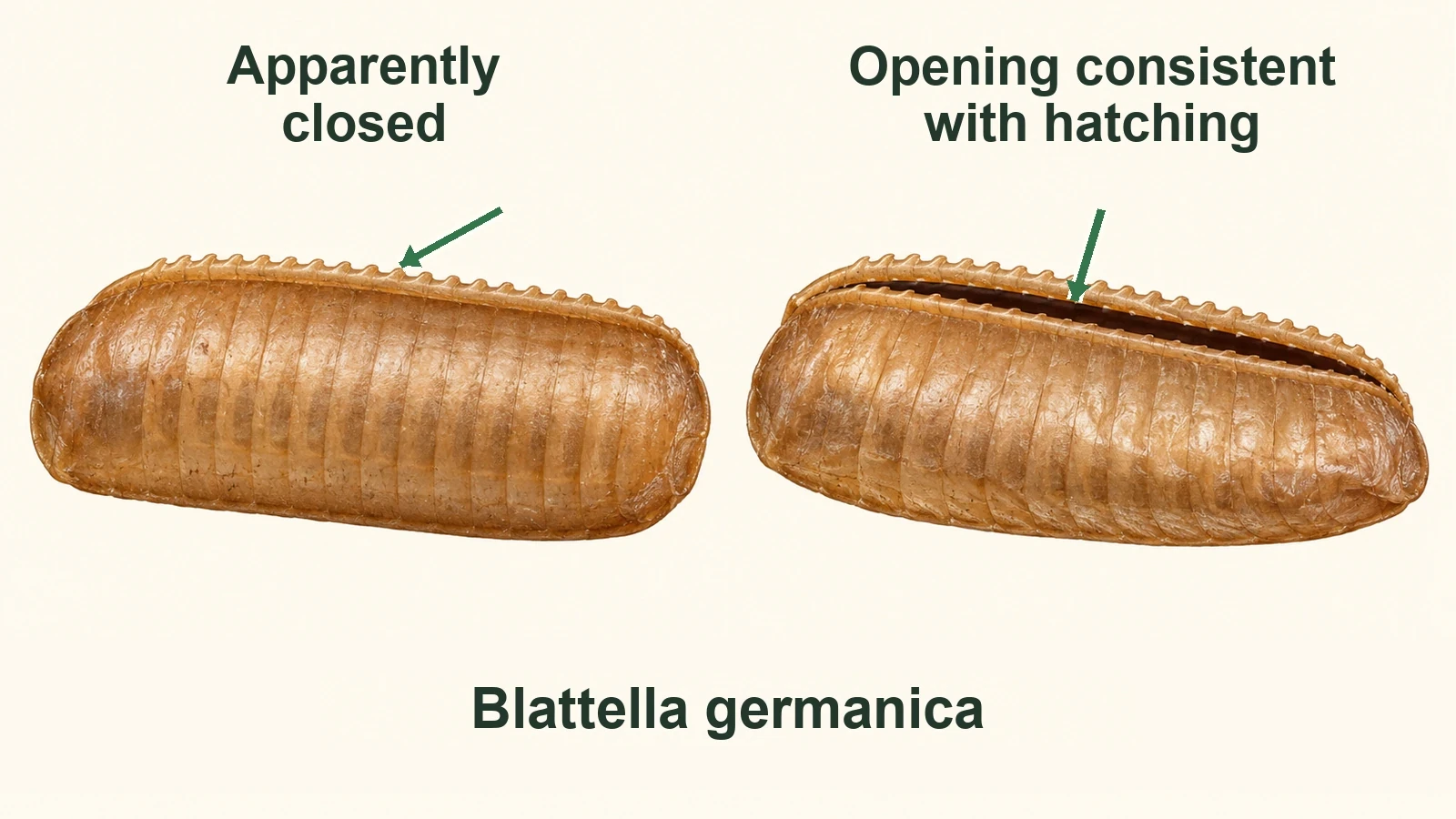
- Opening: Examine the raised edge for a split, gap, or separated seam. This can indicate that nymphs have emerged. However, damage can also produce openings, and a case that appears sealed is not necessarily viable.
- Position: Record exactly where you found it. Was it attached beneath furniture, wedged into a cabinet joint, lying behind an appliance, or loose inside recently unpacked storage? The original location may be more informative than the room where the object was eventually noticed.
- Nearby evidence: Look for baby cockroaches, adult roaches, shed skins, and cockroach droppings in immediately accessible hiding places. Finding independent evidence near the capsule makes a cockroach explanation more convincing.
Do not take apart energized appliances or reach into electrical components to search for additional cases. Accessible cabinet joints, baseboards, appliance exteriors, and plumbing areas are more reasonable places to begin.

Common Identification Mistakes
- Identifying every small brown, ridged object as a cockroach egg case without checking its longitudinal seam.
- Assuming a dry capsule must be empty or that an apparently intact capsule must still contain viable eggs.
- Assigning a cockroach species from color alone, without considering size, structure, and surrounding evidence.

Key Clue
The strongest initial clue is the combination of a small, organized capsule and a distinct ridge running along one edge. Size and location strengthen the identification. Color alone is less reliable; look for an opening or nearby nymphs when assessing whether the eggs have developed.

Watch Out
Some dark, pellet-shaped objects may be rodent droppings rather than insect capsules. If that possibility remains, do not crush, sweep, or vacuum the material. Avoid disturbing potentially contaminated dust and use appropriate precautions before handling or cleaning the area.
What Does Finding a Cockroach Egg Case Actually Mean?
A confirmed ootheca shows that a cockroach produced an egg case. To assess current activity, look for nearby nymphs, adults, and fresh signs, and examine whether the eggs have developed or hatched.
An opened case may be evidence of earlier hatching. An apparently intact case may contain developing eggs, may have failed to develop, or may be an older case whose opening is difficult to see.
Location also matters. A capsule found inside a recently delivered box could have arrived with that item. A case discovered in a sheltered kitchen crevice alongside live cockroaches carries a different implication.
These situations illustrate why the object and its surroundings must be interpreted together:
| What You Observe | What It May Mean | What to Check Next |
|---|---|---|
| A brown capsule without clearly visible egg-case features | Identification remains uncertain; it could be another insect stage or an unrelated object. | Obtain clearer photographs, verify the scale, and compare the longitudinal structure. |
| One recognizable, apparently sealed egg case with no other evidence | A cockroach produced the case, but its viability and the presence of other roaches remain unknown. | Record the location, remove the case, and monitor the immediate area. |
| An opened case with small live roaches nearby | Hatching and continuing cockroach activity become more plausible. | Identify the young roaches and inspect nearby hiding places for additional evidence. |
| Several egg cases accompanied by adults, nymphs, or repeated fresh signs | A more established or continuing problem becomes increasingly likely. | Extend monitoring and evaluate whether targeted control is needed. |
A female cockroach observed carrying an egg case is stronger evidence of current reproductive activity than a loose, weathered capsule of unknown age.
How Serious Is Finding One Roach Egg Case?
One capsule is not a population count. A German cockroach egg case may hold 30–40 eggs, but that does not mean 30–40 young roaches are currently living in your home. Some eggs may fail to develop, some nymphs may not survive, and the case itself may have been transported from another location. The practical concern comes from the combination of the case, its surroundings, and any evidence that activity is continuing.

Details That Change Your Assessment
Before deciding how extensive the problem may be, consider four factors:
- Location: A case found in a protected kitchen cabinet near food, warmth, and water deserves closer attention than an unidentified capsule found in a recently unpacked box. Cases near exterior entry points may also involve cockroach species that commonly live outdoors.
- Repetition: Several cases discovered in the same protected area are more concerning than a single isolated object, particularly when some appear to have opened.
- Associated evidence: Live nymphs, adults, shed skins, and repeated deposits of droppings strengthen the interpretation. These signs of a cockroach infestation matter more when they occur together than when each is considered separately.
- Ongoing activity: New sightings or repeated catches on sticky monitoring traps provide better evidence of current activity than an old capsule alone.
How Long Do Cockroach Eggs Take to Hatch?
Hatching times vary substantially by species and conditions.
German cockroach eggs typically develop over roughly a month under suitable indoor conditions. Females retain their cases until close to hatching, which means a loose German cockroach ootheca may already be near the end of its development when discovered.
American cockroach egg cases can take approximately six weeks or longer to hatch. Brown-banded cockroach cases may remain in place for several weeks to a few months, depending particularly on temperature.
These are contextual ranges, not a countdown you can start when you find a capsule. You usually do not know when the case was produced, whether it remains viable, or whether hatching has already occurred.
The cockroach life cycle also continues through several nymphal stages after the eggs hatch. Time to hatching and time to adulthood are different questions.
An old empty case may remain hidden and appear during cleaning long after the original activity. Conversely, removing one newly discovered case does not establish that no other cases exist nearby.
What to Do After Finding a Roach Egg Case
If the object is reasonably identified as a cockroach egg case, photograph its original location before removing it. Use a tissue or gloves to pick it up, seal it in a bag, and dispose of it promptly in a covered outdoor trash container. If identification is still uncertain, preserve it in a closed container rather than breaking it open indoors.
Next, inspect the accessible hiding places immediately surrounding the discovery. Depending on the location, these may include cabinet joints, cracks near baseboards, spaces behind kitchen appliances, and areas around plumbing.
Remove accessible food debris, store food in sealed containers, and address leaking water sources. These straightforward measures make the area less favorable to cockroaches while you establish whether any remain active.
Place cockroach sticky monitoring traps along wall edges or near the suspected hiding area, away from children and pets. Check them regularly over the following days and record what appears. A trap catching several roaches near one cabinet tells you more about present activity than the appearance of a discarded shell. An empty trap, however, does not prove that every possible hiding place is clear.
If you repeatedly find live roaches, additional egg cases, or evidence in several areas, move from limited monitoring to a step-by-step cockroach control plan appropriate to the species and situation.
Where an insecticide is justified, choose a product labeled for the relevant pest and application site, and follow its instructions exactly. Avoid relying on bug bombs or indiscriminate aerosol spraying, which can create unnecessary exposure without resolving hidden cockroach activity.
Professional pest control becomes appropriate when activity is extensive, hiding places are inaccessible, reasonable DIY efforts have failed, or a recurring problem involves multiple units and requires coordinated treatment. Finding one isolated capsule does not automatically justify that expense.
Related Guide
For a broader introduction to common roaches, their identification, household warning signs, and general control options, see our cockroach identification and control guide.