Identification
How to check a mattress for bed bugs: signs and inspection steps
Check a mattress from its piping to its underside, including one lying on the floor. Learn which insects, stains and shed skins matter and when to inspect nearby areas.
A few dark specks on the sheets can make you wonder what is hiding in your mattress. The important places to check are often not the exposed sleeping surface, but the narrow folds, seams and edges where an insect can stay out of sight.
A useful inspection starts at the mattress perimeter, continues across its sides and underside, and accounts for whatever supports it. The goal is to find recognizable physical evidence, not to turn every stain or unexplained bite into a bed bug diagnosis.
What should you look for on a mattress?
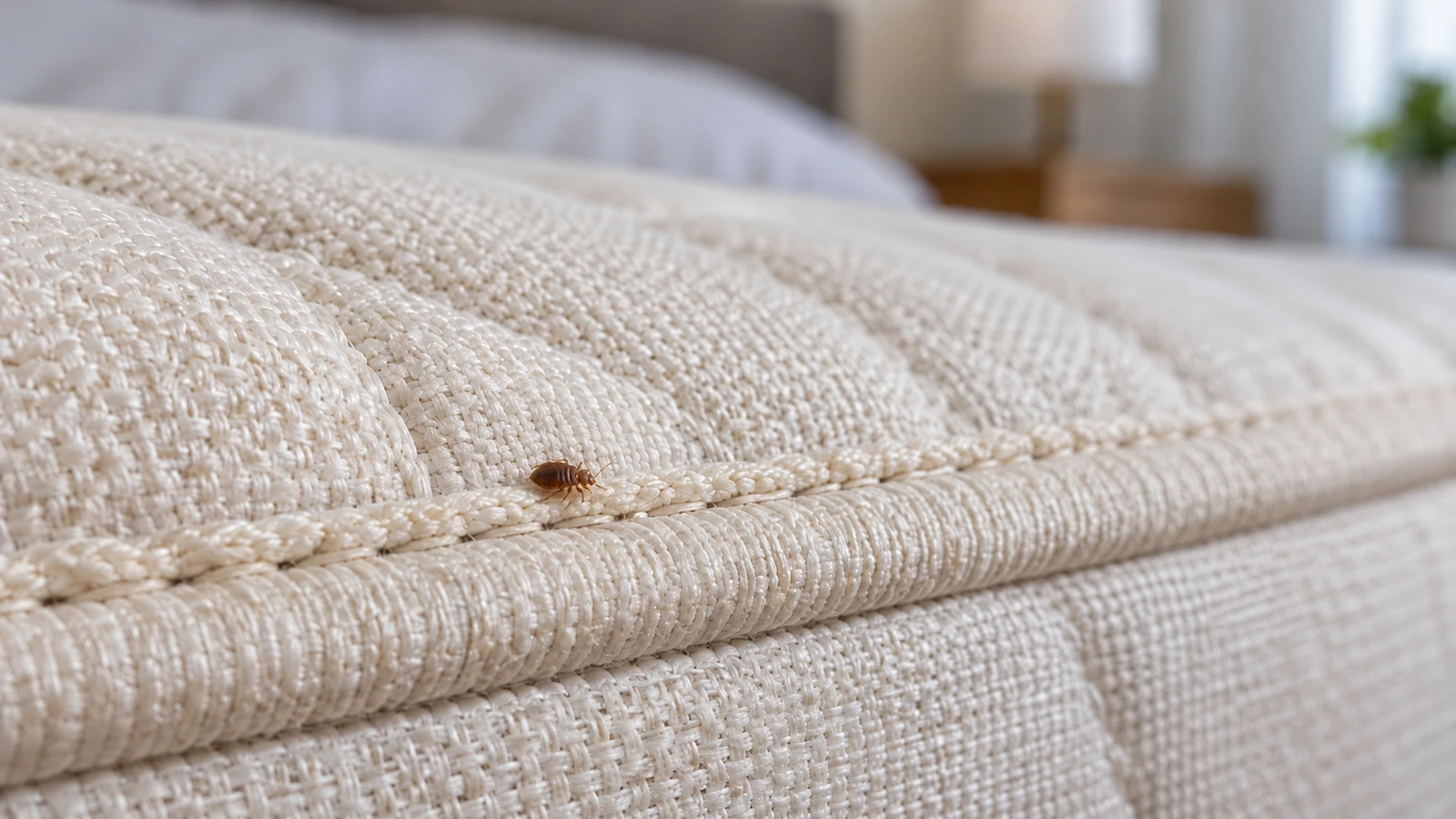
Bed bugs often shelter along the piping, stitched seams, tufting and other protected folds of a mattress. These areas offer narrow spaces where insects can remain concealed. Examine the fabric around labels, handles and reinforced edges as well as the mattress surface itself.
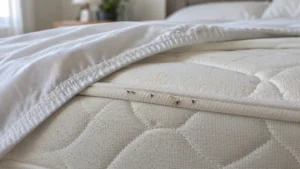
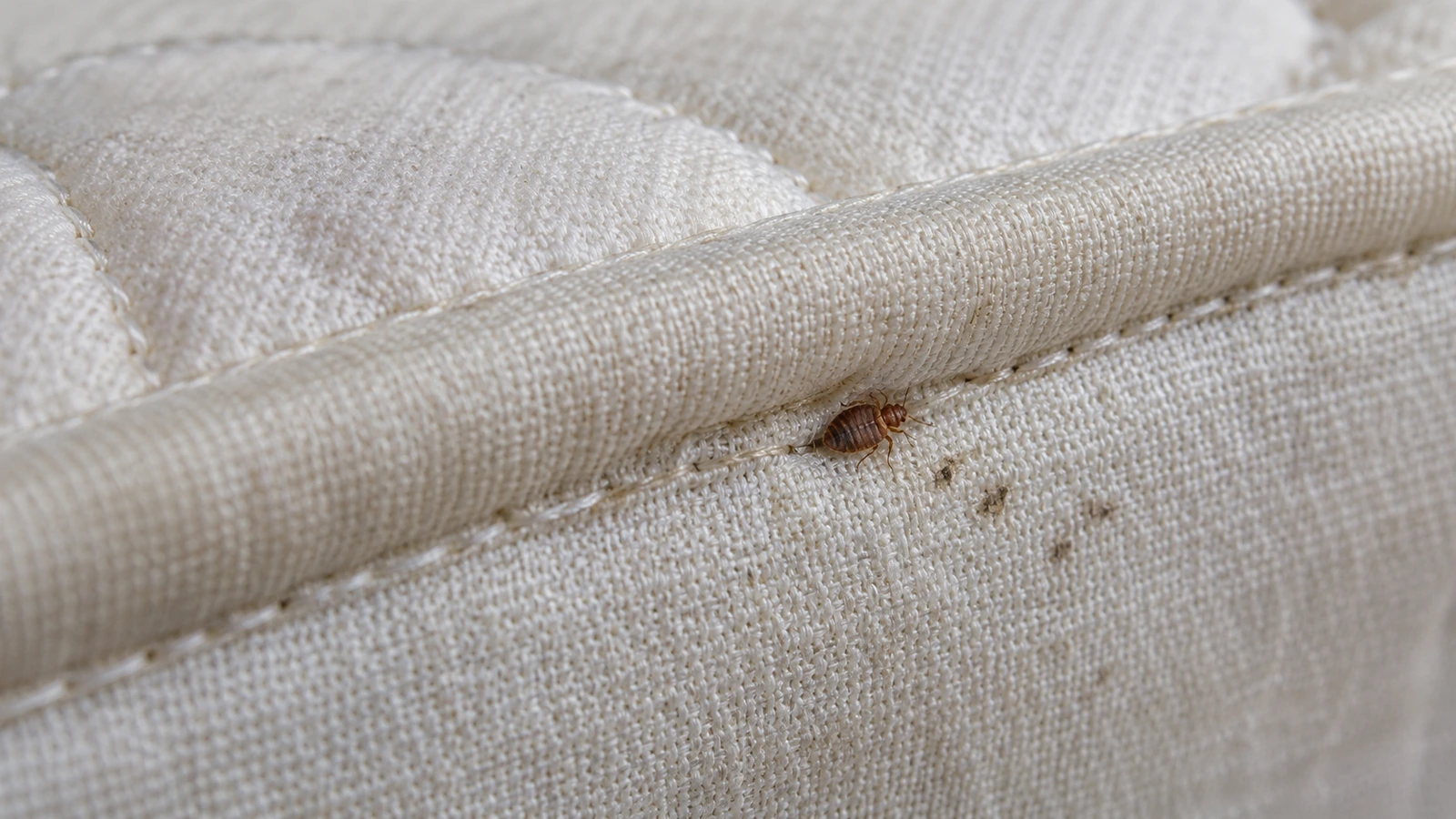
Look for live insects, small dark deposits, pale shed skins and tiny whitish eggs attached to protected surfaces. Adult bed bugs are flat, oval, wingless and reddish brown, roughly the size of an apple seed. Younger bed bugs, called nymphs, are smaller and often much paler.
Identification in 30 Seconds
- Live bugs: Small, flattened, oval insects with six legs and no wings, sometimes tucked beneath stitching.
- Dark spots: Tiny black or dark brown marks, often concentrated along seams or fabric folds.
- Shed skins: Pale tan, hollow insect-shaped coverings left behind as young bed bugs grow.
- Eggs: Very small, whitish oval structures attached to a surface, often hidden in a crevice.
- Rusty stains: Reddish or brownish marks on fabric that may result from crushed bed bugs but require further checking.
These clues are most useful when their location and appearance fit together. Several dark marks clustered beneath a folded seam deserve closer attention than one isolated speck in the middle of a sheet. Live insects and intact shed skins provide more detail to work with than a stain alone.
A mattress can also have ordinary discoloration, lint, fabric pilling or other debris. Look closely before deciding what a mark represents. Some of the strongest bed bug evidence is small enough to miss during a quick inspection, especially on patterned or dark-colored fabric.
How to inspect a mattress for bed bugs

Start with a bright flashlight and, if available, a magnifying glass. Remove sheets, blankets and any mattress pad carefully, looking at their seams and folds as you go. Keep potentially infested bedding within the room rather than carrying loose items through the home.
Begin at one corner of the mattress and follow the perimeter slowly. Direct the flashlight across the stitching and gently open accessible fabric folds to see what is tucked behind them. Avoid tearing material or aggressively scraping an area where insects may be present.
Work through the mattress in a consistent order:
- Top seams and corners. Examine the piping around all four sides, including the corners where fabric folds meet. On a pillow-top mattress, look beneath the raised edge as well as along its stitching.
- Side panels and details. Follow vertical seams, decorative stitching, handles, buttons and reinforced fabric edges. Pay particular attention to tucked or overlapping material.
- Tags and labels. Check around and beneath sewn-on labels. A small fold behind a tag can conceal an insect that is invisible from directly above.
- Bottom surface and seams. If the mattress can be moved safely, lift or tilt it enough to examine the underside and lower perimeter. Get help with a large or heavy mattress rather than trying to handle it alone.
- Immediate contact points. Check where the mattress meets a box spring, platform or frame. If it rests directly on the floor, inspect the contact area beneath its edges instead.
If your mattress is directly on the floor, the inspection follows the same principles, but the underside is harder to access. Carefully raise one side at a time, where safe, and examine the lower seam, the floor immediately underneath and any nearby wall or baseboard edge. Carpet edges and narrow gaps beside the sleeping area also deserve a close look.
A mattress placed on the floor is not evidence of bed bugs by itself. The arrangement changes which surfaces are concealed and how easily you can inspect them. It also means there are no bed legs for conventional leg-mounted monitoring interceptors. Avoid dragging a potentially infested mattress into another room just to reach its underside.
Identification Mistakes
- Checking only the top sheet or the center of the mattress while overlooking seams and the underside.
- Treating every black speck, fabric stain or piece of lint as bed bug evidence.
- Assuming that itchy marks on the skin confirm bed bugs without finding physical evidence.
Key Clue
A correctly identified live bed bug found in a mattress seam is a strong finding. Several compatible signs together, such as dark deposits and shed skins tucked into the same protected fold, also justify a closer investigation.
What to Watch For
If you uncover a suspected live bed bug, photograph it or safely collect a specimen before disturbing the area further. Moving or dismantling the bed unnecessarily can dislodge insects and make the original hiding place harder to identify.
How to interpret insects, stains and other findings
Finding a live insect is much more informative than finding an unexplained mark. A bed bug has a broad, flattened, oval body and no functional wings. Small nymphs can look pale or nearly translucent, particularly before feeding. For a closer comparison of adults, nymphs and eggs, see what bed bugs look like at different life stages.
Dark fecal spots often resemble small ink marks absorbed into fabric. Reddish or rusty marks can occur when a bed bug is crushed, but ordinary staining has other causes too. The position, concentration and accompanying evidence matter. If dark deposits are your main finding, the guide to bed bug droppings and fecal stains explains what to examine more closely.
Other small insects may appear on bedding without being bed bugs. Carpet beetle larvae, for example, are often hairy or bristly rather than smooth and broadly flattened. Loose fibers, crumbs and fabric pills may also resemble tiny insects in a poor photograph. Check for actual body parts before identifying a speck as a bug.
Use the evidence you can recognize, not the most alarming possibility, to choose your next check:
| Finding on the mattress | What it suggests | Next check |
|---|---|---|
| A clearly identifiable bed bug in a seam | Strong evidence of bed bug presence | Photograph or retain the specimen and check nearby protected edges |
| Several dark spots alongside shed skins in a fabric fold | A suspicious combination of physical signs | Examine adjoining seams for recognizable insects or eggs |
| One rusty mark or a few loose dark specks | Uncertain evidence with several possible causes | Check other seams and compare the material before drawing a conclusion |
| No visible insects, spots or shed skins after a careful check | No evidence found on the surfaces inspected | If concern remains, examine the immediate bed support and nearby hiding places |

What does a mattress inspection actually tell you?
A mattress inspection can locate bed bugs or suggest that further investigation is worthwhile, but it is only one part of evaluating a sleeping area. Bed bugs may hide in a box spring, frame, headboard or another narrow space close to where someone rests.
The type of bed affects what you can reasonably inspect. On a raised bed, you may have access to the lower mattress edge and its support. On a floor mattress, the underside and floor-contact area require deliberate access. If a heavy mattress cannot be lifted safely, make a note of the surfaces you could not examine.

A clean-looking mattress is encouraging, particularly when its seams, sides and underside were checked carefully. It is not a complete exclusion of bed bug activity elsewhere, especially when only a small number of insects may be present.
Conversely, a stain or unidentified insect does not establish the size or extent of an infestation. Distinguish what you actually found from what still needs checking. The next inspection should follow the evidence rather than expand automatically into every part of the room.
Good to Know
If your mattress is already enclosed in a properly sealed bed bug-proof encasement, inspect the outside of the cover, its seams, zipper and any tears. Do not unzip a containment encasement just to inspect the mattress underneath, since doing so may release trapped insects.
Learn more: