Identification
Carpet beetle or bed bug? How to tell them apart
Found a small brown insect in your bedroom and wondering whether it’s a carpet beetle or bed bug? The two can turn up in similar places, but their bodies, life stages, and associated clues are quite different. Here’s how to identify what you found, check the evidence around it, and decide what deserves attention.

By


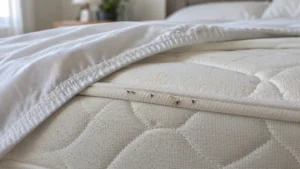
A tiny insect crawling across your pillow or a brown shell caught in a mattress seam can raise an immediate concern about bed bugs. But carpet beetles and their larvae also occur in bedrooms, including on bedding, furniture, and rugs.
The important distinction is not simply where you found the insect. Start with its body shape and surface, then look at its stage of development and the evidence nearby. Those details can often settle the identification without turning an isolated discovery into an assumed infestation.
Carpet Beetle vs. Bed Bug: What Does Each Insect Look Like?
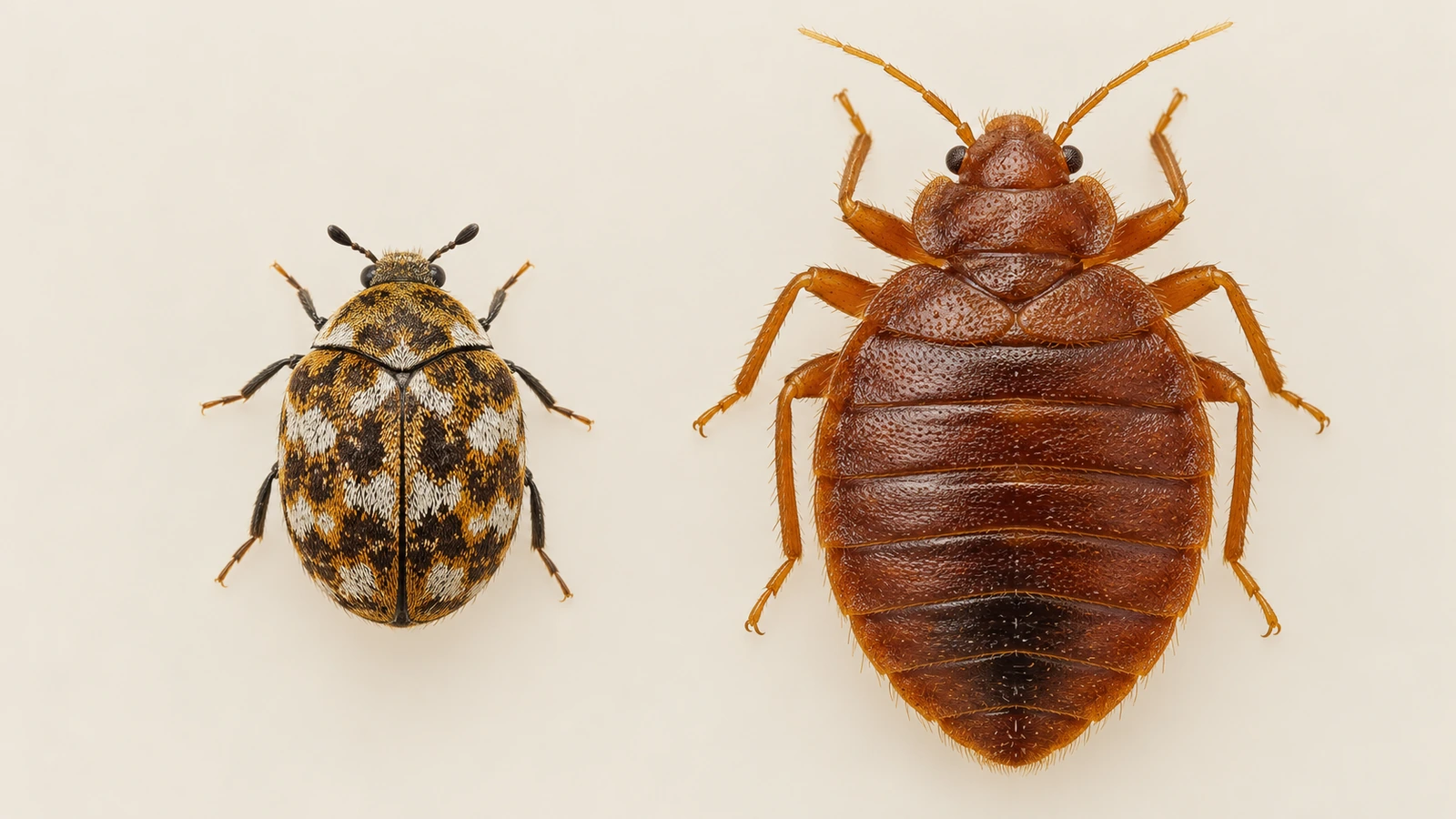
An adult bed bug has a broad, flattened, oval body with visible abdominal segments, six legs, and a small head. Before feeding, it is usually reddish-brown and about 3/16 to 1/4 inch (5–7 mm) long. An adult carpet beetle is generally smaller, often around 1/16 to 3/16 inch (2–5 mm), depending on the species. It has the more rounded or elongated-oval outline of a beetle, with hardened wing covers meeting along a line down its back. Some have a distinctive mottled pattern of white, brown, yellow, or black scales.

Enlarged comparison. Scale bars show the insects’ actual sizes.
Not every carpet beetle is speckled. Black carpet beetles can be uniformly dark and more elongated, while the colorful scales on other species may wear away with age. Shape and wing-cover structure are more dependable than color alone. Bed bugs do not have hardened beetle-like wing covers, and they cannot fly; adult carpet beetles can.
Carpet Beetle Larva vs. Bed Bug Nymph
The confusion becomes more common when the insect is immature. A carpet beetle larva looks nothing like a miniature adult beetle, while a young bed bug retains the general body plan of an adult.
Look for these differences:
- Carpet beetle larva: Usually elongated, tapered, and covered with visible hairs or bristles. Many have brown and tan bands or a tuft of longer hairs at one end. The exact shape varies: some are broader toward the rear, while black carpet beetle larvae are more carrot-shaped and may appear relatively smooth until magnified. Their short legs can be difficult to see.
- Bed bug nymph: A smaller version of an adult bed bug, with six visible legs, antennae, and a flattened, oval, segmented body. Newly hatched nymphs are approximately 1/16 inch (1.5 mm) long and often pale or translucent. Older nymphs are larger, and feeding can make the abdomen appear darker or reddish. They do not have the conspicuous bristly covering of carpet beetle larvae.
- Shed skin: A carpet beetle larval skin may retain a hairy, elongated shape with a recognizable tail tuft. A bed bug nymph’s shed skin generally resembles a pale, empty bed bug, with its legs and flattened body outline still recognizable.
Strictly speaking, bed bugs do not have a larval stage. Their immature stages are called bed bug nymphs. They emerge from eggs looking like small bed bugs and grow through successive molts.
Both carpet beetle larvae and bed bug nymphs crawl. Movement speed alone is not a reliable distinction. However, seeing an adult insect actually fly rules out a bed bug for that particular specimen.
How to Check Whether You’ve Found a Carpet Beetle or Bed Bug

Enlarged immature stages; actual size varies by species and stage.
Before identifying the insect from a dark, heavily zoomed photograph, try to get a clearer view. If possible, contain it in a transparent jar or another closed container rather than crushing it. Photograph the insect from above and from the side on a light background, with a small ruler nearby. A phone’s macro setting or a magnifying glass can help reveal details that are easy to miss at ordinary viewing distance.
Check the Specimen and Its Immediate Surroundings
Use the following checks to test your initial impression:
- Examine the back. On an adult carpet beetle, look for the paired hardened wing covers and the line where they meet. On a bed bug, look instead for the exposed, visibly segmented abdomen without a beetle-like wing-cover seam.
- Inspect the surface and shape. A tapered, bristly body supports the possibility of a carpet beetle larva. A small, flattened insect with a bed bug’s outline and distinct legs supports a nymph identification. If you cannot resolve these features, keep both possibilities open.
- Record where you found it. An adult beetle on a sunny windowsill is consistent with carpet beetle behavior. A hairy larva in stored wool, beneath furniture, or among accumulated lint also fits that possibility. A suspected bed bug close to a mattress seam or bed frame deserves careful verification, but location alone cannot establish its identity.
- Look for associated evidence. Carpet beetle larvae may leave bristly shed skins near natural-fiber materials, along with localized fabric damage. Bed bug droppings, pale bed bug shed skins, eggs, or additional live bed bugs near resting areas would support the other hypothesis. These signs should themselves be checked rather than accepted from appearance alone.
A close-up of the insect is usually more useful than a photograph showing only itchy skin or the place where it was found.
If the specimen is damaged, tiny, or photographed from an unhelpful angle, identification may remain unresolved. Preserve it if possible. If its features do not fit either insect, broaden the search to other bugs that look like bed bugs rather than forcing a choice between these two.

Common Identification Mistakes
- Assuming an insect is a bed bug simply because it was found on a mattress, pillow, or bed frame.
- Mistaking a hairy carpet beetle larval skin for a bed bug nymph without checking its legs and body outline.
- Using color, insect size, or itchy skin marks as the deciding evidence while ignoring the specimen’s structure.

Key Clue
Focus on the body design. An adult beetle has hardened wing covers; a bed bug does not. Among immature insects, a bristly, tapered larva strongly favors a carpet beetle, while a flattened, six-legged miniature bed bug favors a nymph. These distinctions are more useful than the room where you found it.

Watch Out
Identifying a carpet beetle does not prove that bed bugs are absent. Both insects can occur in the same home. If you have independent signs suggesting bed bugs, evaluate those separately instead of treating one confirmed carpet beetle as an explanation for every observation.
What Do the Clues Around the Insect Tell You?
Carpet beetle larvae feed on materials such as wool, fur, feathers, animal hair, and accumulated dead insects. They often develop in dark, undisturbed areas where these resources collect. Adult carpet beetles behave differently: many feed on pollen outdoors and may enter homes through windows or doors. A single adult near a window therefore tells you less about indoor larval activity than several larvae and cast skins in the same stored textile.
Bed bugs have a different relationship with the home. Nymphs and adults feed on blood and commonly shelter near places where people sleep or rest. Dark fecal spotting, shed skins, eggs, and live insects clustered around mattress seams or furniture joints can make a bed bug identification more convincing. Bed bugs can also hide near carpet edges or baseboards, so finding an insect on carpet does not automatically make it a carpet beetle.
Can You Tell the Difference From Skin Irritation?
Carpet beetles do not bite people. However, the specialized hairs of some carpet beetle larvae can irritate the skin or trigger a hypersensitivity reaction in susceptible individuals. The resulting itchy bumps may resemble insect bites.
Bed bugs do bite to feed on blood, but the appearance, timing, and distribution of skin reactions are variable. Some people react strongly, while others show little or no visible reaction.
An itchy rash noticed after sleeping cannot distinguish the two insects or establish that either one caused it. If symptoms are severe, persistent, or otherwise concerning, seek appropriate medical advice while investigating the physical evidence separately.
How to Interpret Common Findings
| What You Find | Most Useful Interpretation | What to Check Next |
|---|---|---|
| A small, rounded beetle with hardened wing covers near a sunny window | An adult carpet beetle is plausible. A single adult may have entered from outside. | Look for additional adults or larvae near susceptible textiles and undisturbed areas. |
| A tapered, hairy larva or bristly cast skin in stored wool, beneath furniture, or among lint | Carpet beetle larval activity is plausible, particularly if similar specimens or feeding damage are present. | Inspect nearby natural-fiber materials, accumulated hair, and other possible food sources. |
| A flattened, six-legged insect with a bed bug’s outline near a mattress seam | A bed bug becomes more likely, particularly when its anatomy is clearly visible. | Examine nearby hiding places for live insects, eggs, shed skins, and characteristic fecal marks. |
| Dark specks on bedding but no identifiable insect | The marks alone do not establish whether bed bugs are present. | Examine the deposits closely and look for independent evidence around the bed. |
| Itchy skin marks accompanied by a carpet beetle larva | Contact with larval hairs is one possible cause of skin marks. Compare the distribution of the marks with the exposure location and look for other clues before assigning a cause. | Confirm the insect’s identity and continue checking for other relevant evidence if concerns remain. |
Does Finding One Mean You Have an Infestation?
One carpet beetle adult on a windowsill may be an incidental visitor, while repeated larval discoveries among damaged woolens point toward an indoor food source. A confirmed bed bug warrants prompt investigation. Use repeatable physical evidence to assess how many locations and items may be involved.

Look for a Pattern, Not Just Another Symptom
Three questions help establish how much attention the finding needs:
- Are you finding the same insect repeatedly? Several carpet beetle larvae in one undisturbed area suggest a local source worth locating. Repeated bed bug sightings around sleeping areas make continued activity more likely than a single uncertain photograph.
- Do the surrounding materials fit the insect? Carpet beetle larvae associated with wool, feather-filled items, pet hair, or lint have a plausible food source. Bed bugs repeatedly found near places where people rest, together with characteristic physical signs, warrant a different investigation.
- Is there evidence of continuing activity? Fresh finds, additional live insects, and appropriately placed monitoring devices are more informative than a single old shed skin. Record when and where new evidence appears rather than estimating an infestation from one observation.
A light or early infestation can be difficult to detect, so the absence of obvious signs during one short check is not absolute proof that nothing is present.

Good to Know
Carpet beetle larvae can occur beneath synthetic carpets even though they do not feed on synthetic fibers themselves. Pet hair, lint, dead insects, and other suitable material trapped beneath furniture or along carpet edges can provide food. A synthetic rug therefore does not rule out carpet beetles.
What to Do Next Once You Have a Likely Identification
If It Looks Like a Carpet Beetle
If you found one adult near a window and no larvae or textile damage, remove the insect and make a limited check of nearby stored fabrics and undisturbed areas. There is usually no reason to arrange professional pest control or treat an entire bedroom based on that finding alone.
If you find larvae, bristly shed skins, or damage to susceptible materials, focus on locating the source. Inspect woolens, natural-fiber rugs, upholstered furniture, stored textiles, and areas where hair or lint collects. Vacuum accessible areas thoroughly, clean washable items according to their care labels, and monitor whether additional larvae appear.
Repeated larval activity or inaccessible sources may justify more targeted pest-control advice. Broad insecticide spraying is not a substitute for finding what the larvae are feeding on.
If It Looks Like a Bed Bug
Keep a clearly identified specimen or useful photographs. Check accessible mattress seams, the bed frame, headboard joints, and nearby resting furniture for corroborating evidence. Avoid moving potentially infested belongings into other rooms while the situation is being assessed.
A confirmed bed bug is a reason to investigate promptly, even if you have found only one. If additional insects or physical signs are present, or activity continues, move toward an appropriate complete bed bug treatment guide rather than relying on improvised sprays or household remedies.
Professional help is particularly useful when bed bugs are confirmed in multiple locations, activity persists, hiding places cannot be adequately examined, or coordinated treatment is needed in a multiunit building.
If You Still Cannot Identify the Insect
Keep the specimen in a closed container or save several clear, well-lit photographs showing its body and approximate size. A local Cooperative Extension identification service or a qualified pest professional may be able to resolve a difficult specimen.
Avoid treating your home for bed bugs solely because a small unidentified insect was found near the bed. Confirming the insect first can prevent unnecessary expense, exposure, and treatment directed at the wrong pest.
Related Guide
For a broader overview of bed bug identification, warning signs, initial checks, and general control options, see our bed bug identification and control guide.