
Identification
How to find a carpenter ant nest inside or outside your home
A carpenter ant trail may lead into your house without ending at a nest. Learn how to check frass, moisture, worker routes, and outdoor sites before deciding where the colony may be.

A carpenter ant disappears beneath a window frame. Later, you notice a few wood shavings below the trim. Is the nest in that wall, or are the ants simply passing through from the yard?
The answer depends on where workers travel, where fresh debris appears, and whether the surrounding wood offers a place to nest. You can narrow down the likely location with a careful inspection, without prying open walls or treating every crack you see.
What clues actually point toward a carpenter ant nest?
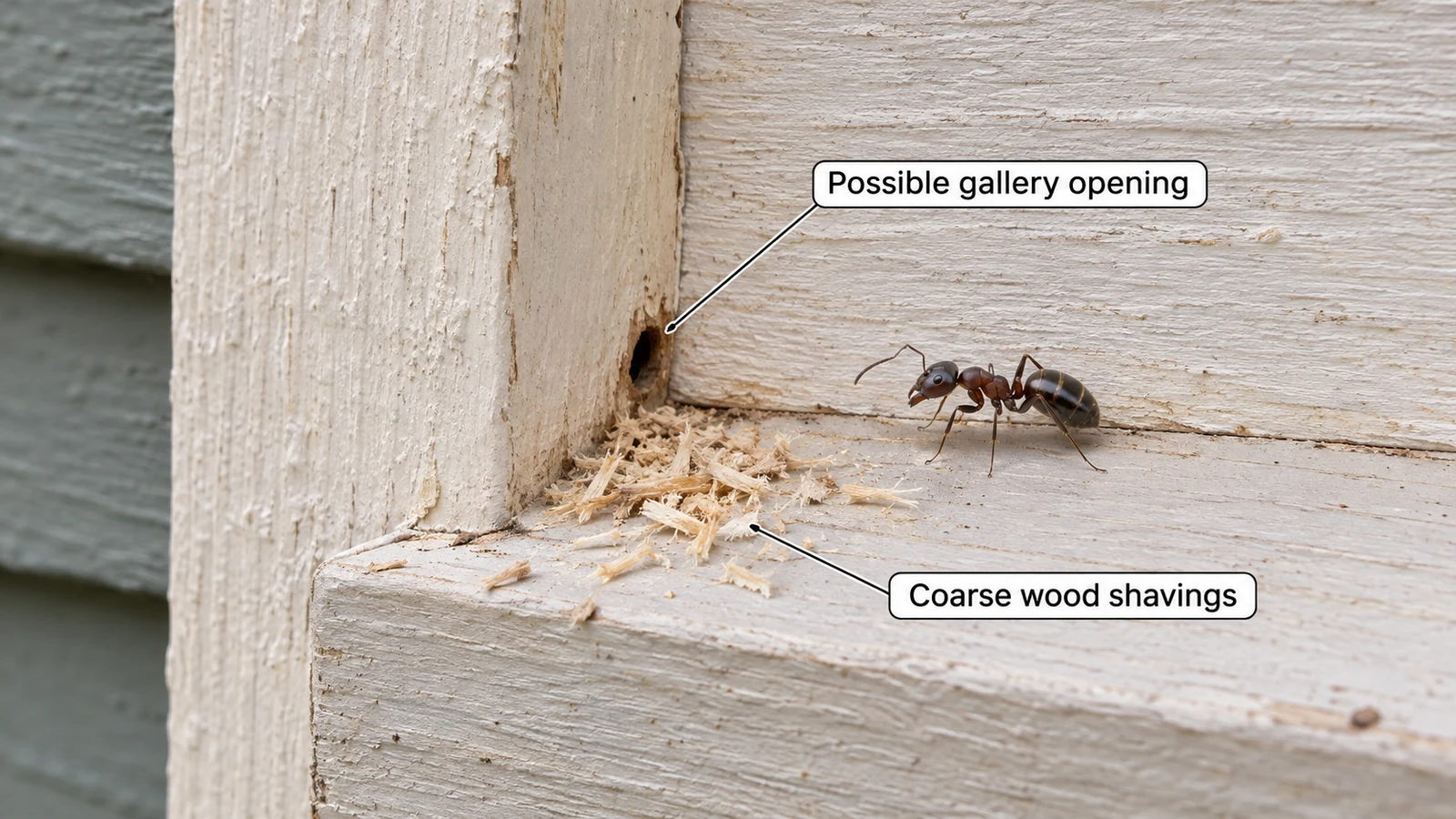
Carpenter ants excavate spaces in wood for their nests; they do not eat the wood. Workers may push out coarse, sawdust-like shavings mixed with tiny insect fragments. Fresh debris repeatedly collecting beneath the same small opening is a useful clue that excavation may be occurring nearby.
A trail alone tells you where ants travel, not where they live. Carpenter ants can forage a considerable distance from their nests. They may enter a kitchen for food or water, then return to an outdoor colony. Before interpreting their behavior, check that the insects are carpenter ants rather than another kind of large ant. The guide to what carpenter ants look like covers the distinguishing features.
Identification in 30 Seconds
- Several ants repeatedly enter or leave the same wood opening: inspect that area for fresh debris and moisture.
- A steady trail crosses a window, door, or foundation gap: follow it on both sides before deciding where the nest is.
- Coarse wood shavings appear beneath the same slit or crack again: focus your search on the adjacent wood or hidden cavity.
- One large, dark ant crosses the floor: identify it first; that sighting alone gives little information about nest location.
Check the area below a suspected opening without disturbing it. Carpenter ant debris may look like little wood curls rather than a uniform powder, but ordinary sawdust from repairs can look similar. The combination of ant traffic, new debris, and a plausible nesting site matters more than any single clue.
How to trace ants to the likely nesting area
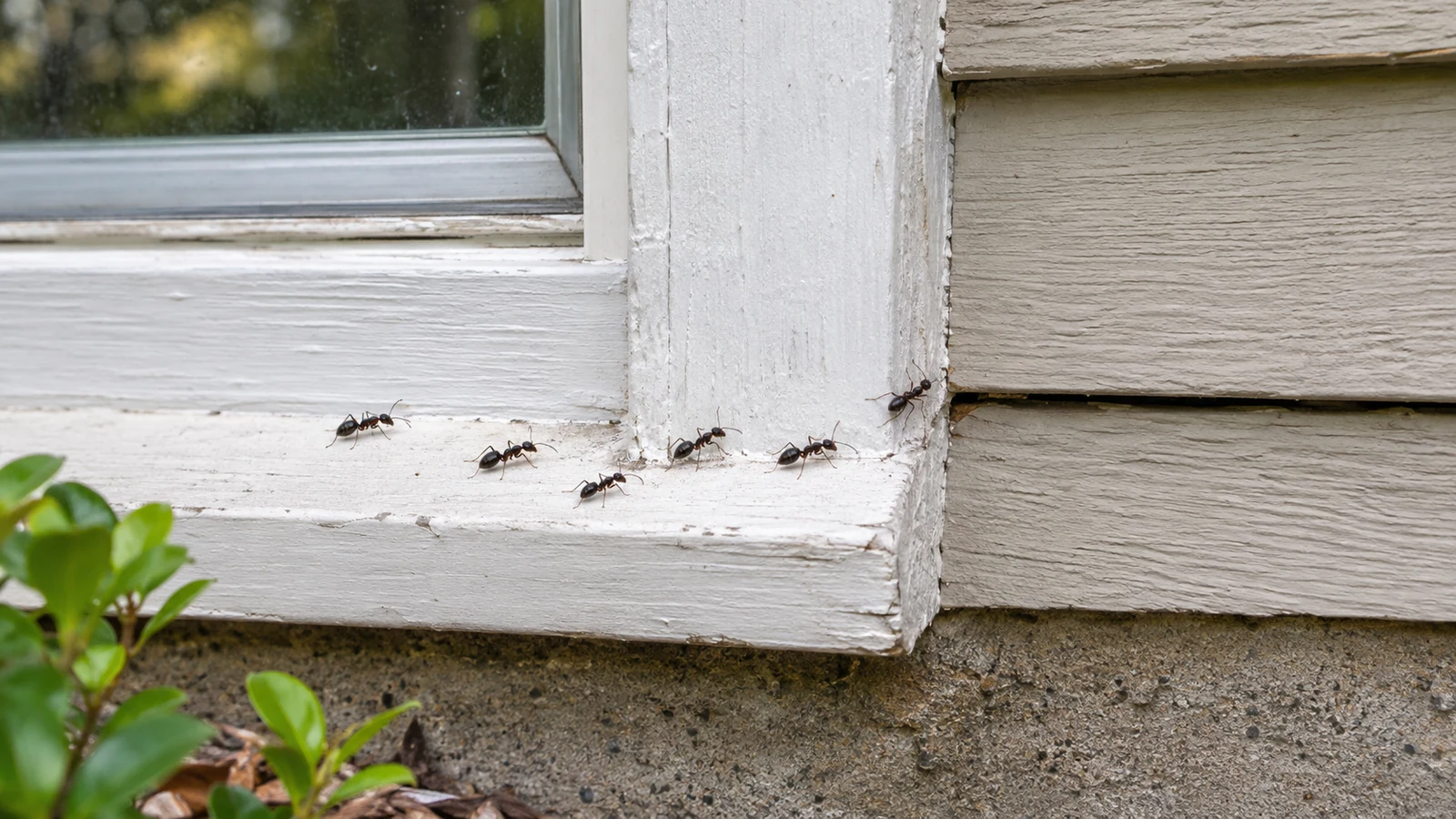
Watch active workers from a safe distance, especially around dusk or after dark when many carpenter ants forage. A flashlight can help you follow a trail along a baseboard, siding joint, porch edge, or tree without disturbing the insects.
Look for ants moving in both directions. Note where they repeatedly disappear, but keep watching: an opening may be a route through the building envelope rather than the nest itself. Record the room or outdoor location and any nearby leak or damp wood. A brief note or clear photo is enough to compare your observations later.
Where to check indoors and outdoors
Start with places suggested by the actual trail rather than searching the whole property at random:
- Inside: inspect accessible window and door trim, areas near plumbing leaks, damp framing visible from a basement or crawl space, and spots below roof or gutter leaks.
- At the house edge: check porch supports, deck connections, sill areas, siding gaps, and places where tree branches or utility lines provide a route to the structure.
- In the yard: look around decaying stumps, dead limbs, old fence posts, landscape timbers, and wood piles, especially when the workers continue away from the house.
Stay with visible surfaces. Do not pull apart sound walls, drill into cavities, probe near wiring, or remove structural material to chase a suspected nest. The broader signs of carpenter ants can help you distinguish recurring frass or other material clues from unrelated household debris.
Identification Mistakes
- Calling every large black ant a carpenter ant.
- Assuming the gap where ants enter the house is their nest.
- Treating leftover construction sawdust as fresh ant debris without checking for renewed accumulation.
Key Clue
Workers repeatedly using a wood opening, together with new coarse shavings accumulating directly below it, make the nearby cavity a high-priority place to investigate.
What to Watch For
A hidden nest may leave no visible debris because shavings collect inside a wall or other void. Lack of a sawdust pile is a reason to follow the trail further, not to declare the structure clear.
Does the trail lead to a main nest or a satellite nest?
A carpenter ant colony may have a main, or parent, nest and one or more satellite nests. A parent nest is commonly outdoors in a decaying tree, stump, or other protected site. Satellite nests can occupy different sheltered places, including parts of a house. Their locations vary by species and conditions.
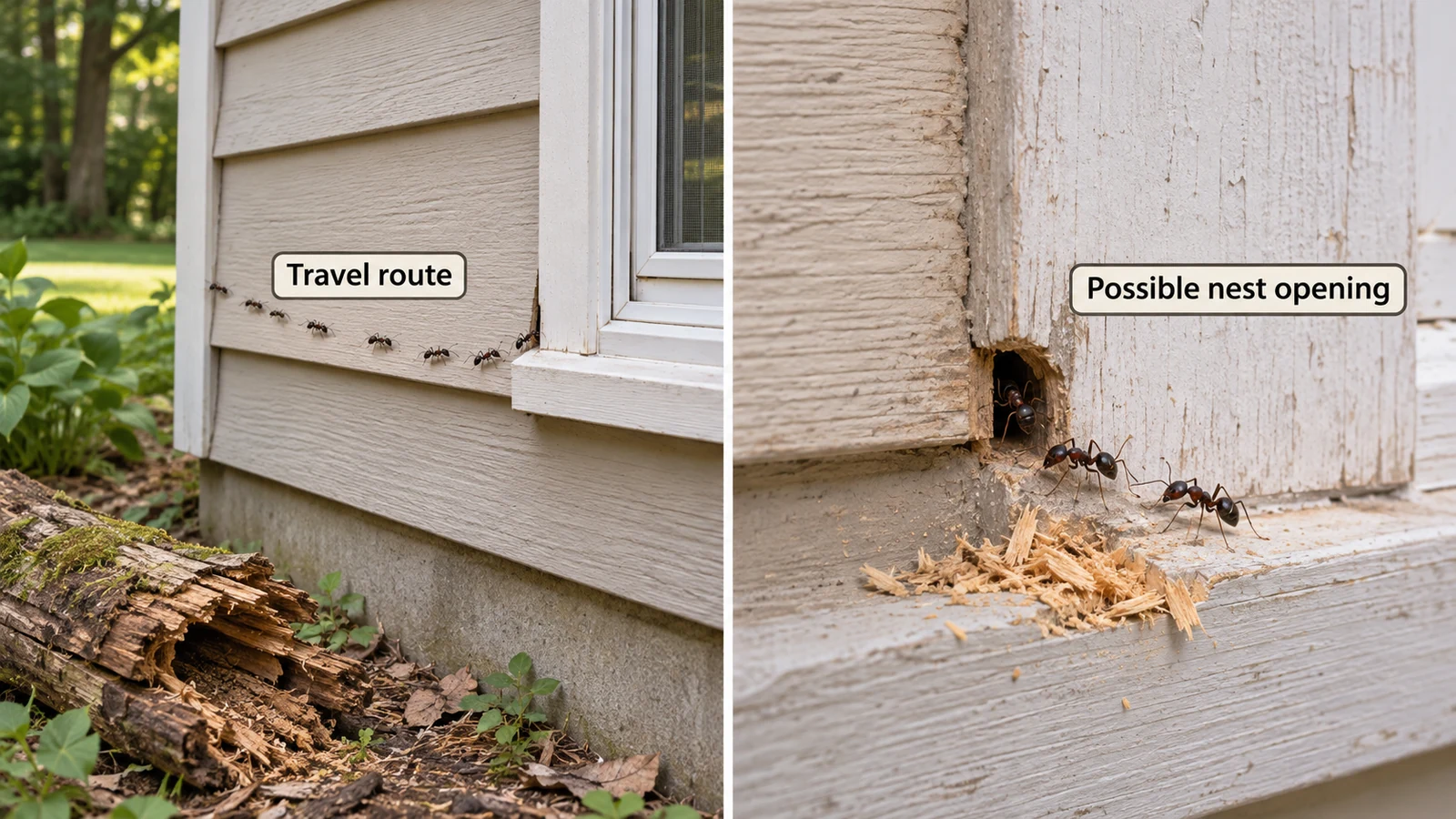
If workers travel through a gap, move toward food or water, then head back outdoors, the evidence currently favors a foraging route. If workers repeatedly emerge from an indoor wood void and fresh frass appears below it, an indoor nesting site becomes more plausible. More than one nest site is possible, so locating an outdoor nest does not automatically account for every indoor observation.
A faint rustling sound or a soft spot in wood can prompt a closer look, but neither locates a colony by itself. Moisture and deterioration may have causes unrelated to ants. Keep the nesting question separate from a full assessment of structural damage.
The following patterns help decide what to check next:
| What you observe | What it suggests | Best next check |
|---|---|---|
| A few workers at food or water, without a repeatable path | Foraging activity may originate elsewhere | Watch their return route, including outdoors |
| A trail passing through an exterior gap | A travel or entry point | Follow the trail beyond the gap in both directions |
| New coarse debris and ant traffic at the same wood opening | Excavation or a nearby nest is more likely | Check moisture and accessible surfaces around that opening |
| Workers and brood visible in an already exposed log or stump | A nest is present at that outdoor site | Check whether a trail connects the site to the house |
How strong is the evidence for an indoor nest?
Evidence is stronger when you can connect several observations: carpenter ants confirmed by appearance, repeated emergence from one concealed location, fresh debris in the same place, and moisture-damaged or sheltered wood nearby. These clues justify inspecting that specific area more closely.
Evidence is weaker when you see an occasional ant on a counter or a line of workers crossing a window frame with no other indoor clues. That pattern may be explained by outdoor foraging, even if the ants repeatedly enter the home.

When should you look beyond a routine inspection?
If trim is soft, water is entering a wall, or you find visible galleries or other concerning wood changes, the carpenter ant damage guide covers how to interpret those findings. The wood condition itself may need attention regardless of where the colony is.
When the likely location is an inaccessible wall, roof, or structural void, stop at the visible evidence. A targeted pest inspection is more useful than opening the cavity yourself. The same applies when several distinct emergence points remain active or a leak cannot be safely accessed.


