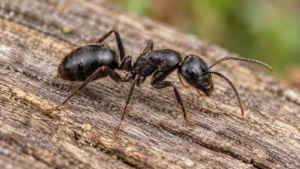
Identification
Signs of carpenter ants: how to check debris, holes, and wall clues
See what carpenter ant frass, wall openings, and other warning signs may mean. Use practical checks to distinguish recurring activity from old sawdust and decide when closer inspection is needed.

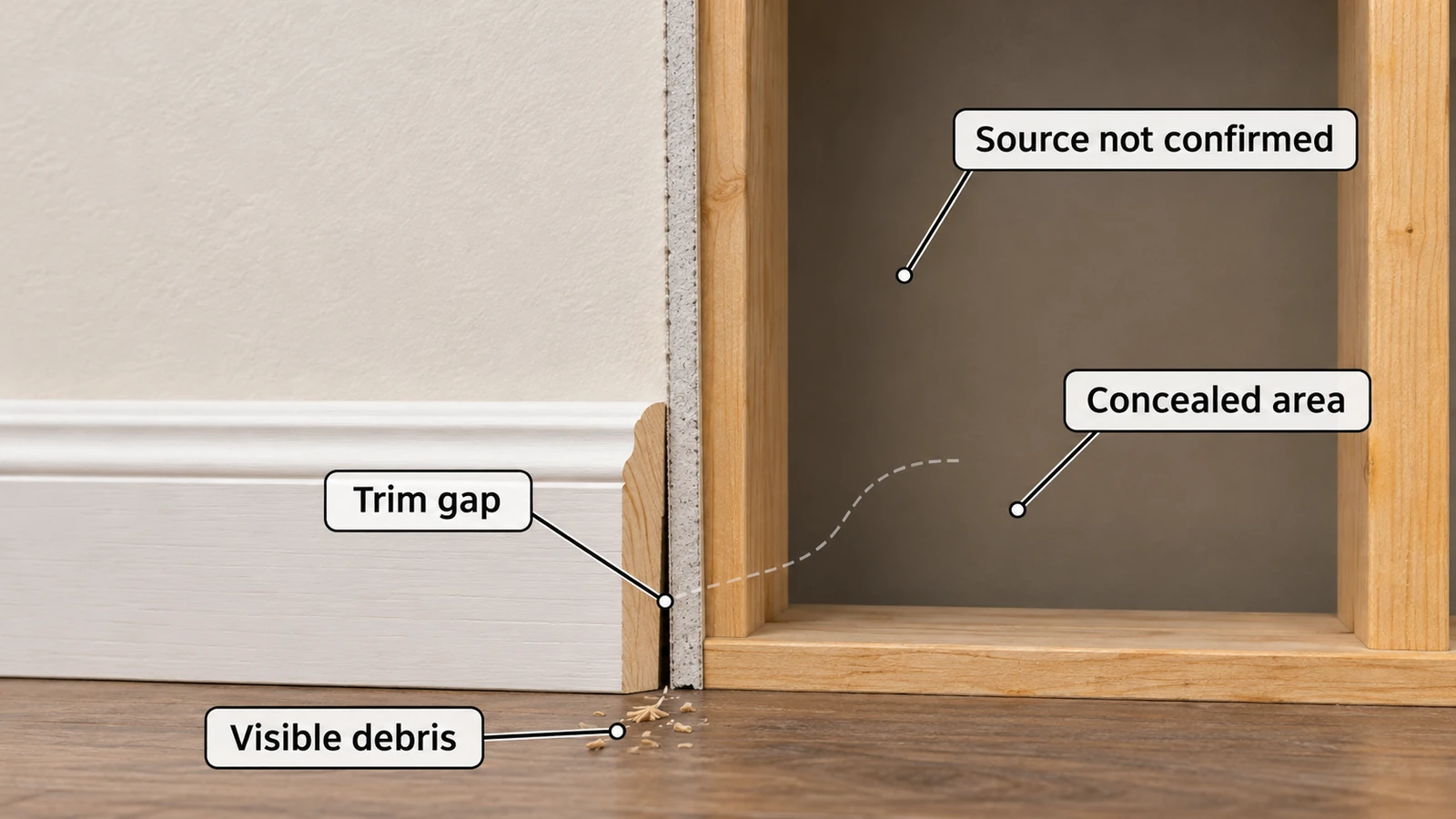
You notice a little sawdust beneath a baseboard. There is a narrow opening in the trim, and perhaps you have seen a large ant nearby. These details are worth investigating, but the dust could also be left over from repairs or come from another source.
Carpenter ants excavate wood to create nesting spaces. As they work, they may push out wood shavings and other debris. The most useful signs of carpenter ants are those you can connect to a particular location and check again, especially when you can also observe the insects.
If you are still assessing the broader ant problem, start with our guide to ants in the house.
What Are the Physical Signs of Carpenter Ants?
One of the most recognizable signs is a small pile of coarse, sawdust-like debris beneath a wooden surface, a piece of trim, or a gap. The material may contain irregular wood shavings, finer particles, and sometimes fragments of dead insects. This mixture is commonly called carpenter ant frass.
You may find it along window frames, door casings, baseboards, or other places where wood and sheltered openings meet. The location helps guide your inspection, but a pile at the edge of drywall does not tell you exactly where the material originated.

Identification in 30 Seconds
- Coarse, irregular wood shavings appear beneath a crack, trim joint, or small opening.
- Similar debris reappears at the same location after it has been documented and safely cleared.
- Identifiable carpenter ants repeatedly travel near the suspected opening.
- Several winged ants emerge or gather indoors, particularly near a window or enclosed area.
- Wood already exposed by ordinary repairs shows clean, smooth-sided galleries.
These signs differ in how much they tell you. Fresh debris accompanied by carpenter ant activity is more informative than old sawdust by itself.
Debris and frass. Carpenter ants remove wood instead of eating it. Their discarded material can resemble coarse sawdust, sometimes mixed with insect remains or other nest debris. Fine powder, sawdust from recent work, and material from other wood-infesting insects can look similar at first glance. The absence of visible insect fragments does not automatically rule carpenter ants in or out.
Holes and gaps. Workers may carry debris out through an opening in wood or an existing gap around trim. A small hole in drywall, however, could come from a fastener, old repair, or another cause. Its shape alone is a poor way to identify the insect responsible.
Sounds behind walls. An active carpenter ant colony can sometimes produce faint, dry rustling sounds. These are difficult to recognize reliably in an occupied home. Pipes, building movement, and other animals can also make noises inside walls. A sound is most useful when it coincides with other evidence from the same area.
Winged ants. Finding numerous winged carpenter ants emerging inside a home is a stronger warning of nearby nesting activity than seeing one winged insect. First establish whether the insects are ants rather than termites. A solitary winged ant may have entered from outdoors.
Visible galleries. If wood is already exposed during repairs, carpenter ant excavations may appear as smooth, clean tunnels. Do not remove drywall or trim simply to look for these galleries. Discovering them can help establish that excavation occurred, but the visible portion alone cannot establish its full extent.
How to Check a Suspicious Area Without Opening the Wall

Start with the surface where you noticed the material. A small pile beneath a windowsill or baseboard is easier to investigate when you can document its precise position before anything is moved.
Use a flashlight to examine accessible edges and nearby wood. Look for a crack above the debris, a trail of ants, and signs of past or current moisture. Keep the inspection non-destructive; you do not need to drill into a wall to gather useful evidence.
Follow this simple sequence:
- Record the location. Note the room, the specific corner or opening, and whether the debris is directly below a gap or scattered across a wider area.
- Photograph what you found. Take a close-up of the material and a wider photograph showing its position relative to the trim, window, or wall. Include a familiar object for scale if that helps.
- Check whether the material returns. If it is safe to do so, clear a small section after documenting it. Leave suspicious insulation, unknown building dust, and inaccessible material undisturbed. Look for fresh accumulation during subsequent checks.
- Observe insect movement. When practical, inspect the area during the evening, when many carpenter ants are active. Watch from an accessible location rather than probing a hidden space.
- Look for nearby moisture problems. Check accessible surfaces for staining, leaks, softened trim, or a history of water exposure. These conditions can make nearby wood more suitable for nesting.
Keep a short record of what changes. A photograph of the same opening with new debris is more useful than repeatedly describing the pile from memory.
Do not seal a suspicious opening, inject pesticide, or dismantle the wall while you are still trying to establish what produced the evidence.
Identification Mistakes
- Assuming every pile of sawdust near a wall was made by carpenter ants.
- Treating a small drywall hole as proof that ants excavated the wall.
- Taking one winged insect or an unexplained scratching sound as confirmation of an indoor nest.
Key Clue
New coarse debris appearing repeatedly at the same opening, combined with identifiable carpenter ants using that area, provides a stronger indication of nearby activity than either observation on its own.
What to Watch For
Avoid drilling, prying off trim, or probing wall cavities to follow a suspected nest. Hidden wiring, plumbing, and damaged building materials can create risks, while the visible opening may not lead directly to the ants’ nesting area.
How to Interpret Frass, Wall Holes, and Other Clues
The strongest assessment combines the type of material, its location, whether it is fresh, and whether carpenter ants are present.
A pile discovered shortly after carpentry work is a weak clue if there is no new material or insect activity. If shavings repeatedly collect below the same gap, there may be a continuing source inside or above that area. Identifying carpenter ants using the opening makes their involvement more plausible.
Even then, you may be seeing an exit for debris rather than the nest itself. Workers can move through spaces connected to a larger colony, including one originating outdoors.
Do Drywall Signs Mean Carpenter Ants Are Inside the Wall?
Drywall signs of carpenter ants are usually indirect. You might notice shavings near the baseboard, particles coming from a joint, or insects traveling along the edge of a wall.
Carpenter ants can occupy wall voids and excavate wooden framing, but debris appearing beside drywall does not establish that they have damaged the drywall itself. Nor does it reveal whether the cavity contains a nest, a travel route, or material coming from another part of the structure.
In areas where drywood termites occur, their relatively uniform, hard fecal pellets can also collect beneath small openings. Those pellets differ from the irregular wood shavings often associated with carpenter ants. Other wood-boring insects and ordinary building debris are additional possibilities.
If winged insects are part of the evidence, identify them before drawing conclusions about the wall. Ants and termites can resemble each other from a distance, and their presence calls for different follow-up decisions.
The combinations below show how different observations affect the assessment.
| What you observe | What it suggests | Best next check |
|---|---|---|
| Old-looking sawdust near recently installed trim, with no fresh accumulation | Leftover construction debris is a plausible explanation | Document the location and check whether new material appears |
| Coarse debris repeatedly collecting beneath the same gap | An ongoing source of material may be nearby | Examine the opening and watch for ant traffic |
| Fresh shavings plus identifiable carpenter ants entering or leaving that area | Carpenter ant activity near the opening is increasingly likely | Record the activity and seek a closer assessment of the suspected area |
| Multiple winged insects appearing indoors | A nearby colony may be producing reproductive insects, or another pest may be involved | Identify the insects and note where they appear |
| Faint rustling behind a wall without visible debris or insects | The source remains uncertain | Check for independent physical signs before attributing the noise to ants |
| Smooth galleries in wood already exposed during repairs | Consistent with carpenter ant excavation if the galleries are correctly identified | Have the affected wood assessed when its condition or function raises concern |
How Concerned Should You Be About the Evidence?
A single unexplained pile is a reason to investigate, not a measure of structural damage. Fresh debris that keeps returning, particularly when carpenter ants are moving through the same area, deserves more attention.
The situation becomes more concerning when several signs occur together, when activity continues indoors, or when the affected area also has a known moisture problem. Those observations justify a more focused inspection without automatically establishing a large colony or serious damage.

The amount of visible frass is not a reliable measure of how much wood has been excavated. A small opening can release debris from a concealed space, and an old accumulation may remain long after the activity that produced it.
Assessing carpenter ant damage requires examining the affected wood, not just the pile beneath it. If you find soft or deteriorating trim, a continuing leak, or signs that important framing may be compromised, seek a qualified assessment of the building condition.
Likewise, locating a carpenter ant nest is a separate task. An apparent debris exit, a worker trail, and the nest itself may occupy different places.