
How-To
How to get rid of ants: a step-by-step home control plan
Not every ant sighting needs insecticide. This plan shows how to distinguish a few scouting ants from a recurring indoor trail, remove what attracts them, use bait where it can work, and check whether the problem is actually improving.

The ants crossing your kitchen counter are usually foragers from a colony you cannot see. Killing those workers may clear the surface for a while without stopping replacements. A better approach is to find the route, remove food and moisture, choose a proportionate control method, and check whether the activity declines.
- Time Required: Allow one session for inspection and initial setup, followed by monitoring over days or weeks. Some colonies take longer to control.
- Difficulty: Straightforward for occasional scouts; moderate when trails recur or nesting areas are difficult to locate.
- Equipment: Flashlight or phone camera, cloth and soapy water, sealed food containers, materials for closing accessible gaps, and an appropriately labeled ant bait if needed.
Check What You’re Dealing With Before Acting
Confirm that the insects are ants before choosing a treatment. Most worker ants have elbowed antennae and a narrow waist, but color and size alone will not identify the species. Photograph one clearly if you are unsure.
Some situations need more specific attention:
- Large ants repeatedly appearing around damp wood, window frames, or suspected wood damage may require checking what carpenter ants look like.
- Stinging ants associated with outdoor mounds may need a fire ant-specific approach rather than a general indoor baiting plan.
- Very small ants recurring across several rooms or apartments can indicate a building-wide problem. Some indoor species, including Pharaoh ants, require particular care because inappropriate insecticide treatment can encourage colonies to split.
If you’re still trying to understand what brought them inside, start with why ants come into the house. The steps below focus on controlling an established problem.
Before You Start
Use a pesticide only when the label permits that pest, location, and application. Keep all baits and treated areas inaccessible to children and pets, and never apply an ant pesticide to food-preparation surfaces unless the label specifically permits that use. Do not combine sprays with an active baiting route.
Follow This Five-Step Ant Control Plan
Most visible ants are only a fraction of the colony. The goal is to remove the reasons they are entering and, when necessary, use a control that reaches beyond the workers you can see.
Work through these steps in order. If you erase the trail or seal its entry point before observing it, you may lose the best clue to where the ants are coming from.

Step 1. Follow the Trail and Find the Entry Point
Watch the ants before wiping them away. Follow their route along the counter edge, baseboards, cabinets, windows, or plumbing penetrations. Identify where they are feeding and where they disappear.
If the trail appears to lead outside, inspect the accessible exterior around the corresponding door, window, or foundation gap. You do not have to locate the entire nest to identify a useful treatment location.
Take a photo of the busiest section or note its location. You’ll use the same spot to judge whether the plan is working.
A few isolated ants with no recurring route may simply be scouts. Remove what attracted them and monitor before deciding to use insecticide.
Step 2. Remove Food, Water, and Easy Rewards
Start where the ants are feeding. Wipe up spills and crumbs, store pantry goods in tightly closed containers, rinse recyclables, empty food waste, and clean up pet food after meals.
Check water sources too: a leaking pipe under the sink, condensation, wet sponges, or persistently damp cabinet areas can keep ants returning even when food is scarce. Repair leaks and dry accessible surfaces.
This is the essential nonchemical part of ant control. Cleaning and exclusion can resolve minor invasions without pesticide use. A vinegar wipe may temporarily disrupt a scent trail, but it will not reliably eliminate a hidden colony.
If you plan to use bait, clean competing food sources while preserving access to the small section of trail that leads to the bait. You can remove ants and wipe other kitchen surfaces without destroying that feeding route.
Step 3. Choose a Method That Fits the Activity
For occasional scouts, continue with cleaning and exclusion. There is no reason to apply pesticide to every ant you see.
For a recurring trail of ordinary household ants, a properly labeled, slow-acting ant bait is often more useful than a contact spray. Foraging workers collect the attractive food and can transfer it to other ants in the colony. That is why the bait needs time to work.
If you’ve traced the route outdoors, favor a bait approved for exterior use near the trail or entry area, where it can intercept foragers before they enter the house. If the route cannot be found outdoors or activity originates indoors, a product labeled for indoor use may be appropriate in a protected location.
Ants may prefer sweet or protein-rich food, and preferences can even change within the same colony over time. If a bait is ignored, do not assume that all baiting has failed. Its food base, placement, or competing food sources may be the problem.
A suspected carpenter ant infestation, a stinging outdoor species, or a possible Pharaoh ant problem needs species-appropriate control rather than automatically following the generic bait choice above.
Step 4. Place the Bait and Let Foragers Work
Set the station or other labeled bait formulation beside an observed trail, entry point, or other location permitted by its label. A protected placement near the route is more useful than scattering bait randomly around the kitchen.
Follow the product’s instructions for opening, positioning, quantities, replacement, and indoor or outdoor use. Keep bait away from food-contact surfaces and inaccessible to children and pets.
Do not spray insecticide on ants traveling to the bait or apply repellents along their route. Workers need to survive long enough to return to the colony.
You may initially see more ants gathering at an attractive bait station. That can indicate that workers have found it, not that the infestation has suddenly grown. Let them feed without disturbing the station, and check whether the bait remains usable.
Step 5. Close Entry Routes and Reduce Reinfestation
Once you’ve identified the entry points, seal accessible cracks around window frames, baseboards, and pipe penetrations. Repair damaged weatherstripping and door sweeps where needed.
If workers are actively carrying bait from a station, avoid sealing the route in a way that cuts off their access before baiting has had a chance to work. Other unused gaps can be repaired sooner.
Outside, reduce conditions that support repeated entry: vegetation touching the building, moist debris close to the foundation, and water leaks near exterior walls. The objective is to keep colonies from repeatedly foraging indoors, not to eliminate every ant living outdoors.

Avoid the Mistakes That Undermine Ant Control

Bait only helps if workers accept it and can return to the colony. Spraying the feeding trail or repeatedly cleaning immediately around an active station can interrupt that process.
Keep ordinary food-preparation areas clean while leaving the small, protected bait-feeding area undisturbed for as long as the product directions require. Replace bait that is empty, dried out, or no longer usable according to its label.
Three mistakes are especially worth avoiding:
- Killing every visible ant instead of addressing the colony. Contact sprays may give quick relief, but they often leave the nest unaffected. For some species, notably Pharaoh ants, unsuitable insecticide treatments can also encourage colony budding.
- Relying on improvised chemical mixtures. Homemade borax recipes, powders, and essential-oil treatments do not offer the same verified directions and exposure controls as a properly labeled product. Cleaning a trail is not the same as eliminating its source.
- Changing methods before checking the evidence. One quiet afternoon or one busy bait station is not enough to judge the outcome. Check bait acceptance, the condition of the product, and the trend in ant traffic before making an adjustment.
How to Tell Whether the Plan Is Working
Return to the entry point and foraging route you recorded earlier. Check under reasonably similar conditions: are workers still entering, are they reaching the same food or water source, and have new trails appeared elsewhere?
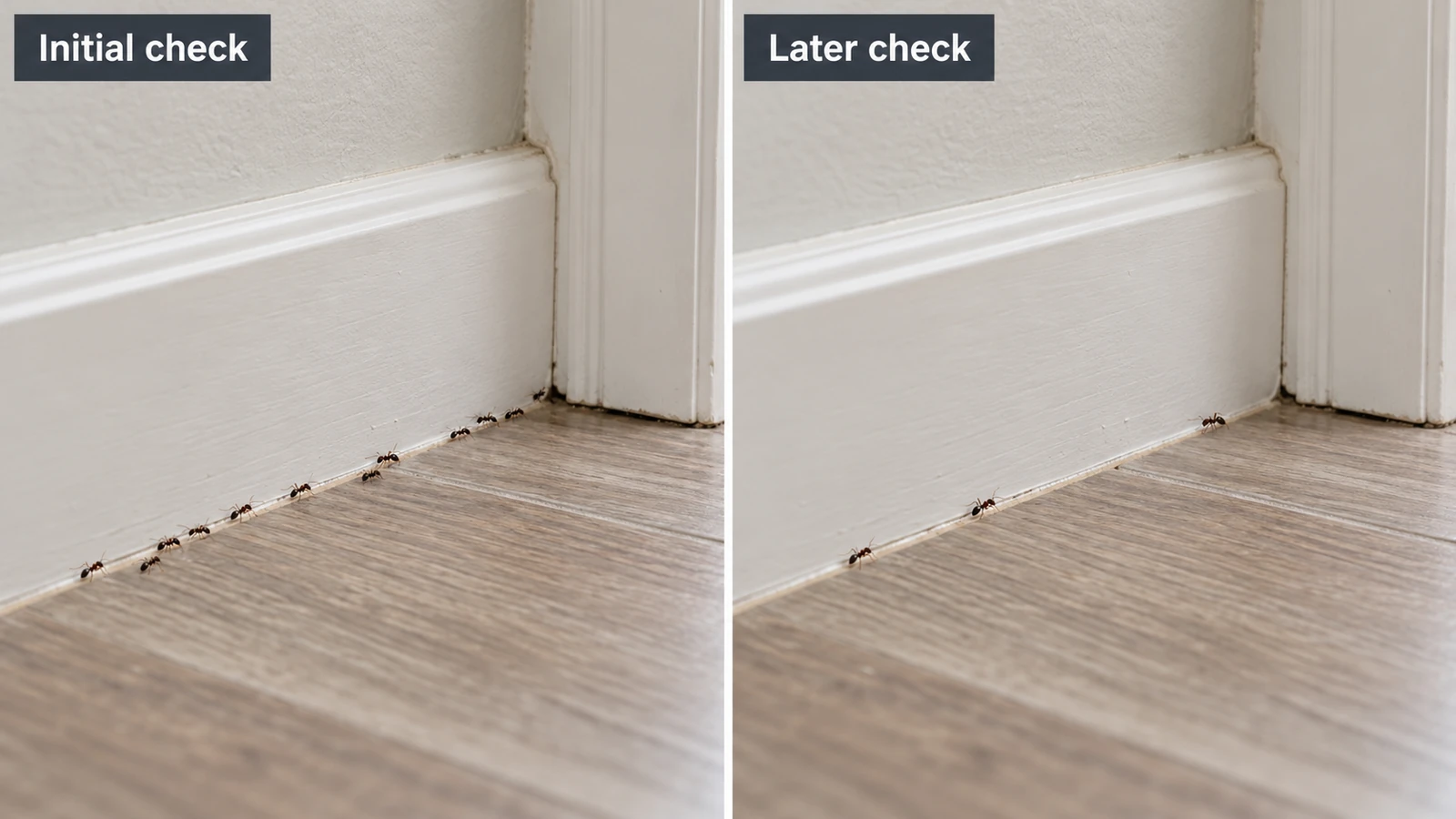
If the ants are taking bait, look for a decline in recurring traffic rather than an immediate disappearance. Some effective baiting efforts produce noticeably fewer ants in roughly 5–10 days, while complete colony control may take several weeks or longer, depending on the species and conditions.
An empty station shows that bait has been consumed or depleted. Track ant activity at the same points and inspect nearby entry routes; activity may shift when ants use another gap.
Use repeat observations of the original route and nearby food areas to decide whether activity is decreasing, remaining steady, or moving elsewhere.
Expected Result
A successful response shows sustained reduction or disappearance of the indoor trail, with no replacement trail developing nearby while food and water remain controlled. Continue monitoring rather than assuming that one ant-free day means permanent elimination.
If the Ants Keep Coming Back
Start by checking the assumptions behind the plan. Did the ants actually use the bait? Was it positioned beside an active route? Is an overlooked pet bowl, pantry spill, or water leak still drawing workers inside?
If a bait is consistently ignored, a different location or food-based formulation labeled for the pest may work better. If ants are feeding but the route persists, allow the product’s instructed treatment period and check for additional entry points or colonies before switching methods.
When Should You Call a Professional?
Professional help makes sense when a well-executed control attempt fails repeatedly, the nest is inaccessible, activity spans multiple units, or there may be structural damage or a species requiring specialized treatment.
If carpenter ants are identified or strongly suspected, use a carpenter ant control plan rather than assuming ordinary household baiting will solve a possible nest inside structural wood.
A few isolated ants, especially when they stop appearing after food is removed and entry gaps are closed, do not automatically justify hiring a pest control company.
Match what you observe to the next useful correction instead of adding more spray.
| What you observe | What may be happening | What to do next |
|---|---|---|
| Ants walk past the bait | The food base is unattractive, the location is wrong, or competing food is available | Correct the placement and food sources; consider a different appropriately labeled bait |
| More ants gather at the station | Foragers have discovered an attractive food source | Let them feed safely and evaluate the traffic trend over time |
| Many dead ants, but the trail returns | Visible workers were killed while the colony remained active | Stop relying on contact knockdown and reassess colony-directed control |
| One trail disappears, then another appears | A different entrance, hidden resource, or continuing colony may be involved | Trace the new route, check moisture and food, then adjust placement or exclusion |
| Activity persists in several rooms or near damaged wood | The problem may involve an indoor nest, multiple colonies, or a specialized ant species | Seek reliable identification and targeted control; involve a professional when warranted |
Keep Ants From Establishing a New Route
While baiting is active, check stations regularly and maintain or replace them as the label requires. After activity subsides, clean residual trails with soapy water, complete accessible entry-point repairs, and keep pantry and pet-food areas protected.
Pay attention when weather or household conditions change. Heavy rain, dry spells, accessible outdoor food, and moisture around the building can create new reasons for ants to forage indoors.
Getting rid of ants permanently is not a realistic guarantee for a home surrounded by outdoor colonies. The durable goal is to make the house difficult to enter, unrewarding to forage in, and easy to check when activity starts again.


