
Explanation
Does diatomaceous earth kill ants? What it can and can’t do
A line of white diatomaceous earth powder across an ant trail raises two different questions: what happens to the workers that cross it, and what happens to the colony behind them? This article looks at the mechanism, the conditions that affect it, and when another approach may be more useful.

A line of white powder near an ant trail can seem like a simple solution. Sometimes the ants disappear for a while. Other times, they keep coming back or start using a different route.
The important question isn’t just whether diatomaceous earth can kill an ant. It’s whether it can solve the problem that’s bringing ants into your home.
Quick Answer
Yes. Diatomaceous earth can kill ants that make sufficient contact with an effective, dry insecticidal dust. It works by damaging their protective outer coating and causing dehydration. But killing exposed worker ants is different from eliminating a colony. For persistent indoor trails, diatomaceous earth alone is usually not the best solution.
Why Diatomaceous Earth Can Kill Ants
Diatomaceous earth, often called DE, is a fine powder made from fossilized microscopic aquatic organisms called diatoms. Their remains contain silica.
When dry particles contact an insect, they can absorb protective oils and waxes from its outer covering. Abrasion can contribute to this process. As the insect loses its protection against water loss, it gradually dehydrates.

This is a physical drying effect. Diatomaceous earth doesn’t need to be eaten to work, and it doesn’t act like a slow-acting poison carried through the colony.
What the evidence actually supports
The insecticidal action of dry diatomaceous earth is well established. There are also U.S. pesticide products specifically labeled for controlling certain ants.
The evidence becomes less straightforward when the goal changes from killing individual ants to controlling an entire colony.
Ants vary in their biology, behavior, and exposure to treated surfaces. In a field trial by Ferreira-Filho and colleagues involving 120 Atta sexdens rubropilosa colonies in a Brazilian eucalyptus plantation, diatomaceous earth applied at active nest openings produced control close to the untreated comparison, while the tested bait performed better. This field result illustrates why effects on exposed workers do not establish nest control; it does not rule out every formulation, ant species, or contact use. A dust that kills exposed workers under favorable conditions may perform poorly against an established colony in a real household or outdoor setting.
That distinction matters when evaluating claims that diatomaceous earth “works on ants.”
Why dead ants don’t necessarily mean the nest is gone
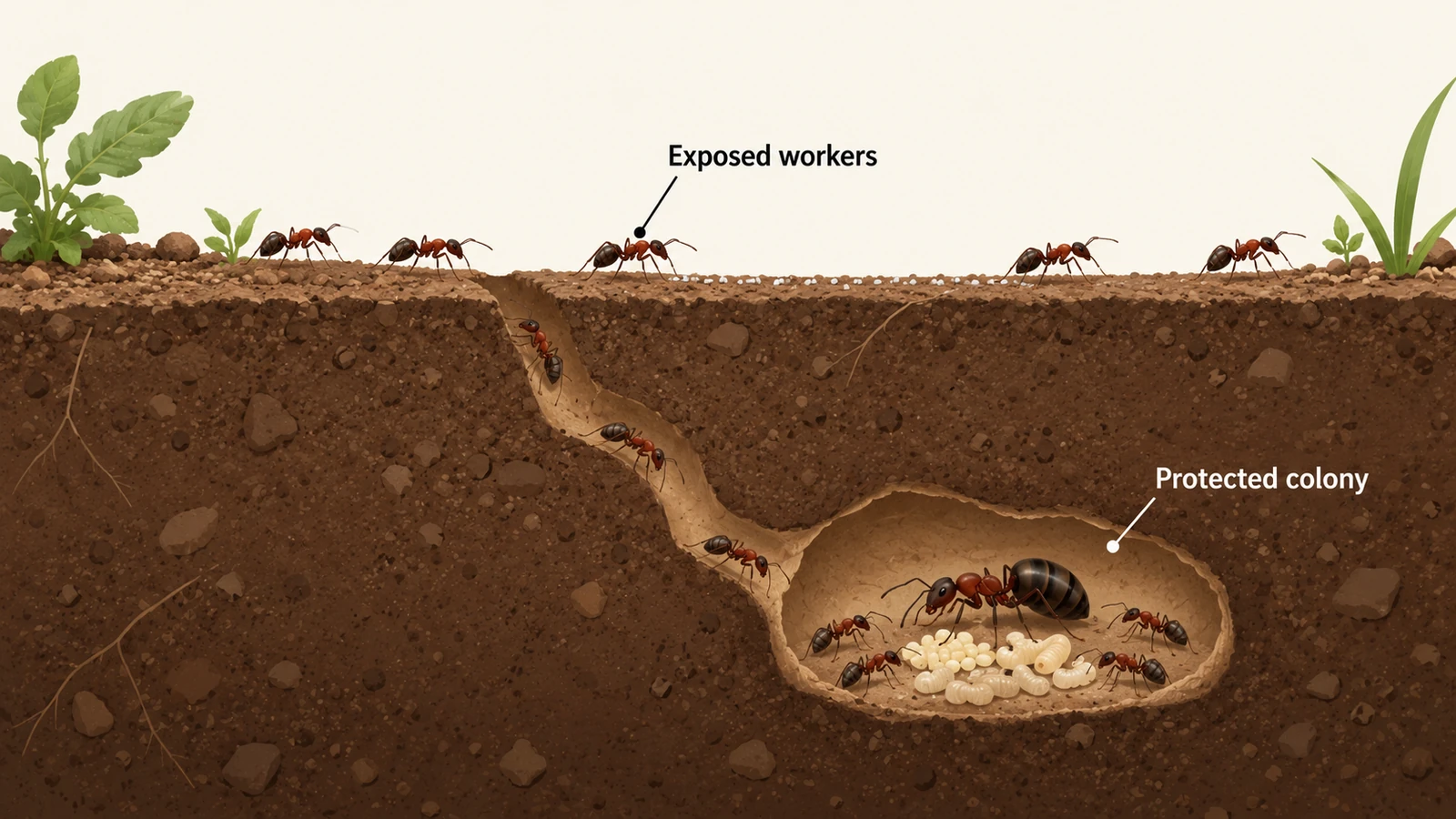
Most ants you see following a trail are workers. The queen, developing brood, and many other workers may remain protected inside a nest.
Diatomaceous earth applied along a trail mainly affects ants that encounter the treated material. It doesn’t reliably reach protected parts of the colony through the ants’ normal food-sharing behavior.
A colony may continue sending foragers even after some exposed workers die. Ants may also change routes around a treated area.
You can therefore see dead ants near the powder and still have an active infestation.
When Diatomaceous Earth Works and When It Falls Short

Diatomaceous earth depends heavily on its surroundings.
It works best when the dust stays dry, relatively undisturbed, and positioned where target insects can actually contact it. Watering, rain, dew, damp surfaces, and repeated disturbance can make it much less effective.
Once wet powder dries, it may remain clumped or attached to a surface rather than transferring readily onto passing insects. Simply waiting for a wet deposit to dry doesn’t guarantee that it will perform as before.
Indoors: limited, protected placements
Some U.S. insecticidal diatomaceous earth labels permit light applications in specified cracks and crevices or other sheltered areas where listed pests travel or hide.
Apply the product only to surfaces permitted by its label.
A thick white line across an open floor is not automatically more effective than an appropriate, label-directed application. It can also create more opportunities for people or pets to contact or disturb the dust.
In practical terms, a protected, dry location where ants actually pass is more relevant than spreading powder throughout a room.
Always confirm that the specific product’s label permits the pest, location, and application method.
Outdoors: rain and humidity are major limitations
Outdoor conditions are harder to control.
A dry, sheltered entrance may provide an opportunity for an appropriately labeled product to contact passing ants. An exposed patio, frequently watered garden bed, or damp lawn is a different situation.
Rain, irrigation, dew, and high humidity can reduce effectiveness. Wind and foot traffic can also disturb a dust deposit.
This makes diatomaceous earth a poor choice as a dependable, long-term treatment for an entire yard or active outdoor ant colony.
Repeatedly adding more powder to a wet or exposed area doesn’t solve the underlying limitation.
Not every product is labeled for every ant
“Ant killer” on a product listing doesn’t mean the same product is suitable for every ant species.
Some U.S.-registered diatomaceous earth insecticides explicitly exclude carpenter ants, fire ants, harvester ants, and Pharaoh ants from their labeled ant-control uses.
The exact label matters, including differences between indoor and outdoor directions.
If you’re dealing with large ants associated with wood, stinging outdoor ants, or an unfamiliar species, don’t assume a generic dust treatment is appropriate.
Good to Know
Food-grade diatomaceous earth and insecticidal diatomaceous earth are not interchangeable product categories.
“Food grade” describes a material intended for specified food or feed-related uses. It does not establish that a product is labeled to control household ants or that its dust is safe to inhale.
Pool-filter diatomaceous earth is not a household insecticide and should not be substituted for one.
If you choose this approach, look for a pesticide product specifically labeled for the ants and treatment site involved. Check the product’s registration information, permitted uses, precautions, and any applicable state restrictions.
What Does This Mean for an Ant Problem at Home?
The best choice depends on whether you’re dealing with a few exposed ants or an active colony that keeps sending more workers.
If you’ve seen only a few ants
A few isolated ants don’t necessarily justify a pesticide treatment.
Check for crumbs, accessible food, moisture, and obvious entry gaps. Removing what attracts the ants and closing an entry point may solve a minor problem without adding dust.
Where an ant insecticide is appropriate, diatomaceous earth may offer localized contact control under suitable dry conditions.
But don’t judge success solely by finding dead ants.
If the same trail keeps coming back
Recurring indoor trails suggest that ants are continuing to forage from a colony.
A properly selected, labeled ant bait is often a better match for this situation. Workers can collect an accepted bait and transport it back toward the nest, reaching ants that a surface dust may never contact.
Diatomaceous earth does not provide that same reliable colony-delivery function.
Avoid placing dust where it could interfere with ants reaching or feeding on a bait. If bait is the chosen method, follow its label and keep the feeding route accessible.
Different ant species and colonies may respond to different bait formulations. That makes choosing the right ant bait an important separate decision.
If you haven’t yet identified what is attracting the ants, start with why ants enter the house.
If the problem involves a nest or a particular ant species
For suspected carpenter ants nesting in wood, fire ants creating hazardous outdoor mounds, or persistent activity from an inaccessible location, the decision needs to account for the actual ant species and nesting situation.
A species-specific treatment may be more suitable than surface dusting. Professional control becomes worth considering when the nest is inaccessible, structural damage is suspected, stinging insects create a safety concern, or reasonable home-control measures repeatedly fail.
The key is to address the source rather than repeatedly treating only the ants you can see.
What to Watch For
Diatomaceous earth is a fine dust, and airborne particles can irritate the nose, respiratory tract, and eyes.
Avoid creating dust clouds or leaving deposits where they can be repeatedly disturbed, inhaled, or accessed by children and pets. Don’t spread insecticidal dust over food-preparation surfaces or near air-moving equipment unless the product label expressly permits the application.
Follow the actual label’s handling instructions, including any required protective equipment and restrictions on treated areas.
“Natural” powders can still pose inhalation risks. Apply only the labeled amount in the specified locations and follow the product directions.
Which Approach Makes More Sense?
The useful comparison is between what a method can reach and what you’re trying to control.
| Situation | What diatomaceous earth can do | More appropriate direction |
|---|---|---|
| A few ants crossing a dry, sheltered area | May kill exposed ants that contact a suitable labeled dust | Remove attractants and address entry points; use a labeled dust only if warranted |
| A recurring trail leading from a hidden colony | Can affect exposed workers but may leave the colony active | Consider a suitable slow-acting ant bait and a broader home-control plan |
| Ants on a wet patio or frequently watered surface | Performance is unreliable when the dust becomes damp or disturbed | Address the site conditions and consider a method labeled for the outdoor situation |
| Suspected carpenter ants or fire ants | Some products specifically exclude these ants | Identify the pest and use a species-appropriate control approach |
Diatomaceous earth is most defensible as a limited contact-control tool. It is much less dependable as the main response to a colony that continues producing ants.
Frequently Asked Questions
How long does diatomaceous earth take to kill ants?
It doesn’t kill instantly. Some U.S. insecticidal diatomaceous earth products claim that exposed insects die within 48 hours under their labeled conditions.
That is a product-specific claim, not a guaranteed time for every ant or application. Actual results depend on the formulation, contact, species, and environmental conditions. It also says nothing about how long an active colony might survive.
Can you mix diatomaceous earth with water to spray it on ants?
Only use a water mixture if the exact pesticide product’s label explicitly permits that application method.
Diatomaceous earth doesn’t perform its normal drying action while wet. Some labeled formulations allow applications that become effective after drying, but the resulting deposit and its performance depend on the product and conditions.
Don’t assume an improvised mixture will work, or that wetting ordinary dry dust makes it safer or more effective.
Explore this topic further:


