
Comparison
Fire ant bait: how to choose the right type and application
Fire ant baits differ in how quickly they work and whether they are labeled for whole-yard or mound use. Compare active ingredients, application conditions, and practical limits before treating.

You find a fire ant mound near the patio, then notice several more across the lawn. One container promises faster control, another uses an insect growth regulator, and a third is meant to be spread over a larger area. They may all contain small granules, but they are not interchangeable.
Choosing fire ant bait involves two decisions: what the bait does to the colony and where its label allows you to apply it. First, confirm you are dealing with imported fire ants rather than another mound-building ant. Then compare the options against your yard, the level of activity, and how soon you need results.
What Matters Most When Comparing Fire Ant Baits?
Start with the active ingredient and the labeled target pest. A container marked “ant killer” may be intended for a different species or may contain granules that work by contact rather than being collected as bait. If you’re comparing baits with other options, see our guide to fire ant treatment methods.
For an actual bait to work, the fire ants must be actively searching for food. Workers retrieve the particles and distribute food within the colony, allowing the active ingredient to affect more than the ants seen on the surface. An attractive, fresh bait placed where workers are foraging is often more useful than a stronger-sounding product applied under poor conditions.

Before buying, check these five points:
- Target species: The label must cover the imported fire ants or other fire ant species you are treating. Ant identity matters because feeding behavior and permitted uses vary.
- Allowed application: Check whether the product permits broadcast treatment, individual mound treatment, or both. Do not assume permission for one automatically includes the other.
- Treatment site: Look for the exact setting, such as residential lawns or ornamental landscape beds. Vegetable gardens, edible crops, pastures, and areas near water may have different restrictions or require a different labeled product.
- Coverage and equipment: Compare the labeled application rate and the area the package actually covers. Fire ant bait is often distributed much more sparingly than fertilizer or ordinary lawn granules, so equipment compatibility matters.
- Freshness and storage: Oil-based bait can lose its appeal as it ages, particularly after exposure to heat or moisture. Buy a quantity you can use within the manufacturer’s storage guidance rather than assuming an opened container will stay attractive indefinitely.
Availability also varies. Verify the current product label and any state registration or sales restrictions instead of assuming a fire ant bait sold online is approved for every U.S. location.
The main differences between bait mechanisms are easier to see side by side:
| Bait type | Best-fit situation | Main trade-off | Label priority |
|---|---|---|---|
| Faster-acting insecticidal bait | Active colonies where earlier suppression is important | Still takes time for collection and colony effects; not immediate control | Target species, allowed site, and mound or broadcast directions |
| IGR bait | Gradual suppression across an area without urgent mound removal | Existing workers can remain active while reproduction is affected | Application season, coverage, and permitted treatment area |
| Combination insecticide + IGR bait | Recurring colony pressure where both types of action are useful | More ingredients do not guarantee a better result in every situation | Both active ingredients, use-site restrictions, and application interval |
Broadcast Bait vs. Treating One Mound: The Trade-Offs
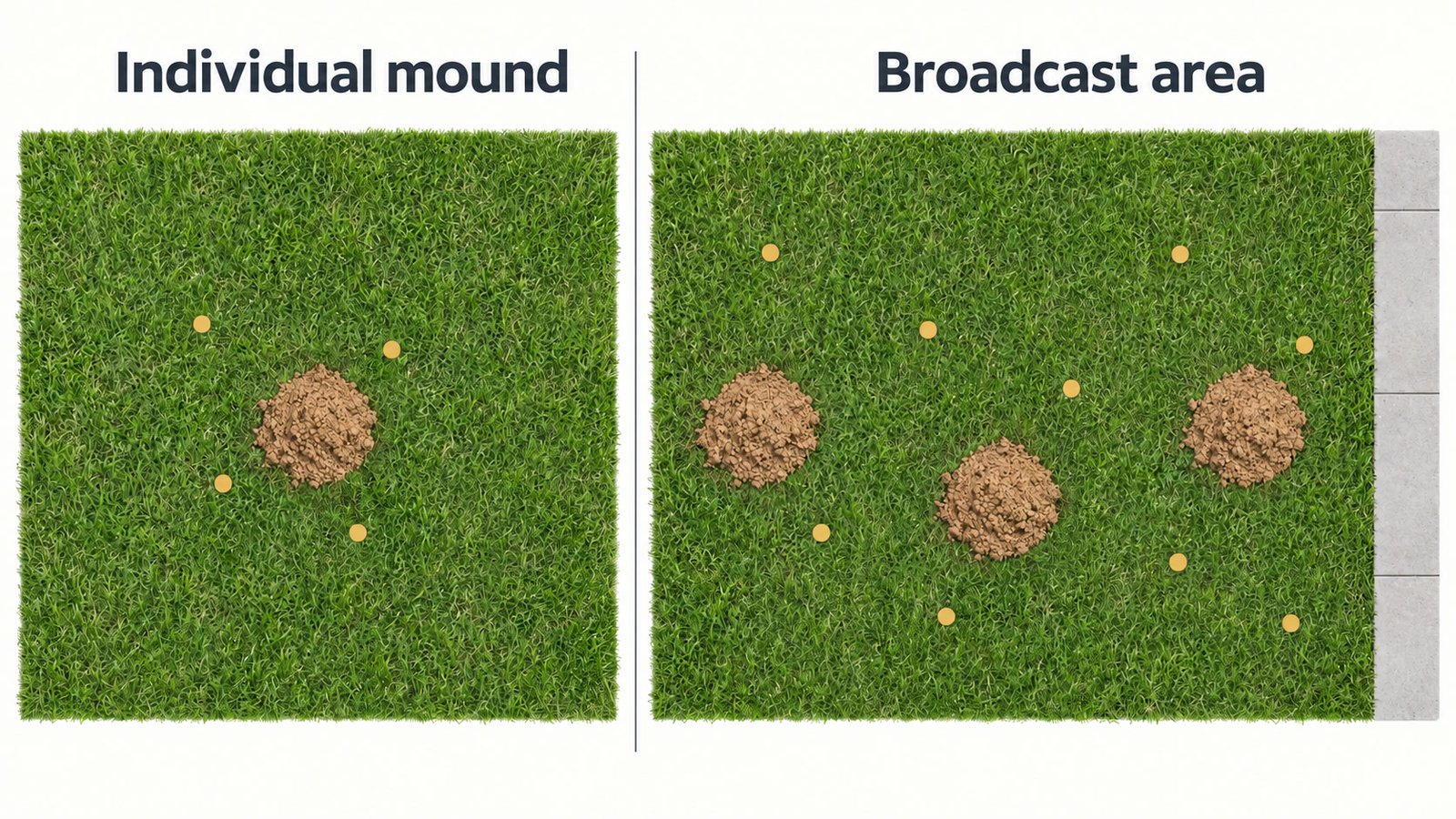
Individual mound baiting focuses on one known colony. When the product permits this use, bait is placed in the surrounding foraging area rather than simply dumped on top of the mound. Workers commonly enter and leave through underground routes beyond the visible mound. Avoid disturbing the colony before application.
This approach limits treatment to a smaller location and can be appropriate for one or a few identifiable mounds. It is less useful when numerous colonies are scattered across a lawn or some have no visible mound.
Broadcast fire ant bait is distributed across an allowed lawn or landscape area so workers from multiple colonies can encounter it. It can reach foragers associated with mounds you have not noticed. A suitable small bait spreader is generally more appropriate than a standard fertilizer spreader, which may release excessive material.
Broadcasting requires the correct labeled rate across the selected area. It should not be treated as permission to spread bait over vegetable beds, sidewalks draining to waterways, or other unapproved sites.
Weather and foraging can change the result
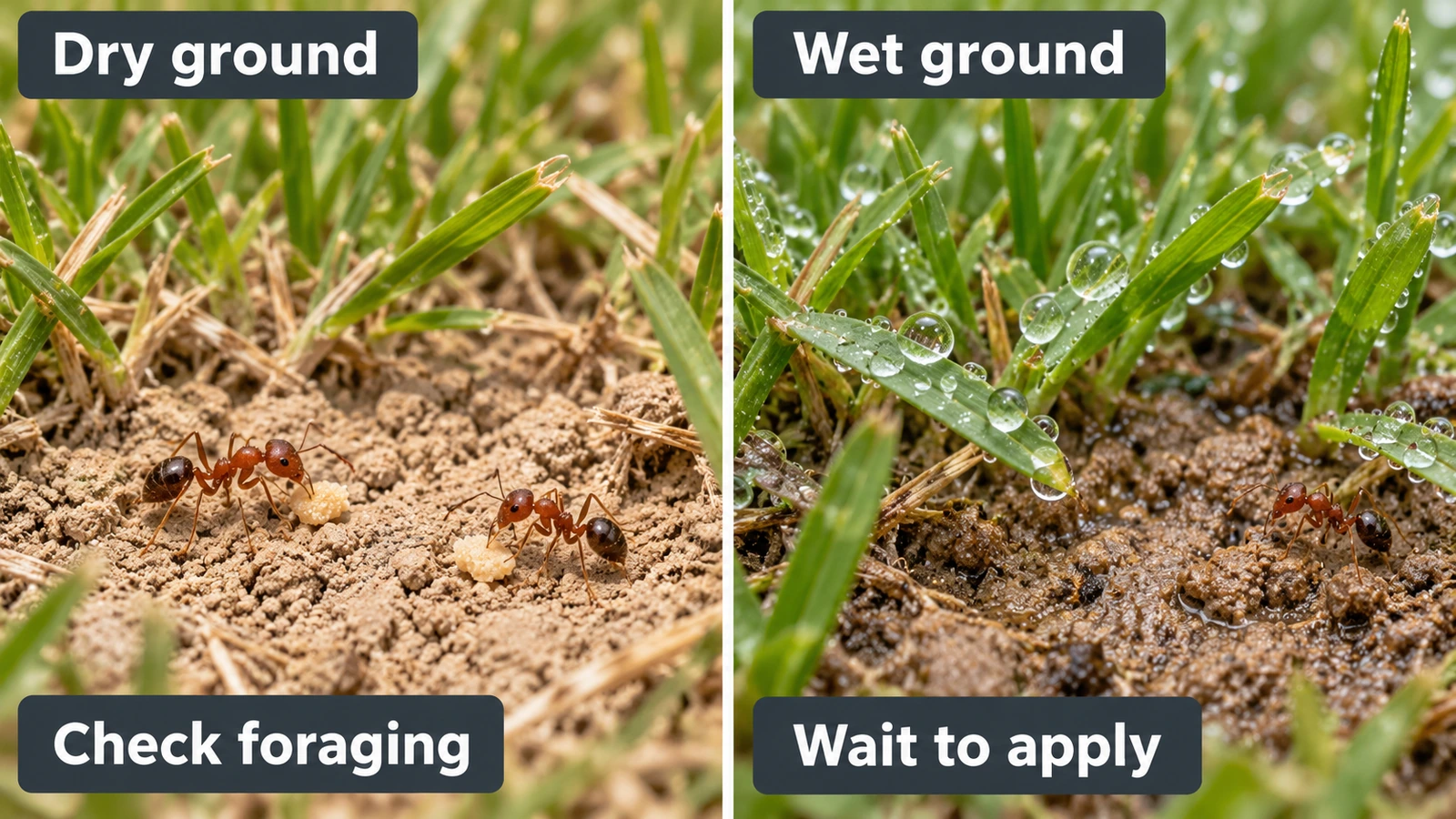
Fire ant workers collect bait most effectively when they are actively foraging and the grass and soil surface are dry. In warm regions, ground temperatures around 70–90°F often favor foraging, although actual activity is more useful than following a fixed temperature or calendar.
You can check activity by placing a small piece of greasy food, such as a potato chip, near an active mound without disturbing it. If workers gather at the food within roughly 20–30 minutes, conditions are promising for bait collection. If they ignore it, reassess the timing rather than automatically applying more product.
Avoid applying dry bait before expected rain or irrigation. Moisture can damage the food-based particles and reduce their attractiveness. Follow the specific label’s required dry-weather interval. Do not water granular bait into the soil unless that product’s directions explicitly require it; some nonbait granular insecticides have entirely different watering instructions.
Mounds may become more visible after rain as colonies move within wet soil. Their sudden appearance does not necessarily mean new colonies formed overnight. Wait for suitable foraging conditions instead of applying bait to wet grass simply because the mounds are easier to see.
Foraging Comes Before Formulation
If workers are not collecting food, even a well-chosen bait has little opportunity to reach the colony. Check foraging activity and dry-weather conditions before deciding that a product has failed or that a different active ingredient is needed.
What to Watch For
A product advertised as “fire ant killer granules” may be a contact treatment rather than a bait. Never transfer its watering, application-rate, or mound-treatment instructions to a granular bait. Read the actual product label, especially around edible plants, water, children, and pets.
Which Fire Ant Bait Fits Your Yard?
Match the bait to the area and the urgency
- One or two active mounds in an ordinary residential lawn: A bait labeled for individual mound use can be a reasonable, targeted choice if you can allow time for the colony to respond. Apply it around the foraging area as directed, not by disturbing the mound.
- Many mounds or recurring activity across a larger lawn: A broadcast-labeled bait is generally more practical than treating each visible mound independently. Choose the active-ingredient category based on how quickly you need suppression and whether gradual reproductive control suits your objective.
- A recurring problem without an urgent hazard: An IGR or combination bait may fit a longer-term suppression approach. Allow for its documented response time rather than judging it by the next day’s mound activity.
- A mound beside a frequently used play area or another immediate exposure concern: Keep people and pets away from the active area while you decide what is appropriate. Bait is not designed for immediate protection; another labeled approach may be needed. Choose a treatment approach for the fire ant problem, then compare the bait options that fit it.
If the ants have not been identified confidently, confirm the pest before purchasing. And if a lawn or landscape area includes edible crops, grazing animals, a pond, or drainage into water, make the permitted use site a deciding factor rather than an afterthought.
Combining Area-Wide Baiting With Targeted Follow-Up
For a yard with widespread activity and a few especially persistent mounds, the two bait application scopes can be complementary. A permitted broadcast application addresses the wider area, including colonies that are difficult to see.
After allowing enough time for the selected bait to work, you can reassess remaining active mounds. A separate targeted bait application is only appropriate if the relevant label permits that use and its reapplication limits are met. More product or immediate repeated applications are not a shortcut to faster control.
Why Fire Ant Bait Sometimes Appears Not to Work
Before replacing a bait or increasing the amount, check what happened during application and afterward.
- Workers ignored the granules: The bait may have been stale, exposed to moisture, placed when ants were not foraging, or unsuitable for the species. Check these causes before treating the lack of collection as resistance.
- A large fertilizer spreader was used: Baits commonly have low application rates. Equipment intended for heavier granules can empty the package too quickly and leave an uneven or excessive amount.
- The mound remained active the next day: Baits act within the colony over time. An IGR in particular should not be evaluated as though it were a rapid contact treatment.
- New mounds appeared after earlier suppression: Colonies can arrive from surrounding untreated areas, and new queens can establish nests. Compare activity over the product’s expected response period rather than treating every new mound as proof that the bait never worked.
Monitor active mounds and foraging patterns over the time frame appropriate to the product. If there is little improvement after that interval, revisit identification, bait uptake, weather, and label directions before choosing another approach.
A suitable fire ant bait is one the workers will collect, that is authorized for your exact treatment site, and whose speed and coverage match the problem you are trying to manage.
Explore this topic further:


