Explanation
Termite tenting and fumigation: What homeowners need to know
Find out why a termite professional may recommend tenting your house, which infestations it can address, and what to clarify about preparation, temporary relocation, safe reentry, and follow-up before agreeing to the treatment.
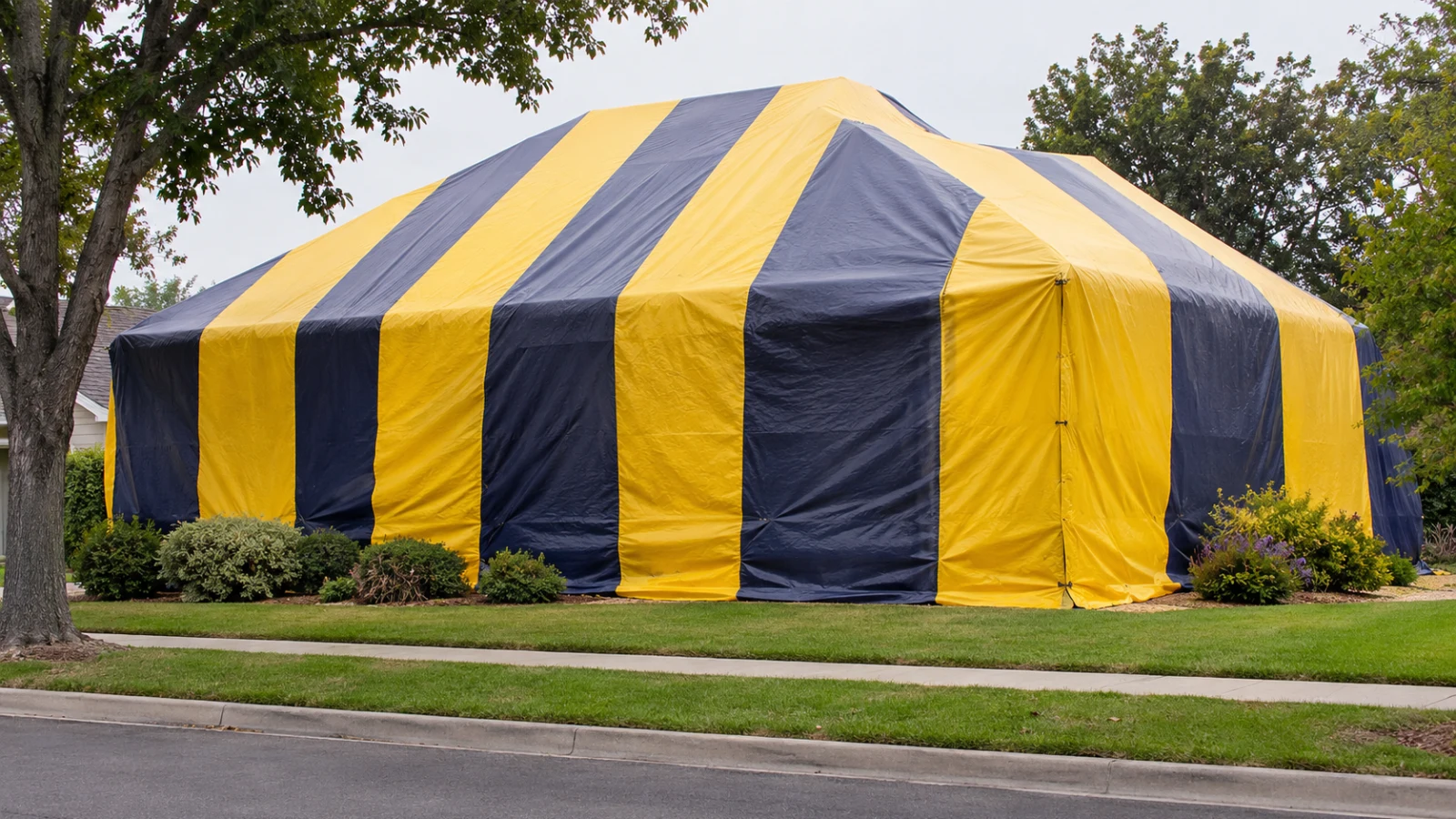
A termite inspection can end with a recommendation that sounds drastic: the entire house needs to be covered with a tent. Before agreeing, you need to know why the treatment has to extend beyond the wood where the termites were found, and what leaving your home will involve.
Whole-structure fumigation has a particular purpose. It makes it possible to treat colonies concealed throughout a building, but it is not the right response to every termite problem.
Quick Answer
Termite tenting is the enclosure of a building for professional fumigation, usually to control drywood termites hidden in wood. It can address multiple concealed infestations at once. Occupants must leave and wait for professional clearance before returning. Fumigation does not provide lasting protection against future infestations.
What termite tenting actually does
Tenting and fumigation describe different parts of the same treatment. The tent is the temporary enclosure; fumigation is the use of a pesticide in gaseous form to treat the enclosed structure. A tent alone does not kill termites, and some other professional treatments also use tarps.
Drywood termites can establish colonies inside beams, trim, and other wooden components behind finished surfaces. A structural fumigant can reach concealed infestations without requiring every affected piece of wood to be exposed and treated individually.

In the United States, sulfuryl fluoride is the only fumigant registered for residential structural use. It is a restricted-use pesticide because inhaling it can be extremely dangerous. The work must be carried out under the responsibility of an appropriately certified applicator, with the required training, equipment, and state-specific credentials.
The treatment includes a period when the building is inaccessible to occupants and a subsequent professional process to remove the fumigant and verify that the air meets the applicable reentry requirements. Neither the application nor the clearance is a homeowner task.
When does a house need termite fumigation?

Whole-structure fumigation is particularly useful when an inspection indicates drywood termite activity in multiple areas or in wood that cannot be adequately reached by a localized treatment.
Subterranean termites present a different problem. Their colonies are usually connected to the ground, so fumigating the house alone may leave the colony outside the treated structure. The termite group matters as much as the extent of the visible damage.
When tenting may be unnecessary
If the infestation is confined to an identifiable, accessible piece of wood, localized professional treatment or removal of the affected material may be sufficient. Whole-structure heat treatment may also be an option for some buildings.
The difficulty is establishing the true extent of drywood termite activity. Finding pellets beneath one window frame does not tell you whether other concealed colonies are present. Ask what the inspection established and what areas remain uncertain before deciding between local and whole-structure treatment.
A professional termite inspection is the appropriate starting point when the termite group or extent of activity has not been established.
What fumigation cannot accomplish
Fumigation addresses susceptible pests in the treated structure at the time of treatment. Once the fumigant has dissipated, it does not create an ongoing protective barrier against termites arriving later.
If subterranean activity is also present, the property may require a separate treatment plan for that problem. The broader guide to termite treatment options explains why these approaches serve different purposes.
Good to Know
Killing the termites does not restore wood they have already damaged. Ask whether the inspection identified areas that need repair or a separate assessment of structural soundness.
What to expect if your home is being tented
Before the fumigation
The company should explain why fumigation is recommended, identify the proposed pesticide, and give you written preparation and safety instructions specific to the property and product.
Read those instructions before making travel arrangements. In particular, clarify how to handle food, pet food, medicines, items stored in the refrigerator or freezer, houseplants, and anything that requires special handling. Do not assume ordinary food packaging or household plastic bags provide suitable protection.
Plan somewhere for everyone in the household to stay, including pets and aquarium animals. Discuss plants and any adjoining or connected living spaces with the fumigator. If utility services need to be interrupted, confirm who is responsible for coordinating their restoration.
During the treatment
The home is out of bounds while the fumigation and clearance process is underway. No one should enter to collect a forgotten medication, check on an animal, or retrieve a valuable. Contact the fumigation company instead.
Plan for several days away from the house, with flexibility if the schedule changes. Building characteristics, the treatment plan, weather, and completion of the safety checks all affect how soon occupants can return.
Returning home
The absence of the tent is not permission to go inside. Sulfuryl fluoride cannot be reliably detected by smell or sight, so an apparently normal house is not evidence that the air is safe.
Wait for the qualified fumigator to confirm that reentry is permitted after the required instrument-based clearance checks. Follow the company’s written return instructions and contact the applicator if anything is unclear. Florida, for example, requires a clearance notice at each entrance; the applicable notice and licensing requirements depend on the state.
If you discover a food or medicine item that was not handled as instructed, ask the fumigator what to do with it before using or consuming it.
Questions worth asking the fumigation company
Before signing a contract, get clear answers to these questions:
- What findings support whole-structure fumigation rather than a localized treatment?
- Which buildings or attached areas are included, and are any excluded?
- Who will perform the fumigation, including any subcontractor, and who holds the applicable state credentials?
- Which preparation requirements apply to our particular household?
- Who will confirm the clearance for reentry, and how will we receive that confirmation?
- What follow-up inspections or retreatment commitments are included if termite activity returns?
Keep the written inspection findings, preparation instructions, agreement, and clearance documentation. These records help you understand what was treated and what remains covered if new evidence appears.

What to Watch For
If you suspect fumigant exposure, leave the area for fresh air and stay out. Call U.S. Poison Control at 1-800-222-1222. For breathing difficulty, a seizure, or collapse, call 911 immediately.
Explore this topic further: