How-To
How to use cockroach bait effectively at home
Roach bait works best when cockroaches can find and feed on it. Use this placement-first approach to choose a suitable format, protect food and pets, and track whether activity is declining.

A bait station on a kitchen shelf may do very little while cockroaches travel along the floor behind the refrigerator. The problem may be where the bait sits, rather than the product itself.
Cockroach bait combines a food attractant with an insecticide that roaches eat. Most formulations work gradually, so successful treatment depends on getting the bait close to active hiding places, allowing roaches to feed, and checking whether activity declines.
If you are still confirming the pest, start with the cockroach identification and control overview.
- Difficulty: Basic, with careful inspection and label-directed placement.
- Equipment: Cockroach bait labeled for the intended use, a flashlight, a way to record observations, and optional sticky monitoring traps.
Choose the Right Bait and Prepare the Area
Start by finding where cockroaches are active. Look along cabinet corners, under sinks, near plumbing openings, behind appliances, and around other sheltered areas. Live roaches, droppings, and catches in sticky monitors can help narrow down the most useful locations.
If the insects are small and repeatedly appearing indoors, the German cockroach identification guide can help you decide whether you are dealing with a species that breeds inside homes. An occasional large outdoor roach entering near a door may require more attention to entry points than to indoor baiting.
Choose a bait format that you can place close to the activity while following its U.S. product label:
- Ready-to-use bait stations: These enclosed units contain insecticidal bait. They are convenient for placing along accessible edges and sheltered routes, provided children and pets cannot reach them.
- Gel or paste bait: A roach gel bait can reach certain narrow, label-permitted cracks and crevices that a plastic station cannot. It requires more precise application and attention to exposed deposits.
- Granular bait: This may suit certain locations or cockroach species, but approved indoor and outdoor uses vary by product. Check the label before choosing it.
A common source of confusion is the phrase “cockroach bait trap.” A bait station contains insecticide that roaches consume and generally allows them to leave. Sticky cockroach traps catch insects on adhesive and are mainly useful for locating activity and measuring progress.
Before placing anything, remove accessible crumbs, food residue, and spills. Store food and pet food securely, empty overflowing trash, and address leaks where possible. Removing competing food and water makes it more likely that roaches will encounter and feed on the bait.
Before You Start
Read the entire label on the specific bait product, including approved locations, quantities, handling instructions, replacement directions, and restrictions. Keep all bait away from children, pets, food, pet dishes, and food-contact surfaces. An enclosed station is not an invitation to leave it within reach. Never open or refill a prefilled station unless its labeling expressly permits it.
How to Place Cockroach Bait Where It Will Work
Think of bait placement as intercepting a route. Cockroaches often move along edges between their hiding places and sources of food or moisture. Put bait where they are likely to pass, rather than expecting it to attract them across an entire room.
Step 1: Target the areas with the clearest activity
Begin with the places where you have actually seen roaches, found fresh signs, or caught them in monitoring traps.
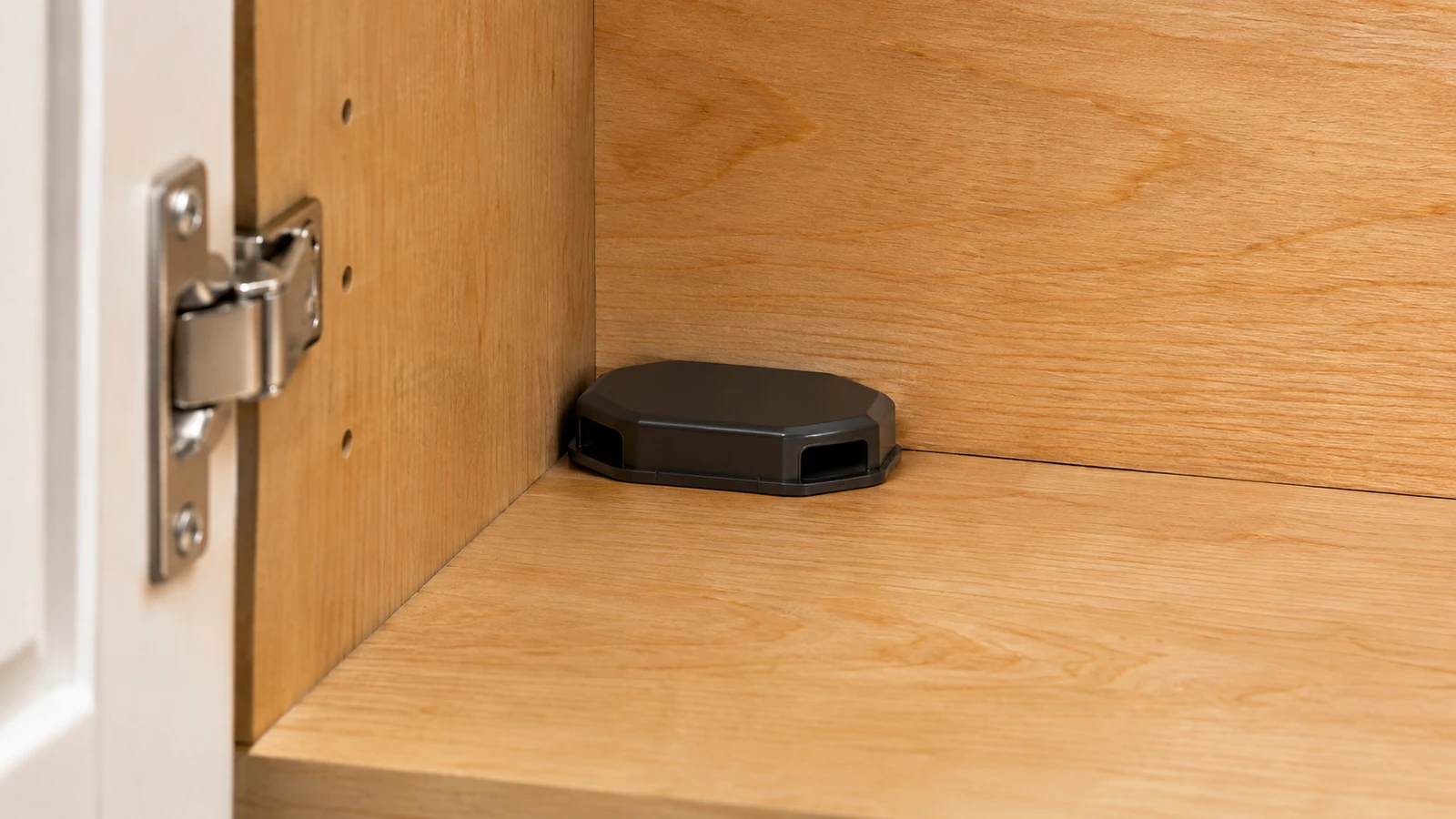
A cabinet corner behind stored items, the sheltered area beside plumbing, or a dry section near an appliance may be more productive than a highly visible spot on an open floor.
Use the flashlight to check the surrounding edges and gaps. You do not need to dismantle appliances or reach into electrical equipment to find a useful placement.
Step 2: Position each bait format correctly
For ready-to-use stations, place them flat and close against a wall, cabinet side, or corner when the label permits. Keep their entrances unobstructed so roaches can enter and leave.
Avoid setting all the stations in the middle of a room or grouping them in one convenient location. Spread them among confirmed activity areas according to the package directions.
For gel bait, the basic principle is similar: place the bait close to the places roaches hide or travel, only in locations and amounts allowed by its label. Small, distributed placements are often more useful than a large exposed deposit. The exact application pattern belongs to the specific gel product’s directions.
For granules or other formulations, use the designated application sites and method on that product’s label. Do not assume that a bait approved for an outdoor perimeter can be scattered inside kitchen cabinets.
Step 3: Use the label-directed amount
Follow the product’s instructions for the number of stations, spacing, application quantity, and treated areas. These requirements differ among formulations and products.
If several spots show activity, distribute the approved placements among those spots rather than putting the entire supply in one corner. Do not add extra pesticide simply because you want faster results.
Keep stations in their intended orientation and avoid blocking access with stored containers or other objects.
Step 4: Leave the bait available to feeding roaches
Once the bait is in position, let cockroaches find it. Avoid moving stations from place to place every evening just because you have not seen a dead insect.
Continue normal cleaning and food storage, but do not wash away exposed bait or contaminate it with other products. Inspect the bait periodically, using the replacement or replenishment instructions supplied with it.

Mistakes That Can Make Cockroach Bait Less Effective

Cockroach bait has to remain accessible and appealing to the insects. A product can be correctly labeled for the pest and still perform poorly if the location or surrounding conditions interfere with feeding.
Watch for these common mistakes:
- Spraying insecticide on or near the bait. Some sprays can contaminate bait or discourage roaches from feeding. Never spray over bait or place it on recently sprayed surfaces contrary to the product directions.
- Leaving alternative food everywhere. Grease, crumbs, trash, and pet food can compete with the bait. Concentrate cleaning on removing these food sources without disturbing treated spots.
- Choosing exposed or unsuitable locations. Countertops, food-preparation surfaces, wet areas, and places accessible to children or pets are poor choices. Heat, sunlight, moisture, and frequent cleaning can also make certain placements unsuitable.
- Using a large amount in one place. More bait in a single location does not compensate for missing the routes where roaches actually travel.
- Ignoring bait condition. Some gel deposits can dry or harden, and stations can become depleted or reach their replacement interval. Recheck their condition as the label directs.
Also avoid using a total-release fogger to compensate for an apparently unsuccessful bait treatment. Foggers generally fail to reach many cockroach hiding places and introduce additional exposure risks.
How to Tell Whether Cockroach Bait Is Working
The most useful evidence is a change in cockroach activity over time, not the number of dead insects lying beside a station.

Place sticky monitoring traps in dry, sheltered locations along the routes you identified, keeping them separate from bait placements. Mark or record each trap’s location and inspection date. These monitors help you compare activity in the same places as treatment continues.
Check for three practical signs:
- Fewer cockroaches caught in the same monitoring locations over comparable observation periods.
- Fewer live roaches appearing in previously active areas.
- Bait that remains properly positioned and available, with replenishment or replacement performed when the label calls for it.
Most cockroach baits act slowly. It may take a week or longer before you see a clear reduction, and an established infestation can require further treatment and monitoring.
Do not judge the entire treatment by one roach crossing the kitchen overnight. Look at the trend. If one area becomes quieter while another continues producing catches, that second area deserves closer inspection.
For help interpreting droppings, sightings, and other evidence, see signs of a cockroach infestation.
Expected Result
A useful sign of progress is a downward trend in captures from the same monitoring locations, supported by fewer live sightings in the areas that were previously active. Continued activity tells you where to inspect and adjust the treatment.
What to Do If the Bait Is Not Working
Start by checking the placement and the evidence of activity before buying another insecticide.
If roaches are consistently appearing somewhere the bait cannot be reached, reposition or add bait only in label-permitted locations closer to that activity. If food and water remain readily available, correct those conditions as well.
If the bait appears untouched, that alone does not identify the cause. Enclosed stations may not make feeding obvious, and roaches may be using a different route. Sticky monitor results and direct observations are more useful than repeatedly changing products without understanding the problem.
If properly placed bait produces little improvement after the product’s recommended assessment period, consider whether you have identified the species and the active area correctly. Product suitability, bait condition, and the extent of the infestation may need reassessment.
When Should You Call a Professional?
Professional help becomes more worthwhile when roaches continue appearing in several rooms, activity persists despite reasonable corrective steps, or important hiding places cannot be inspected or treated safely.
In apartment buildings, roaches may move between units through shared spaces and service openings. A persistent problem may require coordination with building management and a qualified pest-control provider rather than repeated treatment of one apartment alone.
A few isolated sightings do not automatically require professional treatment. Use the activity you can verify, the response to properly placed bait, and the limits of safe DIY access to make that decision.
Use this troubleshooting table to match what you observe with a reasonable next action.
| What you notice | Possible explanation | What to do next |
|---|---|---|
| Roaches remain active, but bait seems untouched | Bait is away from the main routes, or competing food is available | Recheck activity locations, remove food sources, and adjust label-permitted placements |
| Activity drops in one cabinet but continues elsewhere | Another hiding area remains active | Inspect the area with continuing sightings or monitor catches |
| Gel has dried or hardened | The deposit may no longer be as attractive or usable | Follow the gel label for inspection, removal, and fresh application |
| Bait is next to an area recently treated with spray | Spray contamination or repellency may interfere with feeding | Follow both product labels and use a suitable uncontaminated placement rather than layering pesticides |
| Large roaches keep appearing near exterior doors | Roaches may be entering from outdoor hiding places | Check identification and address entry points; reassess the need for indoor bait |
| Captures remain high across an apartment despite adjustments | The source may be inaccessible or extend beyond one unit | Arrange a broader inspection and coordinate building-level control where appropriate |
Keep Monitoring and Maintain Control
Continue checking the previously active locations even after sightings become less frequent. Follow the bait label for replacement, reapplication, and removal, rather than assuming every bait format has the same useful life.
Keep food sources contained, fix accessible moisture problems, and watch for a return of activity. If your monitoring results rise again, revisit the affected area instead of automatically treating every room.
Explore this topic further: