Comparison
Ant powder: Which dust to use and when to skip it
Not every ant powder works the same way. Compare contact, borate, and drying dusts by intended use, application site, exposure risks, and the result you need.

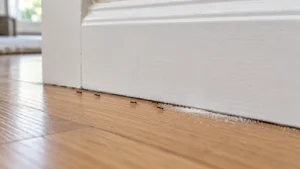
A line of ants along the baseboard makes ant killer powder look like a simple fix. Sprinkle it where they walk, and the problem should disappear. In practice, powders can affect the workers that encounter them while leaving the colony supplying those workers untouched.
The useful choice is not which powder has the strongest promise on the package. It is whether a particular dust is labeled for your ants and the exact place you want to treat, and whether contact treatment fits the problem.
The checks that matter before choosing a dust
Start with the label’s intended pest and application site. A product that lists ants may still exclude particular types, and an outdoor-only dust cannot be assumed suitable for your kitchen or a wall void.
Then ask where the ants are coming from. Workers crossing a countertop might be visiting from an outdoor nest, while repeated activity from a confirmed enclosed nest calls for a different response. A trail disappearing beneath trim is a clue to investigate, not proof that the nest is behind it.

Before choosing a powder, compare these four things:
- Target ants: Are the ants you are dealing with among the pests listed on the specific product?
- Permitted location: Does the label allow that precise indoor or outdoor site and type of treatment?
- Intended result: Are you trying to stop ants at a narrow access point, treat a known nest, or control the wider colony?
- Exposure and conditions: Could people, pets, food, airflow, rain, or moisture contact or disturb the dust?
The label also specifies how the material may be used, protective measures, restrictions, and any applicator qualifications. If you cannot identify a permitted use for your situation, do not improvise one.
Ant powder types compared by use
These are product families, not interchangeable recipes. The permitted uses and outcomes still depend on the individual label and the ants involved.
| Format | Main way it works | Situation it may fit | Key limitation |
|---|---|---|---|
| Conventional insecticide dust | Ants encounter an insecticidal residue | A specific labeled crack, void, or outdoor target | Killing exposed workers may leave the colony active |
| Borate insecticidal dust | Toxic effect after intake or contact, depending on formulation | A label-approved sheltered treatment site | Not equivalent to homemade borax or to a food bait |
| Desiccant dust | Damages the protective body layer and causes drying | A suitable dry, label-approved location | Moisture, movement, and lack of contact can undermine results |
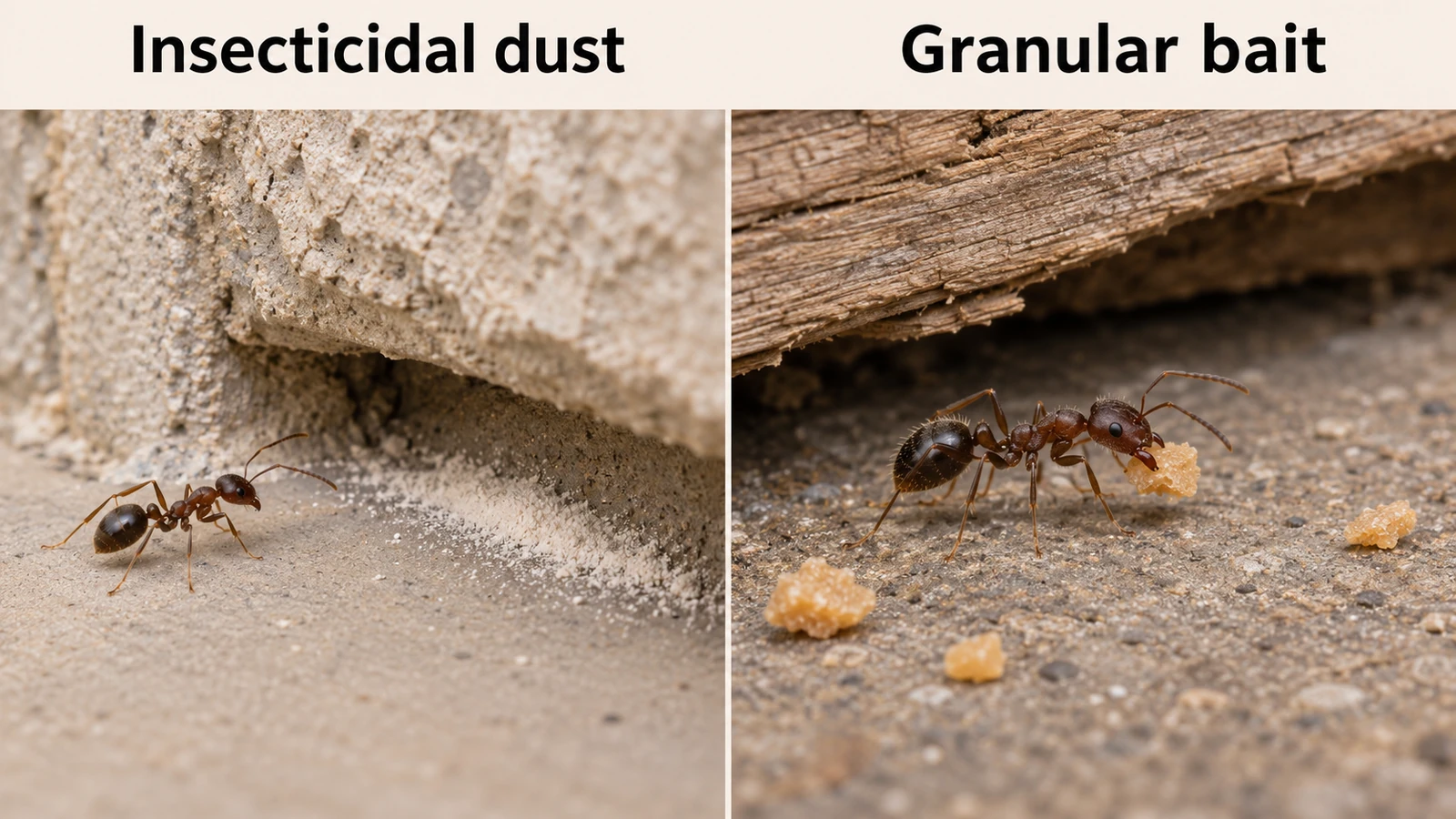
| Granular ant bait (not dust) | Attracted foragers collect pesticide-containing food | A colony-focused approach when ants accept the bait | Can be slow, ignored, or confused with contact-killing granules |
Where ant powders fall short

A powder can reduce visible activity where ants pass through it without reaching the place those ants came from. If the nest is somewhere else, more workers may return along another route. That is why a quick drop in the trail is not, by itself, proof of colony control.
A dust also has to remain appropriate for the site. Some desiccants lose effectiveness when wet; loose material can be disturbed by cleaning, traffic, or air movement. That creates a practical limit as well as a potential exposure problem.
For outdoor use, a label that allows a particular mound treatment is not permission to spread dust across an entire lawn or sidewalk. Weather, runoff, nearby plants, and non-target exposure matter. Spray products have their own site restrictions and tradeoffs; the ant spray comparison covers that separate choice.
Do not assume that adding dust to the same place as an attractive bait improves control. Contact residues can interfere with foraging or contaminate the bait, making ants less willing or able to carry it back to the colony.
When a dust has a clear role
A known, inaccessible ant nesting space or travel gap may suit a targeted insecticidal dust if the exact product label authorizes that site. There is no reason to dust every nearby void.
What to Watch For
A visible ant trail on a kitchen counter is not a reason to coat a food-contact surface with powder. Exposed dust can be disturbed, inhaled, or reached by children and pets.
Which ant-control option fits your situation?
A few ants on an exposed indoor surface
Start by removing the food or moisture attracting them and observing their entry route. A scattering of powder on a counter is a poor match for the setting. If ants continue arriving from a hidden colony, the most useful next decision may involve an ant bait rather than a dust.
Repeated ants at a known hidden gap
If the site is genuinely implicated and the product explicitly permits that location, a narrow, contained dust treatment may have a role. But ants emerging beside a pipe or electrical outlet do not automatically mean the nest is inside the wall. Do not open electrical fittings, drill into an unknown void, or improvise a dust application to reach it. Professional inspection makes sense when access or safety requires it.
Outdoor ants or mounds
First distinguish workers that wander inside from a colony or mound you have actually located outdoors. Some ant powders have narrowly defined outdoor uses; others are indoor-only or not labeled for the ant species in question. For a broader starting point, see why ants come into the house and what to do.
The best choice is the method that matches the ant activity, the achievable target, and the permitted application, not whichever container says “ant killer” most prominently.
Mistakes that can change the result
- Treating every granule as bait. A grain-shaped contact insecticide and an attractive ant bait behave differently. Check which one the label actually describes.
- Substituting household powders for labeled insecticides. A bag of laundry borax or food-grade diatomaceous earth does not supply pest-control use directions or the same risk evaluation as a pesticide-labeled product.
- Increasing dust because the trail returns. Repeated visible piles may increase exposure without identifying the colony, improving contact, or correcting a poor site choice.
Explore this topic further: