
Guide
Flea eggs and the flea life cycle: what each stage looks like
Flea eggs are barely visible, and the larvae and pupae that follow look nothing like jumping adult fleas. Understanding these hidden stages explains where fleas develop, how long the life cycle can take, and why new adults may appear even after you have started addressing an infestation.

By


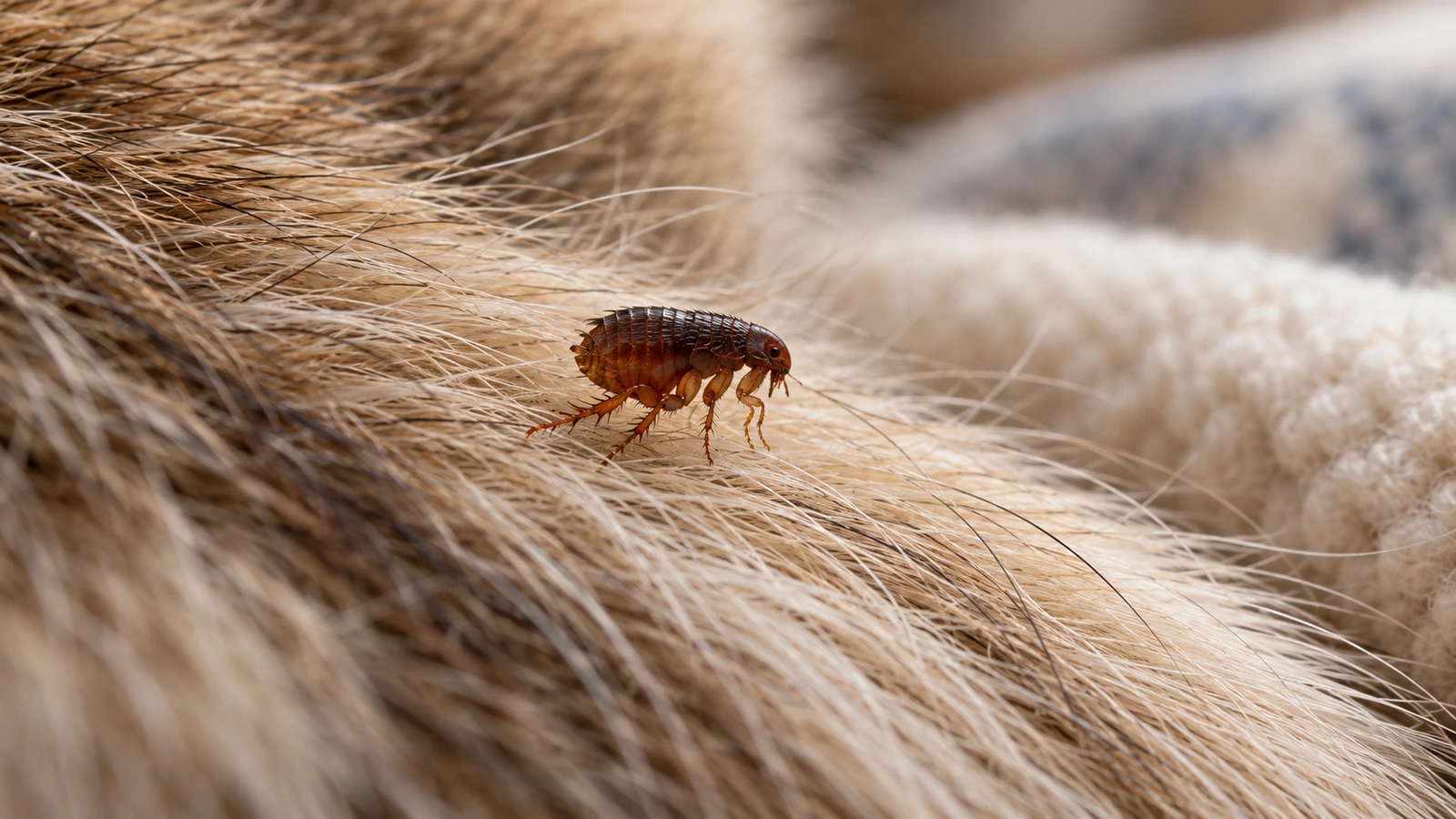
Finding an adult flea on a dog or cat is one thing. Finding the eggs it leaves behind is much harder. They can fall into pet bedding, carpets, and other resting areas, where the next stages develop away from the animal.
This is why a home can contain developing fleas even when very few adults are visible. To understand what is happening, you need to follow the complete cycle from egg to larva, pupa, and adult and recognize which parts occur on the host and which take place in the surrounding environment.
Why flea eggs matter in a home infestation
Fleas undergo complete metamorphosis. They pass through four distinct stages: egg, larva, pupa, and adult. Each stage has a different appearance, behavior, and relationship with its surroundings.
The cat flea, Ctenocephalides felis, is the most common flea associated with household pets in the United States. Despite its name, it commonly infests both cats and dogs.
Adult female cat fleas feed on an animal and lay eggs among its fur. Unlike lice eggs, flea eggs are not firmly attached to hair. Their smooth surfaces allow them to fall into the places where the animal spends time.
Once the eggs hatch, the larvae live in the environment rather than on the pet. They feed, grow, and eventually spin cocoons. Inside these cocoons, they transform into pupae and develop into adult fleas.
This creates a connection between the animal and its surroundings. The pet supports the reproducing adults, while bedding, rugs, upholstery, and sheltered floor spaces may support the immature stages.

Key takeaways
- A flea egg is a tiny, smooth, whitish oval, not a miniature version of an adult flea.
- Eggs fall from the host, making pet resting areas particularly important places to examine.
- Larvae develop in protected environments; pupae remain enclosed in cocoons that can delay adult emergence.
- New adult fleas may appear from stages already present in the home, even when few adults were visible earlier.
What flea eggs, larvae, pupae, and adults look like
The four stages look very different. Flea eggs resemble tiny pale grains, larvae look like small worms, pupae are protected inside silk cocoons, and adults are dark, jumping insects. Each stage has its own visual clues.
Size is equally important. A flea egg is only about half a millimeter long, while a mature larva can reach approximately 5 mm (3/16 inch). Close-up photographs often magnify these stages substantially, so a realistic sense of scale matters when examining something found at home.
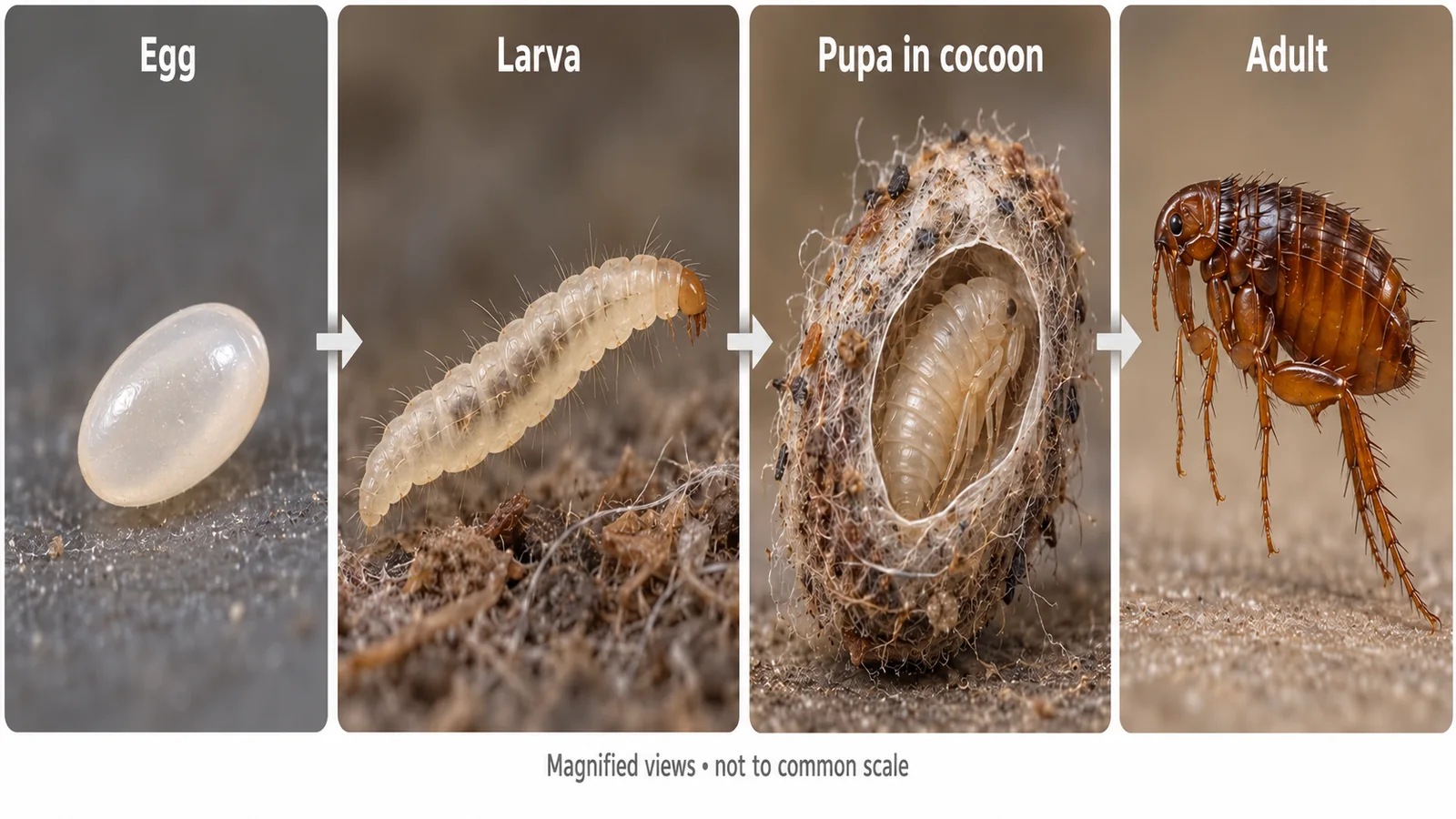
Magnified views of the four stages; the specimens are not shown at a common scale.
Flea eggs: tiny white or pearly ovals
A typical cat flea egg is approximately 0.5 mm long, or about 1/50 inch.
It is smooth, oval, and whitish to pearly white. Under magnification, it has a more regular shape than most pieces of skin, dust, or fabric debris.
Several eggs collected together may resemble scattered grains of fine salt. A single egg, however, can be difficult to notice without magnification, especially against light-colored bedding.
Flea eggs do not move, crawl, or jump. They are also not sticky, so they readily fall through an animal’s coat.
This explains why examining a pet’s fur alone may reveal few eggs even when adult fleas are reproducing.
The most likely places to encounter fallen eggs are surfaces frequently used by the host, particularly pet beds, blankets, carpets, rugs, and upholstered furniture.
Not every tiny white particle in these places is a flea egg. Skin flakes, lint, dust, and other debris can look similar without close examination.
Flea larvae: pale, wormlike insects
When a flea egg hatches, it releases a larva rather than a small jumping flea.
Newly hatched cat flea larvae are approximately 1.5 mm long. As they feed and grow, they can reach around 5 mm (3/16 inch).
They have elongated, segmented bodies and no legs. Their coloring is usually whitish, cream, or somewhat translucent, with a darker head.
Under magnification, fine hairs may be visible along the body. Dark material inside the digestive tract can sometimes be seen through the translucent body.
Unlike adult fleas, larvae cannot jump.
They move by crawling and generally avoid light. This behavior helps explain why larvae are more likely to develop deep among carpet fibers, underneath furniture, or within other protected spaces than on exposed, brightly lit surfaces.
Larvae do not feed on living pets. Much of their nutrition comes from blood-rich droppings produced by adult fleas, together with other suitable organic material in their surroundings.
Flea pupae: protected inside cocoons
After completing their larval development, fleas spin silk cocoons and enter the pupal stage.
A typical cat flea cocoon is only a few millimeters long, often around 3 mm (1/8 inch).
The newly formed cocoon is pale, but its outer surface readily collects dust, pet hair, carpet fibers, and other small particles. This gives it camouflage within the surrounding material.
The pupa itself develops inside this protective covering. In an ordinary home inspection, a person is more likely to encounter the debris-covered cocoon than to see the exposed pupa.
This stage is particularly important because the cocoon provides protection against environmental conditions and reduces the effectiveness of many treatments.
A fully developed adult flea may remain inside the cocoon until conditions favor emergence.
The cocoon can therefore be difficult to find and even harder to recognize correctly without magnification.
Adult fleas: the jumping stage
Adult cat fleas are generally about 1–3 mm long. They are reddish-brown to dark brown, wingless, and flattened from side to side.
Their enlarged hind legs allow them to jump onto passing hosts. Once established on a suitable animal, adult cat fleas spend much of their time feeding and reproducing there.
This is also the only stage in the usual household cat flea cycle that feeds directly on the animal.
If you want to examine the adult insect more closely, the guide to what adult fleas look like covers their body shape, color, and distinguishing features.
What does a baby flea look like?
The expression “baby flea” can be misleading.
Fleas do not pass through a series of miniature, jumping juvenile forms resembling smaller adults.
Their immature stages are the egg, the wormlike larva, and the pupa. A flea that has just emerged from its cocoon is already an adult.
How long does the flea life cycle take?
There is no single development time that applies to every home.
Temperature, humidity, food availability, and the presence of suitable hosts all influence how quickly fleas develop. The timing also differs between the stages.
For the common household cat flea, useful reference ranges are:
- Egg: Hatching can occur in approximately 1–10 days, often within just a few days when conditions are favorable.
- Larva: Feeding and development commonly take several days to a few weeks. Under favorable conditions, larvae may form cocoons after roughly 5–20 days.
- Pupa: Development and emergence may occur within days or weeks, but a fully developed adult can remain protected inside its cocoon much longer.
- Adult: Once a suitable host is found, an adult can feed, reproduce, and produce another generation of eggs.
In favorable warm, humid conditions, the entire egg-to-adult cycle can take as little as roughly two to three weeks. In less favorable conditions, development and emergence may extend over many weeks or months.
These are biological ranges, not a timetable for eliminating an infestation.
Why warmth and humidity matter
Flea larvae develop best in protected environments with suitable moisture and temperature.
Warm, humid conditions generally favor faster development. Dryness, excessive exposure, or unfavorable temperatures can make survival and development more difficult.
This helps explain why immature fleas are concentrated in sheltered microhabitats rather than distributed evenly across an entire room.
A carpeted area beneath a pet’s favorite sleeping spot may provide a more favorable environment than a dry, sunlit section of flooring.
The relationship also varies with climate. In parts of the United States, flea activity is strongly seasonal outdoors, while suitable indoor conditions can support development outside the main outdoor season.
Why new fleas can appear after a quiet period
The pupal stage adds an important complication to the life cycle.
Adult fleas developing inside cocoons may wait for signals associated with a nearby host. Movement, vibrations, warmth, and carbon dioxide can encourage emergence.

Walking across a previously quiet carpet may therefore coincide with the appearance of adult fleas that were already developing there.
This is particularly relevant in rooms that have been vacant or used infrequently.
A new burst of adult activity does not necessarily mean that eggs have just been laid. The insects may have completed most of their development earlier and remained protected before emerging.
The survival of active adult fleas without a host is a separate question from the delayed emergence of adults inside cocoons. Both matter when investigating a property without resident pets.
Where are flea eggs and larvae hiding?
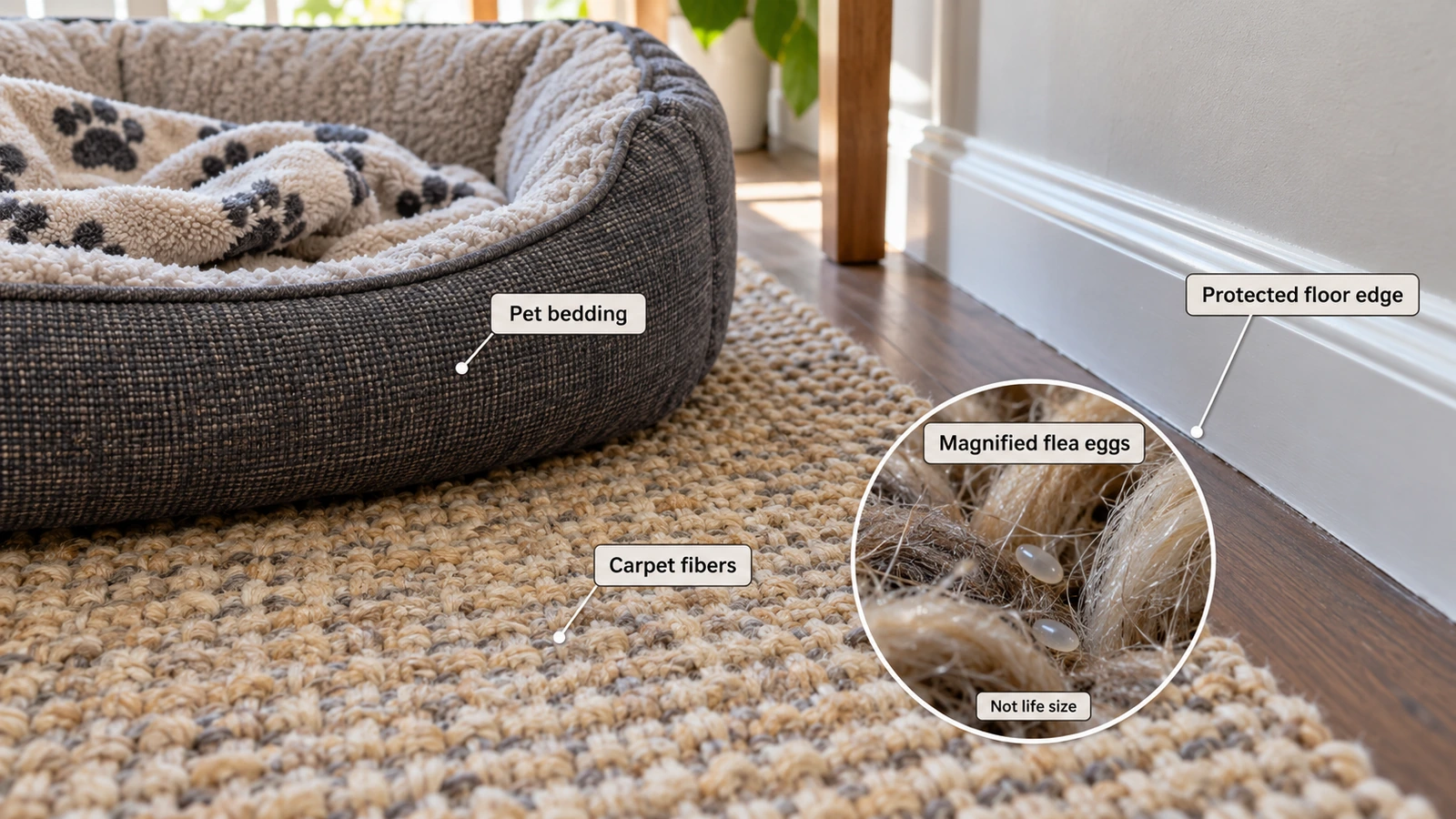
The magnified detail is not life size; a flea egg is about 0.5 mm long.
The most useful starting point is the animal’s resting environment. Eggs commonly fall from an infested pet, while larvae move into protected spaces where suitable food and moisture are available. Cocoons can become incorporated into carpet fibers and nearby debris, making them difficult to recognize.
The places most worth examining depend on where the host spends time:
- Pet beds and blankets: Eggs, flea droppings, and other organic material can accumulate where an animal regularly sleeps.
- Carpets and rugs: Fibers near resting areas can shelter larvae and cocoons, particularly beneath furniture and along less-disturbed edges.
- Upholstered furniture: Cushions, seams, and fabric folds deserve attention when pets regularly rest there.
- Floor gaps and baseboards: Protected crevices near animal resting areas can collect material that supports immature flea development.
- Sheltered outdoor resting spots: Shaded, protected locations may matter when a pet regularly spends time outside.
A human bed can become a relevant location when an infested pet routinely sleeps there. Check the bedding and nearby soft furnishings for signs of flea activity.
What can you actually identify at home?
Adult fleas are generally easier to recognize than their immature stages.
A moving, jumping insect provides a different kind of evidence from a tiny white grain. A pale wormlike larva may be visible under favorable conditions, but identifying it reliably can require magnification or specialist examination.
Flea cocoons are especially difficult to recognize because their surfaces often resemble surrounding dust and debris.
Dark, pepper-like particles are not flea eggs. They may be flea droppings, but ordinary dirt can look similar. The flea dirt identification guide explains how to examine those particles separately.
If repeated adult activity is found in several locations, the next question is whether the observations indicate a developing household infestation. Checking the signs of a flea infestation is more useful than attempting to count every hidden egg.
A lack of visible eggs or larvae should not override convincing evidence of adult flea activity.

Practical tip
If you find tiny pale grains on pet bedding, examine a small sample against a dark, plain background with a magnifying glass and a size reference. Smooth, regular ovals are more consistent with flea eggs than irregular skin flakes, but appearance alone may not confirm the identification.

Watch for
A small, pale, wormlike insect found near food, a drain, or an unrelated damp area is not automatically a flea larva. The location and surrounding evidence matter. Several other small insects have larvae that can look similar.
What the flea life cycle tells you about control
Flea control involves two connected environments. Adult fleas feed and reproduce on suitable hosts, while eggs, larvae, and pupae commonly develop in the surrounding home. Addressing only the visible adults can leave immature stages behind; cleaning the environment without addressing fleas on the host allows new eggs to continue entering it.
The life cycle therefore explains why pet protection and environmental cleaning need to work together. Vacuuming and laundering can reduce exposed eggs, larvae, and the material larvae feed on, while cocoons may remain protected and produce adult fleas later.

Protecting pets reduces the supply of new eggs
An effective flea-control approach must address adult fleas reproducing on the host.
For households with dogs or cats, this means using an appropriate, effective flea-prevention or treatment plan for the animals involved.
The suitable product depends on the animal, its age, weight, health, and other circumstances. A veterinarian can help determine the right option.
Products intended for dogs must not automatically be used on cats. Some ingredients that are appropriate for one species can be dangerous to another.
Treating the home cannot replace suitable flea control for an infested pet.
Environmental cleaning targets the developing stages
Vacuuming carpets, rugs, upholstered furniture, and relevant floor crevices can remove many exposed flea eggs and larvae, along with some of the debris that supports larval development.
Seal and dispose of vacuum waste as directed for the equipment; never add insecticide to its reservoir. Before moving exposed bedding, fold its corners inward and carry it contained, separate from clean items. If a surface treatment has been applied, follow its label or the professional’s instructions before resuming vacuuming or washing; timing depends on the treatment.
Washing suitable pet bedding helps reduce the material accumulating where eggs are most likely to fall.
These measures are most relevant around the animal’s actual resting areas. Flea larvae do not normally develop equally well in every part of a house.
Some infestations may require additional environmental treatment, but the need depends on the situation. Broadly treating every room or the entire yard is not an automatic requirement.
Why treatments affect different stages differently
Not every flea-control method works equally well against every stage.
Some environmental insecticides target exposed insects. Insect growth regulators, when included in an appropriately labeled product, interfere with immature flea development or reproduction rather than immediately eliminating every protected adult.
The cocooned stage is more difficult to reach. Pupae and fully developed adults sheltered inside cocoons may survive interventions that affect exposed stages.
A successful initial reduction in visible fleas can occur while some developing fleas remain protected in their cocoons.
Any pesticide used in a home must be labeled for the intended location and application. Follow the current label, including precautions for pets, children, ventilation, and reentry. Never apply an environmental product directly to an animal unless its label specifically authorizes that use.
For the complete treatment sequence, see our guide to getting rid of fleas in your house.
How to prevent another flea cycle and track progress
Follow-up needs to account for delayed emergence. A newly visible adult flea may have developed inside a cocoon before the earlier cleaning or treatment. Compare new sightings with the intervention date and monitor the same areas to assess whether activity continues.

Look for a trend, not just one sighting
The useful question is whether adult flea activity is decreasing over time and whether the likely sources are being addressed.
Occasional emerging adults may still appear while previously protected stages complete their development.
However, continuing or increasing activity, especially alongside fleas remaining on a pet, suggests that the cycle may still be receiving new eggs or that another source has not been addressed.
Light-colored socks can make jumping adult fleas easier to notice near a suspected activity area. This can help with monitoring, although it does not reveal the eggs, larvae, or cocoons hidden nearby.
Consider the source if fleas keep returning
Pets are not the only animals capable of bringing fleas into a property.
Wildlife or rodents using an attic, crawl space, outbuilding, or sheltered outdoor area may contribute to flea problems in some situations. Previous animal occupants can also explain developing fleas in a recently vacated home.
These possibilities become more relevant when there are no resident pets or when a persistent problem cannot be explained by the household animals.
Avoid assuming that every returning flea comes from a dirty carpet or that repeated spraying will solve an unidentified source.
Where activity persists despite appropriate pet protection and environmental measures, reassess the source and the overall infestation. Professional help can be appropriate for widespread persistence, inaccessible animal harborages, or situations that cannot be reasonably investigated or controlled.
Explore this topic further:
Related guide: How to Get Rid of Fleas in Your House

