Comparison
Best flea killers for the home: which type should you choose?
Compare indoor flea sprays, growth regulators, powders, and foggers by the problem they can address. Learn which product features matter before choosing a treatment.
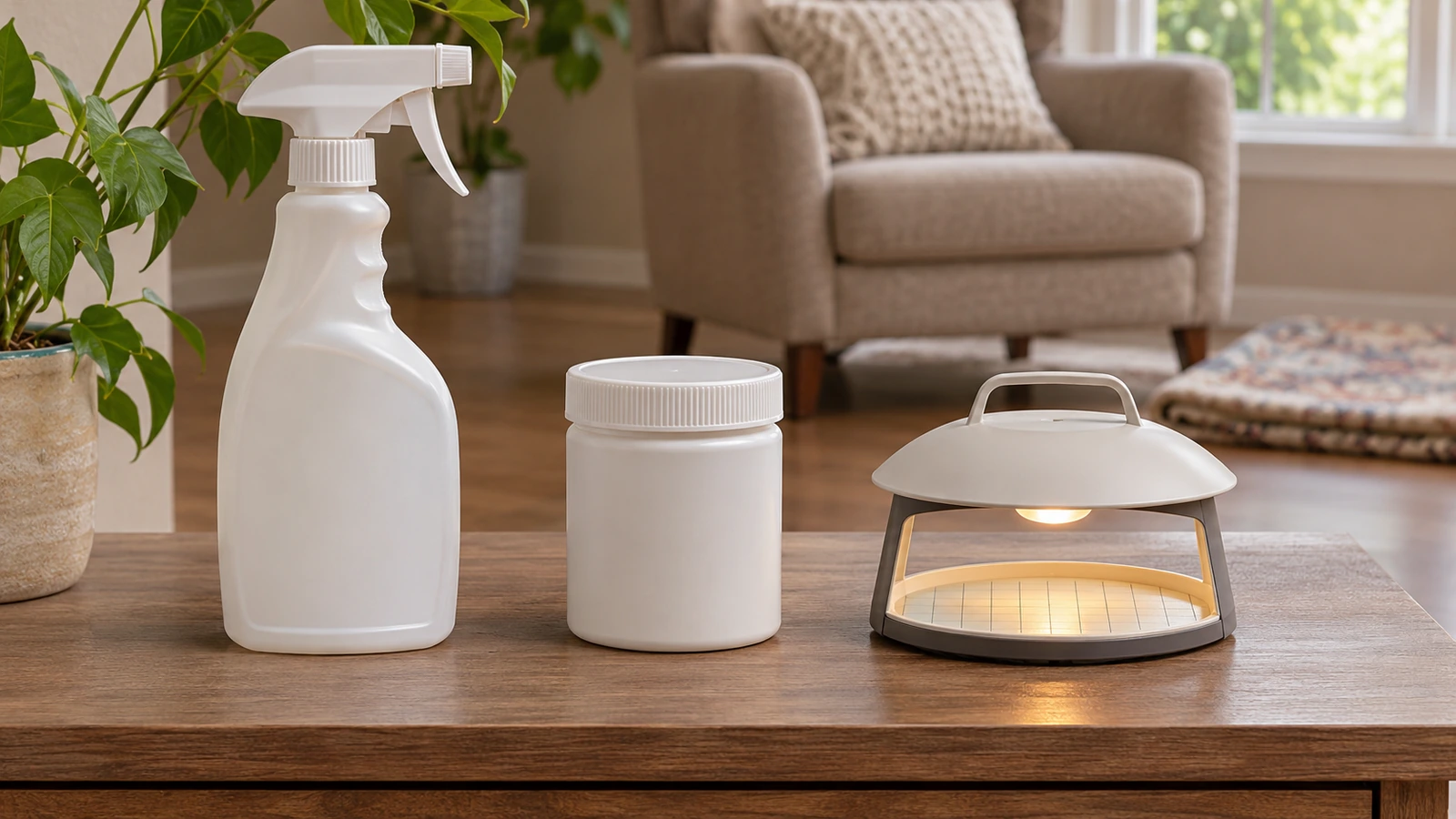
You can kill the fleas jumping across your carpet and still find new ones days later. That is what makes choosing a flea killer for home use more complicated than picking the spray with the strongest promise on its label.
Some treatments act mainly on exposed adult fleas. Others interrupt the development of eggs and larvae. A few combine both approaches, while foggers, powders, and traps have very different uses and limitations.
The best choice depends on where fleas are developing, which life stages need attention, and which surfaces a product is actually labeled to treat.
How Should You Compare Indoor Flea Treatments?
Start with the problem you have actually identified. If you are unsure whether the jumping insect is a flea, compare it with our guide to what fleas look like before buying a treatment.
Next, locate the activity. Flea eggs commonly fall from an animal into its surroundings, and larvae develop in sheltered areas where suitable food and conditions exist. Carpets beneath furniture, rugs, and places where pets regularly rest can become important treatment locations.

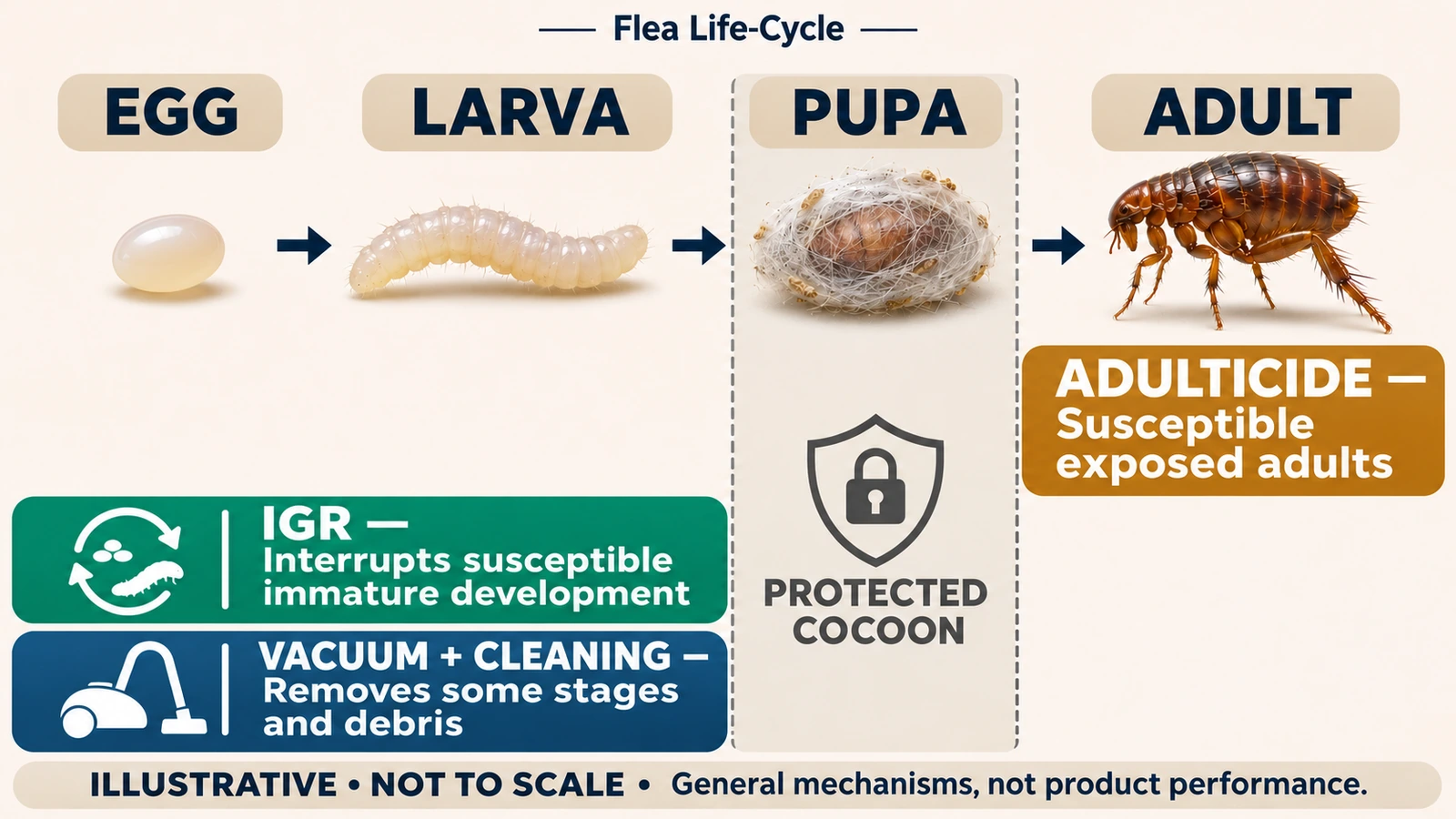
The visible adults are only one part of the problem. The flea life cycle includes eggs, larvae, protected pupae, and adults. These stages respond differently to insecticides and environmental cleaning.
When evaluating a product, use these criteria:
- Target stages: Does the formulation address exposed adult fleas, immature development, or both?
- Permitted surfaces: Does the current label specifically allow the intended indoor site, such as carpet, an appropriate upholstery fabric, or a particular crack or crevice?
- Exposure restrictions: What does the label require concerning children, pets, food areas, ventilation, drying, and reentry?
- Treatment and follow-up: Is the product designed for direct application to identified areas, and what does its label say about coverage, cleaning, and any repeat application?
For registered pesticide products, check the EPA registration number and current product label rather than relying on advertising claims alone. Product availability and additional restrictions can vary by state.
A useful comparison separates the treatment mechanism from the application format. Two aerosol cans can contain different active ingredients, while a pump spray and a handheld aerosol may perform similar functions when their formulations and approved uses are comparable.
The table below compares the main options by what they can realistically contribute.
| Product type | Better suited to | Main limitation | What to verify |
|---|---|---|---|
| Adulticide + IGR surface spray | Confirmed activity in permitted indoor flea-development areas | Protected pupae can still produce emerging adults | Fleas, indoor surfaces, active ingredients, and application directions |
| Adulticide-only spray | Reducing susceptible exposed adult fleas in a labeled location | Limited control of continuing development when immature stages are not addressed | Contact or residual claims, permitted surfaces, and reapplication rules |
| IGR-only product | Interrupting susceptible immature-stage development | No rapid adult knockdown | Indoor flea use, formulation, and intended treatment sites |
| Insecticidal powder or dust | Specific labeled locations where contact with the material is plausible | Airborne dust, exposure, and limited suitable placement | Indoor registration or exemption status, site restrictions, and precautions |
| Total-release fogger | Particular applications expressly allowed by its label | Less targeted coverage and additional exposure or fire hazards | Room-volume directions, evacuation, ventilation, and safety requirements |
| Flea trap | Detecting adult activity and monitoring changes | Limited population control and no direct immature-stage treatment | Trap placement, capture method, and monitoring purpose |
The Trade-Offs That Matter More Than the Product Name
The main advantage of a combined adulticide-and-IGR treatment is that it addresses two different parts of a flea problem. The adulticide targets susceptible exposed fleas while the IGR helps prevent immature fleas from completing development.
However, pupae inside cocoons are relatively protected from many environmental treatments. Adults may continue emerging after a properly applied product has begun working. A fresh sighting therefore needs to be interpreted alongside the treatment timing, label instructions, and other evidence rather than triggering an automatic second application.
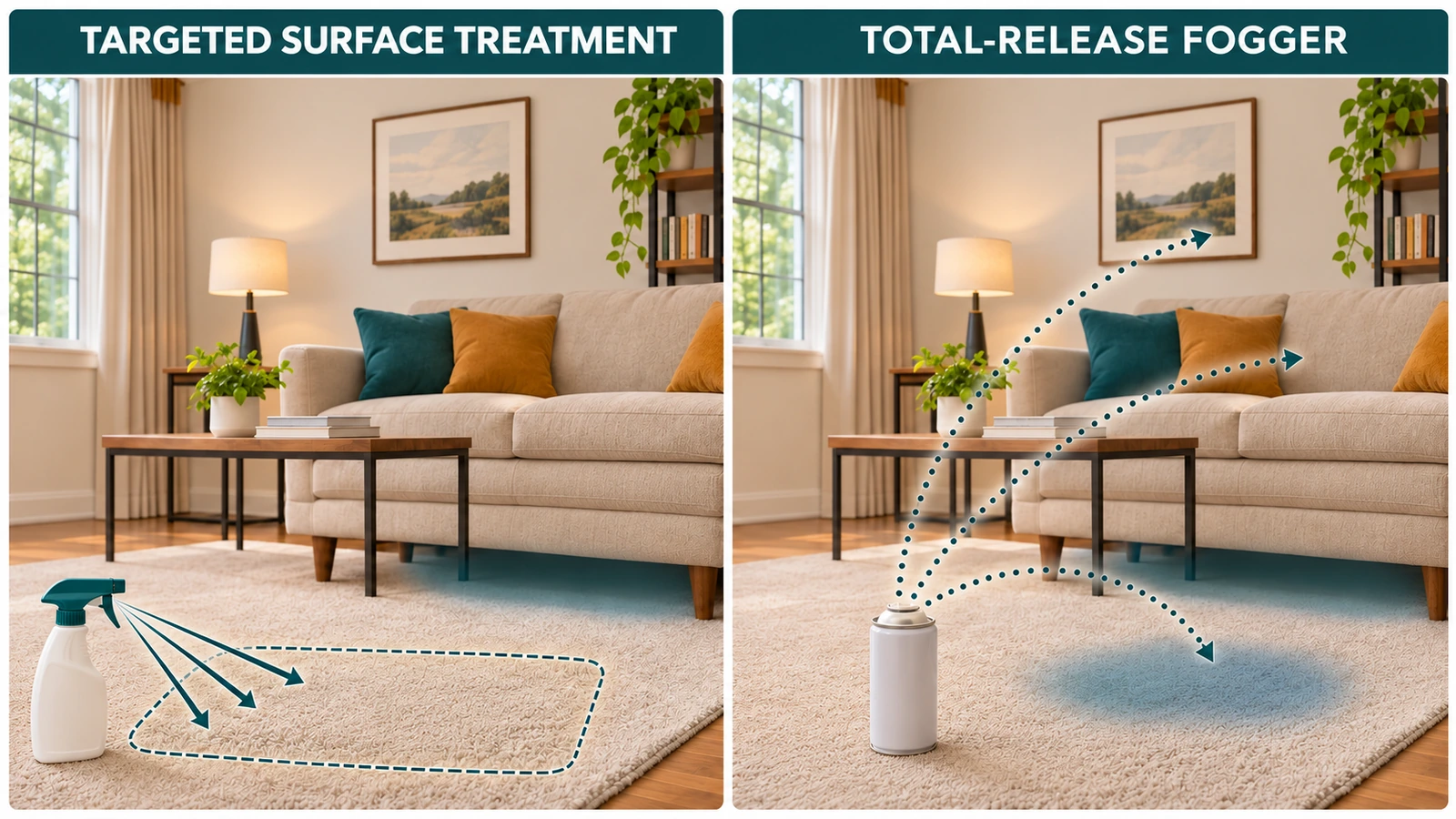
Handheld Sprays Versus Room Foggers
A handheld spray allows treatment to be directed toward specific sites where fleas develop, provided those locations appear on the product label.
A fogger disperses insecticide through the room, but that airborne distribution may miss the protected locations where larvae and pupae are concentrated. It can also expose surfaces that were never intended to be the focus of treatment.
The safety requirements are substantially different as well. Foggers can require evacuation, control of ignition sources, and ventilation before reentry.
For a fuller evaluation of their benefits, limitations, and safety, see Do Flea Bombs Work?.
Residual Activity Versus Immediate Knockdown
An insecticide that kills fleas on contact may provide visible short-term results. A formulation with residual activity can continue affecting susceptible insects that contact treated surfaces during the period supported by its labeling.
Neither description establishes how well the product will perform on every surface. Carpet fibers, dirt, application conditions, and differences in flea susceptibility can all matter.
A fast-acting claim should not be confused with broad life-cycle control. Likewise, a long residual claim does not make an unsuitable surface or unauthorized application acceptable.
Chemical Exposure Versus Targeted Treatment
The potential for human and animal exposure is part of the choice, not an afterthought.
For a small confirmed problem concentrated around a pet’s resting area, treating the whole house may add pesticide exposure without improving coverage of the important locations.
Dust formulations add the particular concern of airborne particles. Products containing essential oils are not automatically safer or more effective because they are marketed as natural, and some oils can be harmful to pets.
Prefer a product whose approved use closely matches the actual problem rather than selecting the broadest application method available.
Choose by the Labeled Surface
A suitable indoor flea killer must match both the pest and the location. A product labeled for carpet cannot automatically be used on a mattress, upholstered chair, pet bedding, or animal. The site-specific directions are more useful than a general claim of killing fleas throughout the home.
What to Watch For
Household insecticides and flea treatments intended for animals are different product categories. Never apply an environmental pesticide directly to a pet. For animals that may be maintaining the flea population, arrange appropriate on-animal control with a veterinarian and follow the animal product’s specific instructions.
Which Flea Killer Makes Sense for Your Home?
There is no single best flea killer for every indoor situation. The decision becomes clearer when you match the product’s mechanism to the actual location and stage of the problem.
Match the Treatment to the Situation
Fleas repeatedly appear near carpets or pet resting areas. A labeled, targeted indoor surface treatment combining an adulticide and IGR is often a useful option when the infestation has been confirmed and environmental pesticide treatment is warranted. It should accompany cleaning and appropriate control of fleas on animal hosts.
You mainly need to reduce exposed adult fleas in a small area. An adulticide-only product may provide a limited response when its label permits the intended site. If flea activity is recurring, also consider how immature stages are being addressed before assuming that adult knockdown is enough.
You want to interrupt development of immature fleas. An IGR-containing formulation may help where eggs and larvae are developing. An IGR-only product is a poor match if your immediate objective is to kill the adult fleas currently being encountered.
You have occasional suspected fleas but no confirmed indoor source. Identify the insect and check where activity is occurring before purchasing more pesticides. Our guide to signs of a flea infestation in your home can help distinguish a recurring household problem from an isolated observation.
You want to know whether treatment is reducing activity. Use appropriate monitoring rather than treating traps as a replacement for source control. For their strengths and limitations, see our guide to flea traps.
When Cleaning and a Suitable Surface Treatment Work Together
Vacuuming areas where fleas develop removes insects and organic material, including food used by larvae. Laundering washable bedding and textiles helps address parts of the environment that may not need pesticide treatment. Follow any product-specific cleaning restrictions for treated surfaces.
Where a confirmed infestation justifies chemical treatment, a properly labeled adulticide-and-IGR formulation can complement these nonchemical measures by targeting exposed adults and susceptible immature development. If animals are present, controlling fleas on the hosts is a separate but essential part of the overall plan. There is no need to mix pesticide products or add extra treatments without label authorization.
Buying Mistakes That Can Waste Money or Increase Risk
A useful product comparison should eliminate unsuitable choices before considering brand claims, package size, or promotional language.
Avoid these common mistakes:
- Buying an outdoor or pet-only product for indoor surfaces. Check the entire label for the correct pest and application site. The words “flea killer” alone are insufficient.
- Assuming every spray contains an IGR. Read the active ingredients and intended function. Adulticide-only and combination sprays serve different treatment goals.
- Treating “natural” or “food grade” as a safety guarantee. The relevant questions are whether the product is authorized for that use and what exposure precautions apply.
- Reapplying as soon as another flea appears. Adults can emerge from protected pupae after treatment. Follow the product’s response period and reapplication instructions rather than increasing exposure through repeated unscheduled applications.
- Selecting by claimed room coverage instead of actual hiding places. A product that disperses widely may be less useful than a targeted method reaching the relevant, label-permitted surfaces.
The strongest purchasing decision is often the one that avoids an unnecessary product or rules out a formulation that cannot address the problem you have.
Explore this topic further: