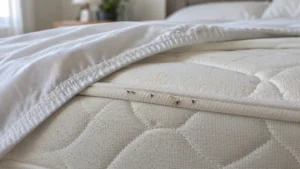
Identification
Bedbug eggs: what they look like and where to find them
Tiny white particles in bedding can be difficult to identify. Learn the features of bed bug eggs, where they are usually attached, and which additional signs make a finding more meaningful.

A few tiny white specks along a mattress seam can be surprisingly difficult to identify. Fabric fibers, dried debris, empty insect shells, and bed bug eggs can look similar until you examine their shape and surroundings.
The important details are small: an egg’s outline, whether it is attached to a surface, and what else is hiding nearby. A closer inspection can tell you whether those specks deserve attention or are more likely ordinary household debris.
What Do Bedbug Eggs Look Like Up Close?
Bed bug eggs are tiny, elongated ovals, about 1/25 inch (1 mm) long. They are usually pearly white to translucent, with a smooth surface and a slightly rounded or curved outline. At one end is a small cap, which becomes easier to distinguish under magnification. Unlike a grain of rice, a bed bug egg is barely more than a visible speck at normal viewing distance.
Female bed bugs attach their eggs to surfaces with a glue-like substance. You may find a single egg or several close together, tucked against stitching, wood, or another sheltered surface. The eggs have no legs or body segments, and their pale color can make them especially difficult to see against light fabric.

Identification in 30 Seconds
- Size: about 1/25 inch (1 mm) long, much smaller than a grain of rice.
- Shape: smooth, elongated, capsule-like, with a rounded end and a tiny cap at the other.
- Color: pearly white to translucent, sometimes difficult to distinguish from light-colored surroundings.
- Position: commonly attached to a protected seam, crack, or furniture surface, singly or in small groups.
After hatching, the empty eggshell can remain attached. Under magnification, it may look more transparent and show an opening where the cap came off. An intact-looking egg may still contain a developing bed bug, but its color or apparent dryness alone cannot establish whether it is viable.
Where to Look for Bedbug Eggs on a Mattress and Bed Frame

Start where you found the suspicious particles, then examine the protected edges nearby. Use a bright flashlight directed along the surface rather than only from above. A magnifying glass or close-up camera lens makes it easier to separate smooth egg-shaped objects from loose fibers.
On a mattress, focus on piping, stitched seams, corners, labels, and fabric folds, including the underside. Then check the adjoining box spring or foundation, frame joints, slats, screw holes, and the back of the headboard. Bed bugs often hide in narrow gaps rather than remaining on the exposed sleeping surface. Eggs can also occur in crevices of nearby upholstered furniture where people regularly rest.
If you find something suspicious, photograph it sharply before disturbing the area. Include part of the seam or surrounding surface, and a size reference when practical. A heavily zoomed image of an isolated white dot can be misleading. If you can safely preserve an identifiable specimen in a small sealed container, it may help with identification; otherwise, record its exact location. While checking, look for live insects, pale shed skins, or dark spotting close to the suspected eggs.
Identification Mistakes
- Assuming every white speck caught in mattress stitching is an egg.
- Judging a tiny particle’s size from a magnified photograph with no scale.
- Treating an empty eggshell as though it still contains a developing bed bug.
Key Clue
A smooth, egg-shaped object about 1 mm long that remains attached to a sheltered surface deserves a closer look, especially when other recognizable bed bug evidence is present nearby.
What to Watch For
Damage, crushing, and poor lighting can obscure the shape and cap of a tiny egg. If those features cannot be examined clearly, identify the object through additional evidence rather than guessing from color alone.
Is It an Egg, an Empty Shell, or Something Else?
An intact-looking bed bug egg has a smooth, pale, capsule-like shape. A hatched eggshell retains much of that outline but is hollow, often more transparent, and open at one end. The opening may be difficult to see without magnification.
A shed bed bug skin is different. It retains the outline of an insect, including legs and a segmented body, rather than resembling a tiny capsule. Fabric pills, lint, skin flakes, and other household particles can also create convincing lookalikes in photographs, particularly when they are caught in stitching.
What About Dried Bed Bug Eggs?
People sometimes describe flattened, yellowed, or hollow-looking particles as “dried eggs.” That description alone is not a reliable indication of what happened to an egg. An empty shell may be left after hatching, while an intact-looking egg can be nonviable. Neither appearance provides a dependable date of when the egg was laid.
The surrounding evidence helps resolve the uncertainty. Several similarly shaped objects attached within a protected crevice deserve more attention than scattered loose particles on an exposed sheet. Dark stains found nearby may provide another clue, but they need their own identification. See how to recognize bed bug droppings and fecal stains without confusing every dark mark with insect activity.
The table below connects the object’s appearance with the next useful check.
| What you found | What it may be | What to check |
|---|---|---|
| Smooth, pale, elongated capsule around 1 mm long, attached to a seam or crack | Possible bed bug egg | Examine its outline and cap under magnification; look for additional physical evidence nearby |
| Hollow, translucent capsule with an opening at one end | Hatched bed bug eggshell | Look for live bed bugs or other evidence of continuing activity |
| Pale or tan insect-shaped husk with legs and a segmented abdomen | Shed insect skin, possibly from a bed bug | Compare the body shape with recognizable bed bug shed skins |
| Irregular white fibers, flakes, or loose particles without a consistent capsule shape | Lint, fabric pilling, or other debris | Examine the material closely and check the surrounding area before attributing it to bed bugs |
If the particle is damaged or too small to resolve clearly, document where it was found and look for another recognizable sign. Repeated guesses from the same blurry photograph will not improve the identification.

What Does Finding Bedbug Eggs Mean?
A positively identified bed bug egg means an egg was laid at that location. An intact-looking egg might still hatch, whereas an opened, empty shell indicates that hatching occurred. Neither finding by itself tells you how many bed bugs are present, when the activity began, or how extensive it is.
Under favorable indoor conditions, bed bug eggs commonly hatch in about 6 to 10 days. Temperature affects development, and cooler conditions can extend that interval. Newly hatched nymphs are very small and pale, so they may also be missed in a quick inspection. This is why an egg finding deserves follow-up even when no moving insect is immediately visible.

The surrounding evidence helps determine the next step:
- One questionable white speck on exposed bedding, without other signs: inspect it more closely and check the nearby seams before drawing a conclusion.
- Several attached egg-shaped objects with suspicious dark spots or shed skins nearby: examine the adjacent hiding places carefully, since the combination of signs raises concern.
- Recognizable live bed bugs found alongside eggs or shells: current bed bug activity is established, and a broader assessment is needed.
Empty eggshells can remain after earlier activity, including after a successful treatment. Their presence should be considered alongside fresh evidence, not used as a measure of infestation severity.