Identification
Springtail vs. flea: how to tell which one you found
Springtails and fleas are both tiny jumpers, but they belong to very different environments. This guide helps you compare their body shapes, behavior and the places where you found them, then make a more confident identification before deciding what to do.

A tiny dark bug jumps across your bathroom floor. You know fleas jump, so that’s your first thought. But the insect is close to a damp windowsill, and there are several more beside a plant pot. Could they be springtails instead?
Both can look like moving specks to the naked eye. The useful differences appear when you examine their body shape, check where they gather and look for evidence of an animal host. Those clues can save you from treating a moisture-related nuisance as a flea infestation.
What do springtails and fleas actually look like?
Adult fleas are small, wingless insects, generally about 1/16 to 1/8 inch long (roughly 1.5 to 3 mm). They are usually reddish-brown to dark brown, with hard bodies flattened from side to side and enlarged hind legs. Viewed from above, a flea can look unusually narrow; from the side, its body has a taller, curved outline.
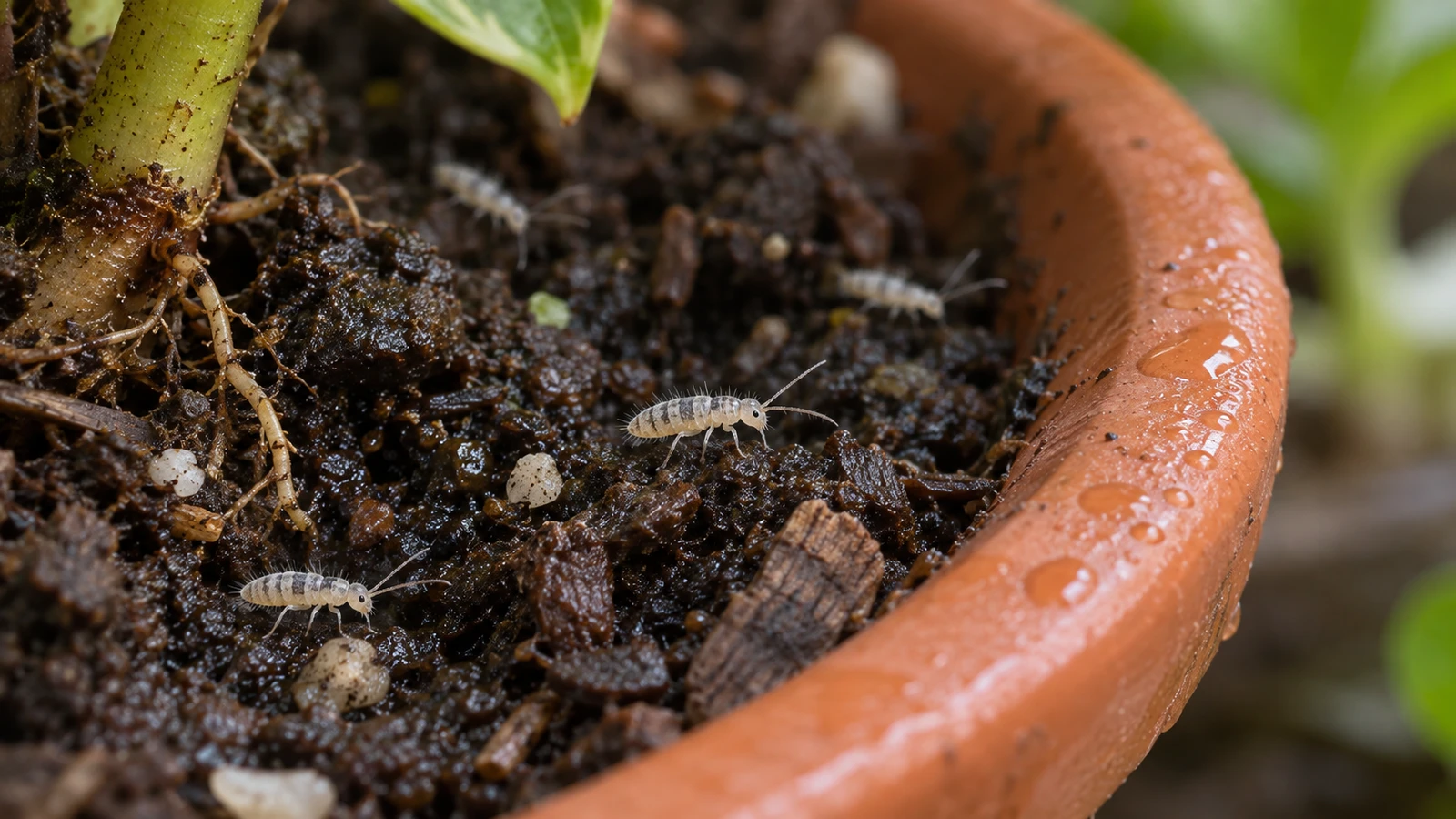
Springtails are tiny, wingless arthropods that commonly measure around 1/16 to 1/8 inch, although their size varies by species. Some have long, slender bodies, while others are rounded. They may be white, gray, brown or nearly black, and their antennae can be noticeable in a clear close-up.

Identification in 30 Seconds
- Body shape: An adult flea is flattened from side to side, with powerful rear legs. A springtail may be elongated or rounded, often with more obvious antennae.
- Jumping: Fleas jump using their hind legs. Most jumping springtails launch themselves with a forked structure folded beneath the abdomen.
- Host: Adult fleas feed on the blood of animals. Springtails do not bite or live as parasites on people or pets.
- Habitat: Pet fur and animal resting spots favor the flea hypothesis. Damp soil, plant saucers and wet surfaces favor springtails.
- Size: Both can be only a few millimeters long. A small, dark jumping speck is not enough to distinguish them.
The springtail’s jumping structure is called a furcula. It is usually tucked beneath the abdomen and may be invisible in an ordinary photograph. Some springtail species lack a functional jumping organ altogether, so you should not require a visible furcula to recognize every springtail.
A flea’s enlarged hind legs and compressed body are often easier to distinguish in a sharp side-view image. If you want a closer look at flea anatomy, see our guide to what adult fleas look like.
How to check whether you found a flea or a springtail
Start with one intact specimen and the place where you found it. A clear photograph taken against a contrasting background can be more useful than repeatedly trying to watch the insect jump. Include a ruler or another reliable size reference if practical.
Next, investigate the likely source. Springtails tend to gather where moisture and organic material are available. Fleas are more closely associated with animals and the places where those animals spend time. Neither pattern is absolute, but each suggests a different place to look.
Use these checks in order:
- Examine the body, not just the jump. Photograph the insect from the side and above if possible. A hand lens or a sharp, enlarged photograph may reveal the flea’s compressed outline and strong hind legs, or a springtail’s antennae and body shape.
- Recheck the damp location. Look around plant saucers, moist potting soil, sink edges, bathroom floors and windows where condensation collects. Several similar organisms concentrated around these areas support the springtail hypothesis.
- Check for evidence on an animal. If you have a dog or cat, gently use a fine-toothed flea comb over a white towel, provided the animal tolerates it. A live flea in the coat is direct evidence. Dark particles may also justify checking for flea dirt, but ordinary debris can look similar.
Do not try to force an insect to jump or crush it to identify it. If it disappears too quickly for a clear photograph, observe where similar insects reappear and record that location.
A quick inspection that finds no fleas on a pet is reassuring, but it does not settle the question. Small numbers can be difficult to detect, and some homes have fleas associated with visiting animals or wildlife rather than resident pets.
Identification Mistakes
- Calling every jumping black speck a flea without checking its body.
- Treating itchy skin marks as proof that the nearby insect is biting.
- Assuming that every dark organism in damp soil is a springtail without examining an intact specimen.
Key Clue
A live, side-flattened flea recovered from an animal’s coat is strong evidence of fleas. Repeated clusters of tiny, antenna-bearing arthropods on damp plant soil or wet surfaces point much more strongly toward springtails.
What to Watch For
You may be seeing two separate problems. Springtails around a damp window do not rule out fleas on a pet elsewhere in the home. Keep specimens and observations from different locations separate.
How to interpret the clues when they don’t all agree
Start by giving the greatest weight to the insect itself. A recognizable adult flea has a distinctive body shape and enlarged jumping legs. A springtail has a different body plan, often with visible antennae, and typically uses a springing mechanism rather than enlarged hind legs.
Location then helps refine the conclusion. Several organisms jumping around wet potting soil, especially when activity is concentrated in the same damp area, are more consistent with springtails. A confirmed flea in pet fur, or repeated adult fleas around an animal’s resting place, favors the flea explanation.
Skin reactions deserve separate treatment. Springtails do not bite humans or pets. Adult fleas can bite, but the appearance, number or arrangement of itchy spots does not identify the insect responsible. A person can have skin irritation and encounter harmless springtails at the same time.
If the specimen does not match either organism, keep the identification open. A clear sample is more useful than choosing between two possibilities simply because both are known to jump.
The following matrix brings together the clues that are most useful once you have narrowed your possibilities to fleas and springtails.
| Feature | Flea | Springtail |
|---|---|---|
| Typical visible size | Adult commonly about 1/16 to 1/8 inch (1.5 to 3 mm) | Many common species around 1/16 to 1/8 inch; considerable variation |
| Body shape | Hard, flattened from side to side; enlarged hind legs | Often elongated or rounded; antennae usually apparent with magnification |
| How it jumps | Pushes off using powerful hind legs | Most jumping species snap a furcula folded beneath the abdomen |
| Relationship with a host | Adult feeds on animal blood; may be found in fur | No blood-feeding host; does not parasitize people or pets |
| Common indoor setting | Animal resting areas, rugs, carpets and nearby floor edges | Damp plant soil, sinks, bathrooms, wet basements and condensation areas |
| Skin marks | Can bite, but skin marks alone cannot identify fleas | Does not bite; nearby skin irritation requires another explanation |
| Best additional evidence | Recognizable adult flea or direct flea evidence on an animal | Intact specimen with matching anatomy and repeated activity around moisture |

What does the pattern of sightings tell you?
Finding one adult flea confirms that a flea was present at that location. It does not, by itself, establish the size or extent of an infestation. Repeated sightings around a pet, its resting places or several nearby floor areas deserve a more systematic assessment.
Finding a cluster of springtails near a wet window or plant saucer points to a different issue. These organisms feed mainly on fungi, algae and decomposing organic material. Repeated sightings can indicate conditions that favor them, especially persistent moisture, rather than an animal parasite problem.

If flea evidence is increasing or appearing in several locations, use our guide to signs of a flea infestation in your home to evaluate the wider pattern.
For suspected springtails, pay attention to where they return after ordinary cleaning. Check condensation, damp potting soil, plumbing leaks and persistently wet surfaces. Moisture may be coming from nearby, so the exact spot where you first noticed an insect is not necessarily where it developed.
A home without pets can still encounter fleas through wildlife, visiting animals or previous occupants. Conversely, the presence of a dog or cat does not turn every jumping insect in the house into a flea.
Good to Know
Springtails found in a sink or bathtub are not necessarily coming from inside the drain. They may have entered from nearby damp soil or gaps and collected on a wet surface. Check the surrounding moisture conditions before assuming the plumbing itself is their source.