Identification
How to check a hotel room for bed bugs: signs to look for
Before you unpack at a hotel, a focused inspection can help you spot bed bugs or signs of their presence. Learn where to look, which marks are worth investigating, and how to decide whether a room is safe enough to use or needs further attention.

By


A clean hotel room can still have bed bugs. These insects hide in narrow spaces around beds and furniture, so freshly changed sheets and spotless surfaces don’t tell you much about what may be concealed nearby.
You don’t need to dismantle the bed or search every corner of the room. The most useful check concentrates on accessible hiding places close to where guests sleep. Finding an identifiable insect or several matching traces can justify immediate action; finding nothing is reassuring, but it cannot guarantee that the room is bed bug-free.
What Do Bed Bugs and Their Traces Look Like?
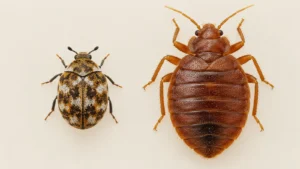
Adult bed bugs are wingless, flattened, oval insects, usually reddish-brown and about 3/16–1/4 inch (5–7 mm) long, roughly the size of an apple seed. After feeding, their bodies become more swollen and reddish. Young bed bugs, called nymphs, are smaller and often pale or nearly translucent, making them harder to notice against light-colored bedding.
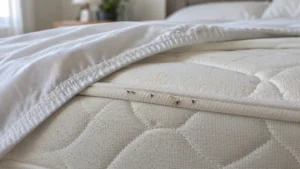
You might also find dark fecal spots, translucent shed skins, or tiny whitish eggs attached to sheltered surfaces. Bed bug eggs are approximately 1 mm long, so isolated eggs can be difficult to recognize without magnification. These traces are most meaningful when they appear together in likely hiding places.
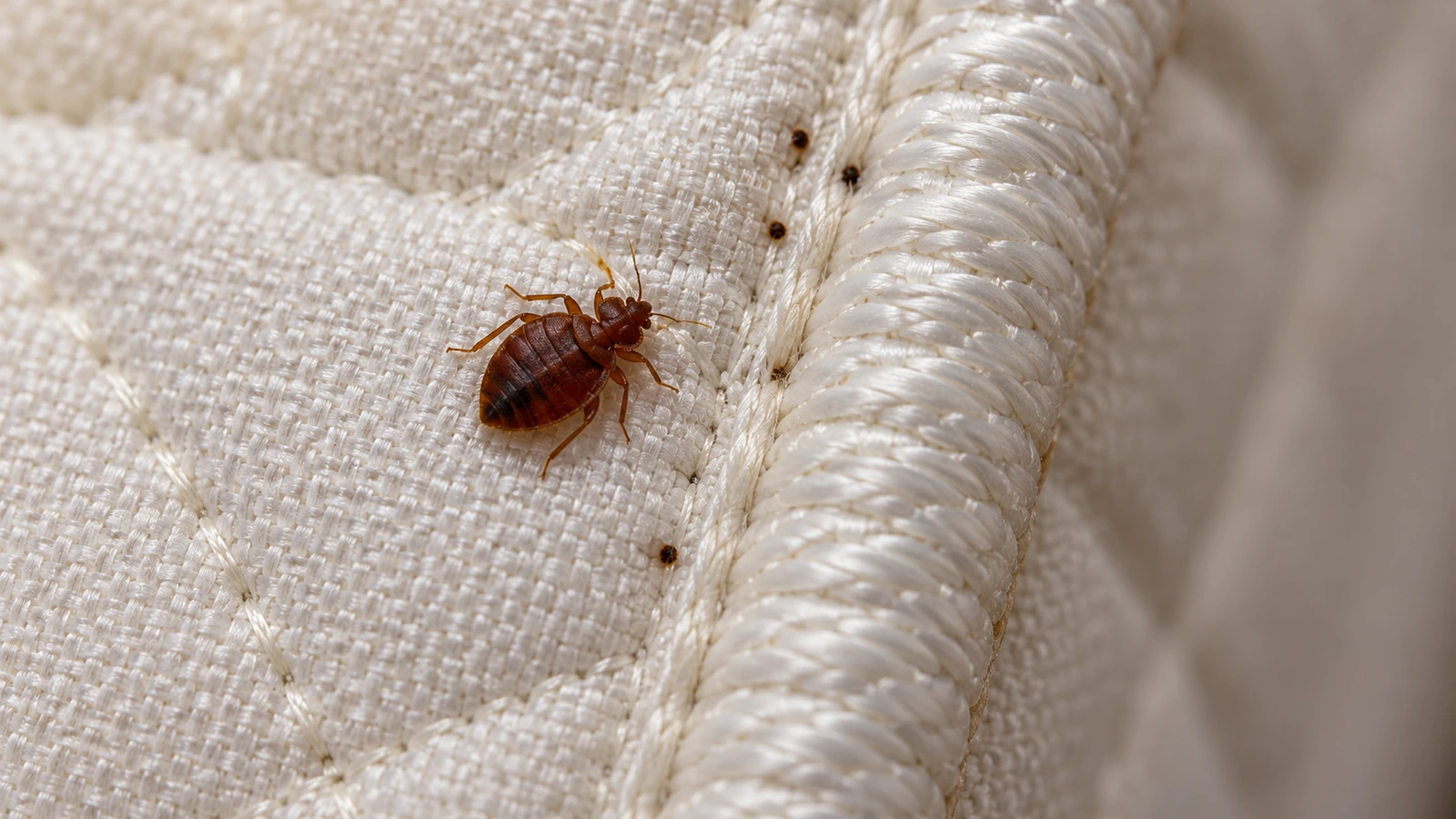
Dark fecal spots often resemble small black ink marks and may soak into fabric. However, a single dark dot could be dirt, ink, mildew, or another type of stain. Rusty or reddish marks on sheets can also have several explanations.
If dark marks are your main concern, compare their appearance and location with bed bug droppings and fecal stains.
The insect itself can be confused with other small household pests. Carpet beetle larvae, for example, have a noticeably hairy or bristly appearance, unlike the smoother, flattened body of a bed bug. Small adult beetles may also be mistaken for bed bugs at a glance.
If you find an unfamiliar insect, the comparison between a carpet beetle and a bed bug can help you avoid identifying the wrong pest.
A blurry phone photograph may not reveal enough detail for a reliable identification. When possible, observe the insect’s body shape, legs, and size before drawing a conclusion.
Where to Check for Bed Bugs in a Hotel Room

Keep your suitcase closed and away from the bed while you inspect. A clean, dry bathtub can be a practical temporary location, if available. Otherwise, choose a smooth, hard surface away from upholstered furniture. Don’t assume an unchecked luggage rack is free of insects.
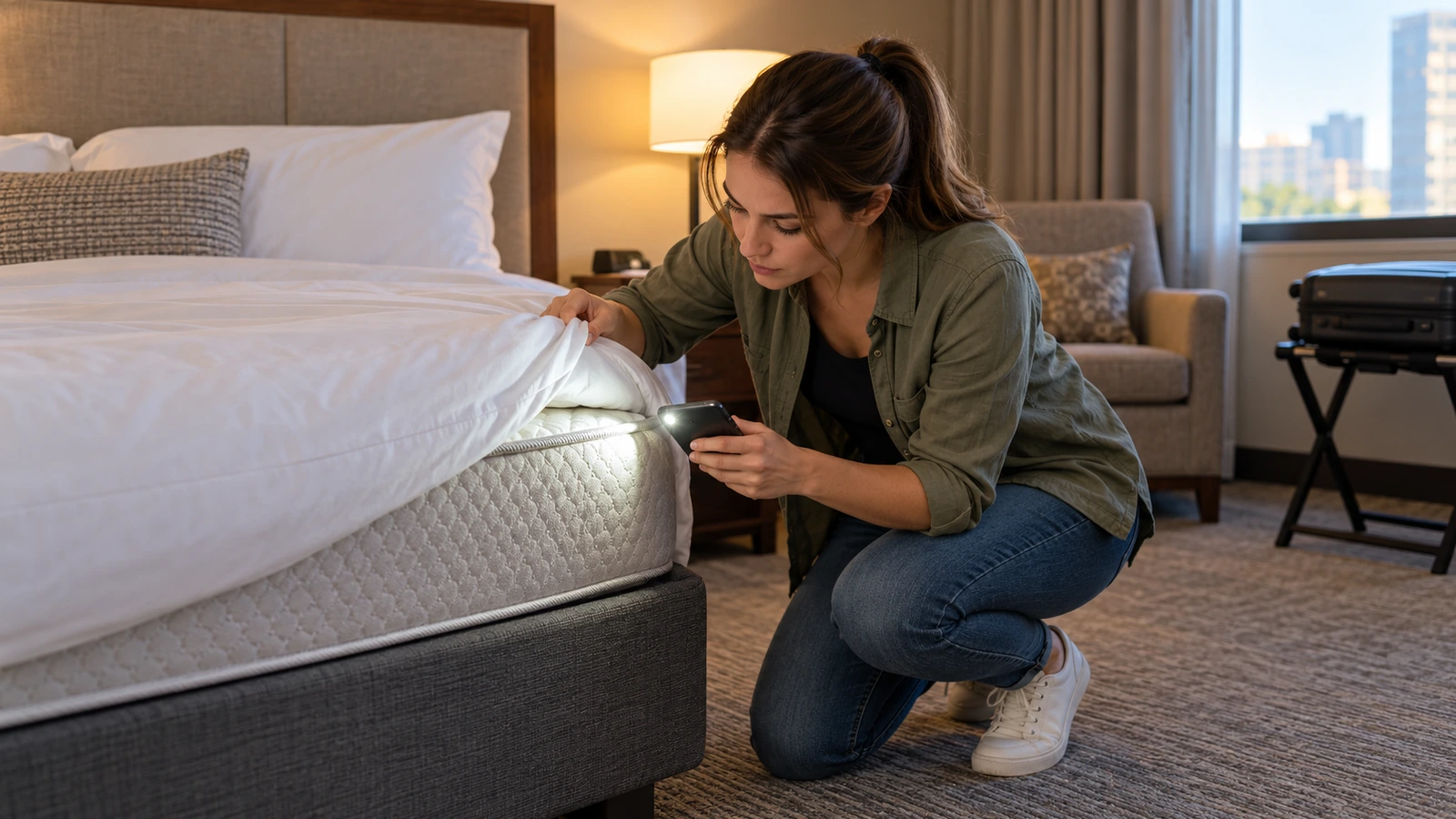
Use your phone’s flashlight or a small flashlight to examine accessible surfaces around the sleeping area. Concentrate on mattress seams, the headboard, bed-frame joints, and nearby furniture rather than starting with distant corners of the room.
The inspection should remain simple and noninvasive. You can move loose bedding and look into accessible gaps, but there’s no need to remove a wall-mounted headboard, open electrical outlets, or dismantle hotel furniture.
If you notice something suspicious, take a clear photograph before disturbing it. A wider image showing the location and a close-up showing the detail are often more useful together than a single heavily zoomed photograph. Include a size reference when practical.
The main places worth checking
Start nearest the pillows and expand only as needed.
- Sheets and mattress seams: Pull back the top bedding and examine the mattress edges, piping, seams, and corners, particularly near the head of the bed. Look for insects, clustered dark spots, or shed skins.
- Box spring or bed base: If visible and accessible, examine exposed seams, fabric edges, and gaps where the mattress meets its support. Don’t lift heavy platform beds or open sealed mattress covers.
- Headboard and bed frame: Shine the light along accessible joints, screw recesses, and narrow gaps, including where the headboard meets the wall. Don’t pry off fixed panels.
- Nearby furniture: Check accessible joints around nightstands and the seams of upholstered chairs close to the bed, especially if you intend to place belongings on them.
- Luggage rack: Before using it, examine the fabric straps, their attachment points, and the joints of the frame. Bed bugs can hide in these narrow areas.
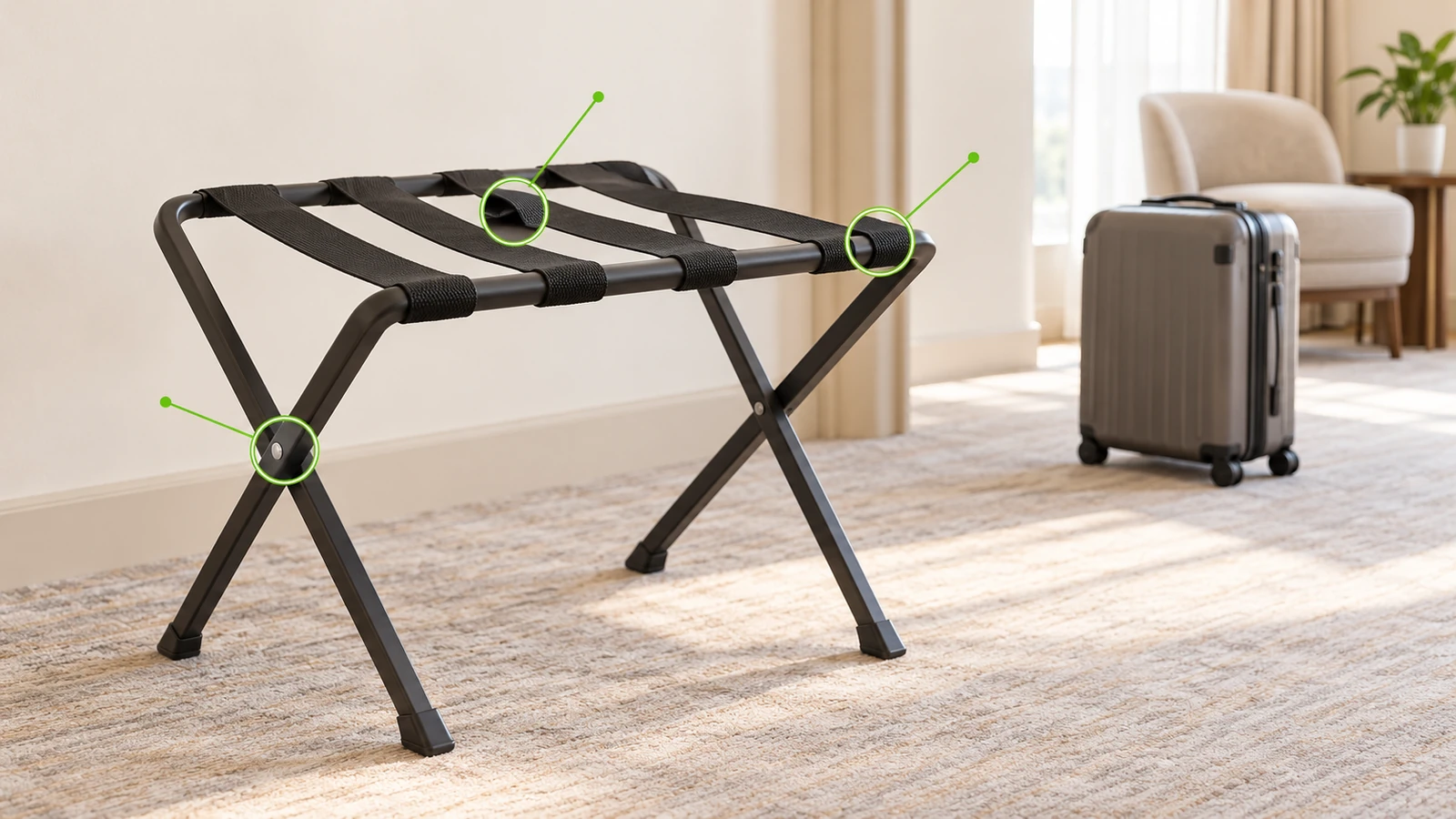
You may find no evidence in any of these locations. That means the inspection found nothing suspicious in the areas you could examine, not that every possible hiding place has been checked.

Identification Mistakes to Avoid
- Treating a single dark spot or reddish stain as definitive evidence of bed bugs.
- Mistaking a carpet beetle larva, lint, or another small insect for a bed bug without checking its features.
- Assuming clean sheets or a spotless hotel room prove that bed bugs are absent.

Key Clue
An identifiable live bed bug found around the bed is stronger evidence than an isolated stain. Clear photographs showing both the insect and its exact location can help establish what was found and support a request for hotel staff to investigate.

Important Caution
A quick visual inspection cannot reveal insects hidden behind fixed headboards, inside furniture, or in other inaccessible spaces. A negative inspection reduces uncertainty in the areas checked, but it cannot certify that the entire room is free of bed bugs.
How to Interpret What You Found
The most important distinction is between a clearly identified bed bug, physical signs compatible with bed bug activity, and marks that could have several explanations.
Finding a live insect that can reliably be identified as a bed bug establishes that a bed bug was present in the room. It does not, by itself, reveal how many insects are present, how long they have been there, or whether a breeding population is established.
Several compatible signs clustered around mattress seams or headboard joints strengthen the evidence of bed bug activity, especially when dark fecal spots appear alongside shed skins or eggs. Some traces can remain after an earlier problem, so check for fresh signs before assessing whether activity is ongoing.
An isolated stain, unidentified insect, or unexplained mark is inconclusive. Inspect nearby areas and seek identification before concluding that bed bugs are present.
Use the following criteria to assess the findings.
| What you found | How strong is the evidence? | What it means |
|---|---|---|
| An identifiable live bed bug | Strong, direct evidence | A bed bug is present or was present when observed; the extent of activity remains unknown. |
| Several compatible fecal spots with shed skins or eggs near the bed | Substantial evidence of bed bug activity | Inspect the areas near the traces and look for recent, repeated signs to assess whether activity continues. |
| One unexplained dark stain or an insect that cannot be identified | Weak or ambiguous evidence | Examine nearby areas and seek identification before concluding that bed bugs are present. |
| No insects or suspicious traces in accessible areas | No evidence detected during the check | The result is reassuring but does not exclude hidden or low-level activity. |
Don’t rely on skin reactions to settle the question. Bites can resemble reactions to mosquitoes, fleas, or other causes, and some people develop no visible reaction to bed bug bites.
How Concerned Should You Be About the Room?
Consider the quality of the evidence, where it was found, and whether different observations support the same explanation. A clearly identifiable insect at a mattress seam warrants more concern than an isolated, unexplained mark on a distant surface. Several matching traces concentrated near the bed also deserve prompt attention.
A closed suitcase kept away from the bed has had less exposure than an open bag resting on upholstered furniture. Use that difference to prioritize a closer inspection of items that contacted the bed or furniture.

If you’ve only just checked in and haven’t unpacked, responding to a suspicious finding is usually simpler: there are fewer belongings to assess and fewer surfaces they may have contacted.
If you’ve already spent the night, a later discovery still deserves investigation. An earlier inspection that found nothing does not cancel out new physical evidence.
Keep the decision tied to what you actually found. You don’t need to assume that every object in the room is contaminated, but you also shouldn’t dismiss an identifiable bed bug simply because the sheets looked clean.

Good to Know
A zippered mattress encasement may be part of a hotel’s preventive bed bug management. Its presence alone does not establish that the room currently has or previously had an infestation. Don’t unzip or remove the cover to inspect inside.
What to Do After Checking the Hotel Room
Your next step depends on whether the inspection found nothing, produced an uncertain observation, or revealed convincing physical evidence.
If you found no suspicious signs
You can proceed with your stay if you’re comfortable with the inspection result.
Keep your suitcase off the bed and upholstered furniture. Use a luggage rack only after checking it, and avoid leaving clothes scattered around the sleeping area.
There’s no need to conduct repeated exhaustive inspections without a new reason. If you later notice an identifiable insect or new physical signs, reassess the situation using that evidence.
If you found an uncertain stain or insect
Take photographs and check the immediately surrounding area for other compatible signs.
A single mark doesn’t justify declaring the room infested, but you can still ask hotel staff to examine it. Explain exactly where it was found and show the photographs rather than relying on a description such as “black spots on the mattress.”
If uncertainty remains significant, requesting another room is a reasonable option. Inspect the replacement room before unpacking.
Avoid moving suspicious objects around the hotel or attempting to treat the room yourself.
If you found a bed bug or several convincing signs
Stop unpacking and keep your belongings away from the suspected area.
Contact the front desk or hotel management promptly. Provide the room number, the location of the finding, photographs, and the approximate time of discovery. If a specimen can be contained safely without handling it directly, it may help with identification, but clear photographs can also be useful.
Ask the hotel to investigate and arrange an appropriate alternative. If another room is offered, request one away from the suspected room where practical, and inspect it before settling in. If a satisfactory alternative isn’t available, consider staying elsewhere.
Don’t apply insecticides, dismantle furniture, or attempt to treat the hotel room.
If clothing or luggage has been in contact with the bed or upholstered furniture, keep potentially exposed items separate where practical until they can be inspected or handled appropriately. The next steps for handling luggage after a hotel stay depend on what was exposed and whether bed bugs were actually found.
Inspect belongings and surfaces that had contact with the bed, upholstered furniture, or other likely harborages first. Use those exposure points to prioritize the next checks.
Learn more:
For broader information about identification, signs of infestation, and control beyond the hotel setting, see Bed Bugs: Identification, Signs, Treatment, and Prevention.