Identification
Carpenter ants in the house: what it means and what to do
A carpenter ant indoors may be a forager from outside or part of activity inside the building. Compare an isolated sighting, recurring trails, and repeated emergence from one gap to decide which non-destructive check comes next.
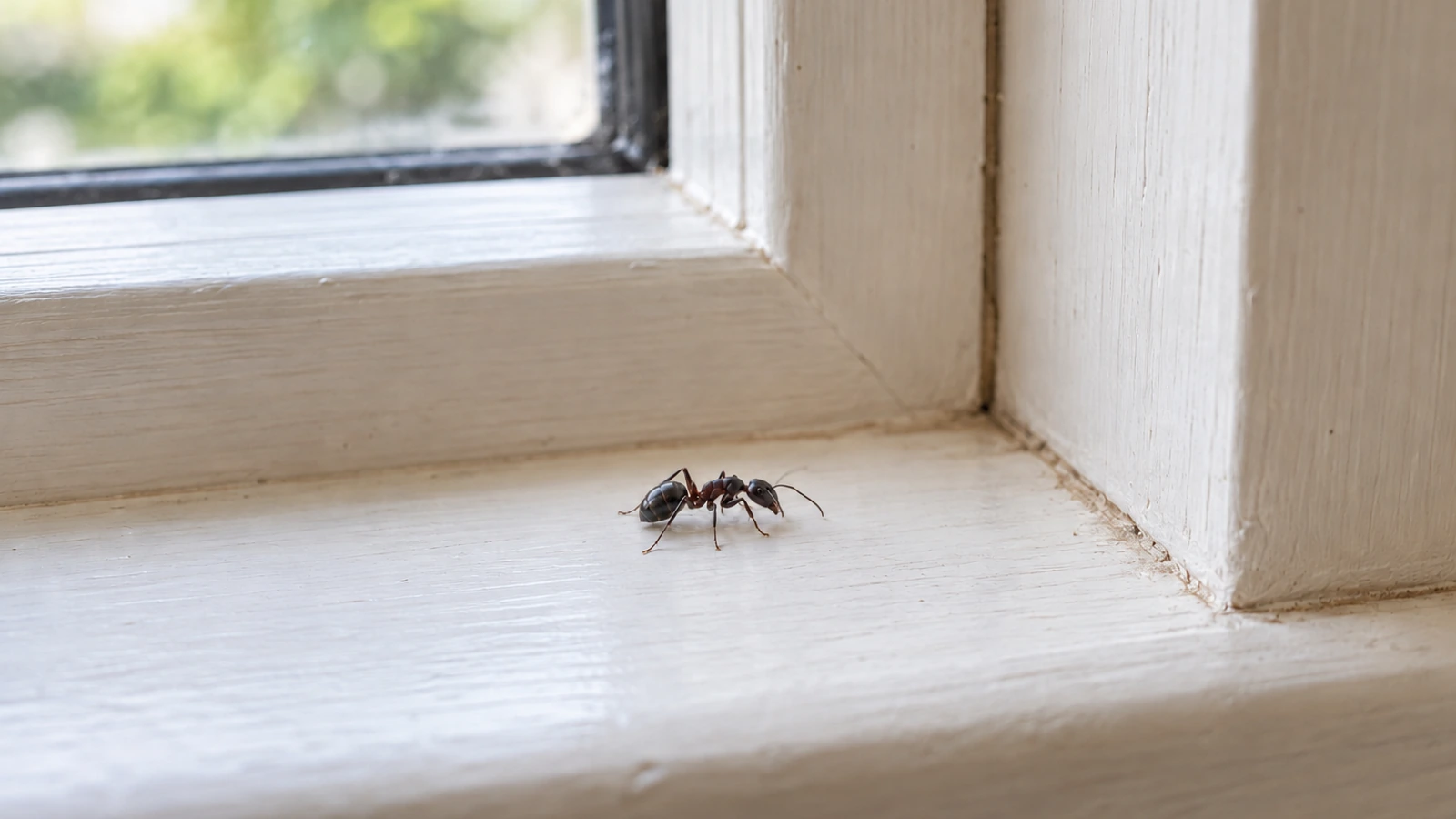
You spot a large black ant crossing the kitchen counter. The next evening, another appears near the same window. Is an outdoor colony sending workers inside, or are ants living somewhere in the house?
Before treating anything, look at where the ants appear, how they move, and whether the same route keeps being used. Those observations will tell you where to check next.
One Worker, a Trail, or Ants Emerging From a Gap?
A carpenter ant inside your home may simply be foraging from a colony outdoors. Workers travel in search of food and water, sometimes crossing through gaps around doors, windows, and utility openings. One sighting, especially when ants are active outdoors, is usually a reason to investigate the entry route rather than assume an indoor nest.
The picture changes when workers repeatedly follow the same indoor path or appear from the same concealed opening. Their direction of travel matters: a crack can be an entrance from outside, a passage through the building, or an opening connected to a hidden nesting area.
Identification in 30 Seconds
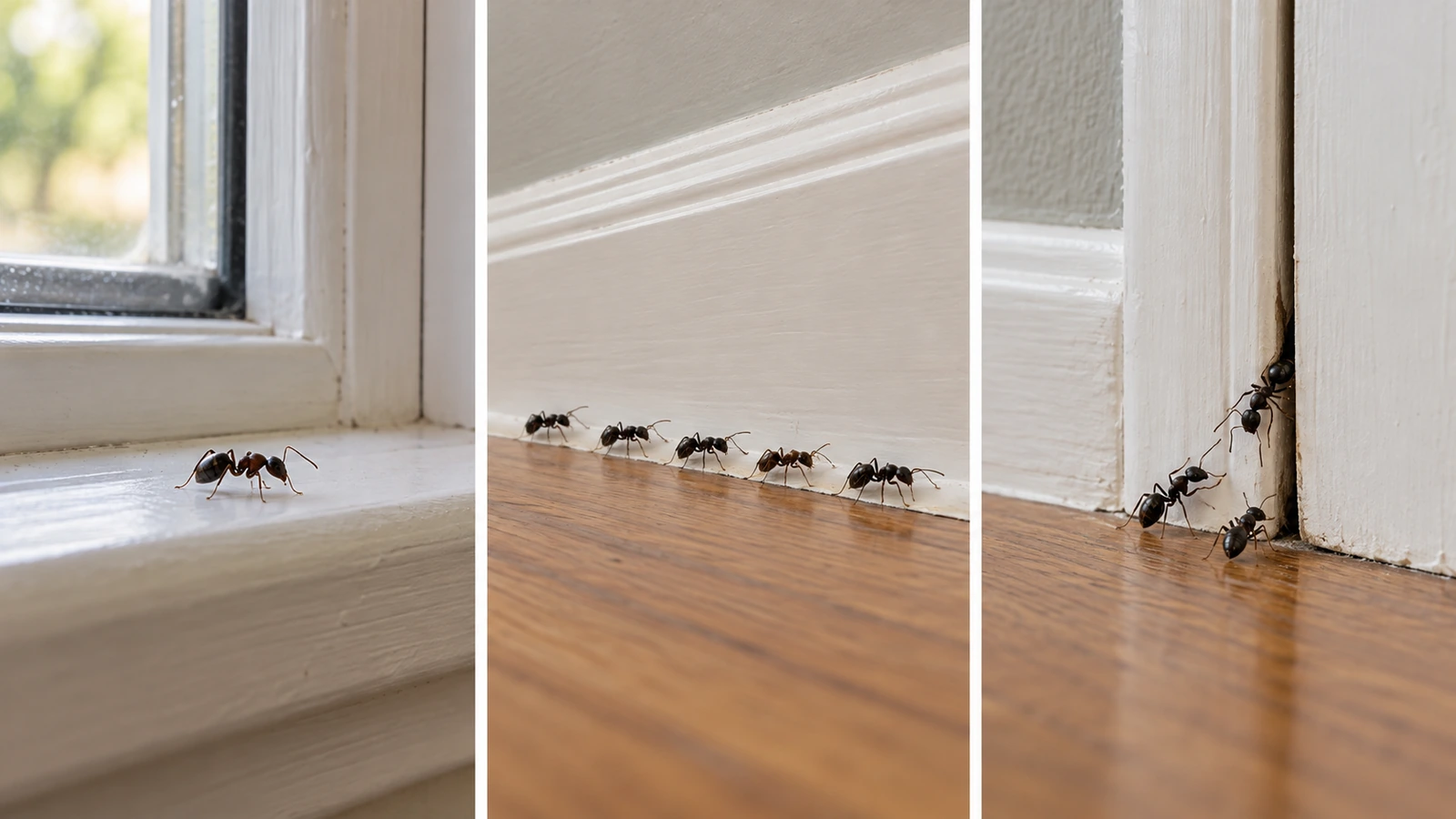
- One large ant near a door or window: Check for an outdoor entry route and watch for another sighting.
- Workers repeatedly using the same edge: Note where they come from, where they go, and whether the route connects outdoors.
- Ants emerging from the same interior seam: Record the exact opening and inspect accessible nearby surfaces for moisture or other activity.
- Only size and color to go on: Confirm the insect before treating the observation as evidence of carpenter ants.
Confirm the insect before interpreting the house
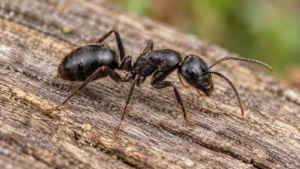
Carpenter ant workers vary in size, and not every carpenter ant is entirely black. Some have reddish-brown body sections. Large black ants in the house may also belong to other species.
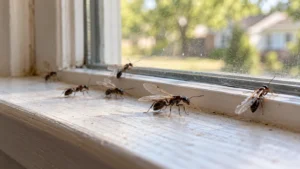
A clear photograph showing the body shape and antennae is more useful than a size estimate alone. The guide to what carpenter ants look like covers the distinguishing features in detail.
What the pattern tells you
A worker found near a patio door after a warm evening may have entered from an outdoor colony. Check the nearby exterior surface for ants moving along the foundation, siding, or vegetation.
A recurring line across a counter or baseboard suggests an established travel route. That route may lead to food indoors while the colony remains outside. Watch which way workers move instead of assuming that the first crack they enter contains a nest.
Repeated emergence from a joint in interior trim raises the priority of further inspection, particularly when you cannot identify an obvious outdoor connection. Keep the area intact and note whether workers also move back into the same opening.
If the insects have wings, the situation needs a different assessment. The guide to flying ants in the house explains what their appearance and timing can mean.
How to Check the Route Without Opening the Wall

Watch an active route before cleaning it away or applying insecticide. Carpenter ants often forage in the evening or after dark during suitable weather. Use a flashlight and observe from a short distance. A brief phone video can help you see whether workers consistently move toward an opening or away from it.
Follow only accessible surfaces. Check along baseboards, window trim, door frames, and visible plumbing penetrations. From ground level outside, look for a connected route along siding, a deck, nearby vegetation, or stored wood. An ant disappearing into a gap gives you a useful inspection point, not necessarily the location of its nest.
Check for nearby moisture problems
Look for visible water staining, peeling paint, swollen trim, dripping plumbing, or old leak marks around the area of activity. Carpenter ants frequently establish nesting areas in wood affected by moisture, so a recurring route near a leaky window deserves attention.
If you find a leak, address the source of the water. There is no reason to open a wall simply because ants crossed a nearby surface.
Fresh wood-like particles or insect fragments appearing near a joint are worth photographing before disturbing them. Their origin needs verification; a closer check of carpenter ant signs and debris is the appropriate next step rather than assuming every pile of shavings came from a nest.
Keep a record that helps locate the source
Note the room, exact observation point, approximate number of ants, time of day, and direction of movement. Return to the same location during another period of activity to see whether the pattern repeats.
If several workers disappear behind a cabinet edge, mark the spot with a small piece of removable tape beside the opening. Keep the opening visible so you can observe it again.
Avoid spraying the visible workers or sealing an actively used gap before you understand the route. Killing a few foragers or blocking one opening can conceal the pattern without addressing the colony responsible.
Identification Mistakes
- Treating every big black ant as a confirmed carpenter ant and every indoor sighting as an indoor nest.
- Spraying or caulking the first active gap before observing which direction workers travel.
- Taking loose wood dust or an old water stain as proof that carpenter ants are currently damaging the structure.
Key Clue
The most useful evidence is a repeatable movement pattern. Several confirmed carpenter ant workers emerging from the same indoor joint on separate occasions give you a specific area to investigate, especially when the route cannot be connected to an obvious exterior entrance.
What to Watch For
Repeated worker activity in a heated room during cold weather, or numerous winged ants appearing from an indoor location, deserves closer attention. In regions with cold winters, those observations are more suggestive of a nest within the structure than a lone worker found during warm-season outdoor activity.
Does the Pattern Suggest a Nest Inside the House?
When a confirmed carpenter ant appears once near an exterior opening, an outdoor forager is a plausible explanation. Carpenter ants can travel considerable distances from a nest to collect food and water. Their appearance in a kitchen or bathroom identifies a place they reached, not necessarily where the colony lives.
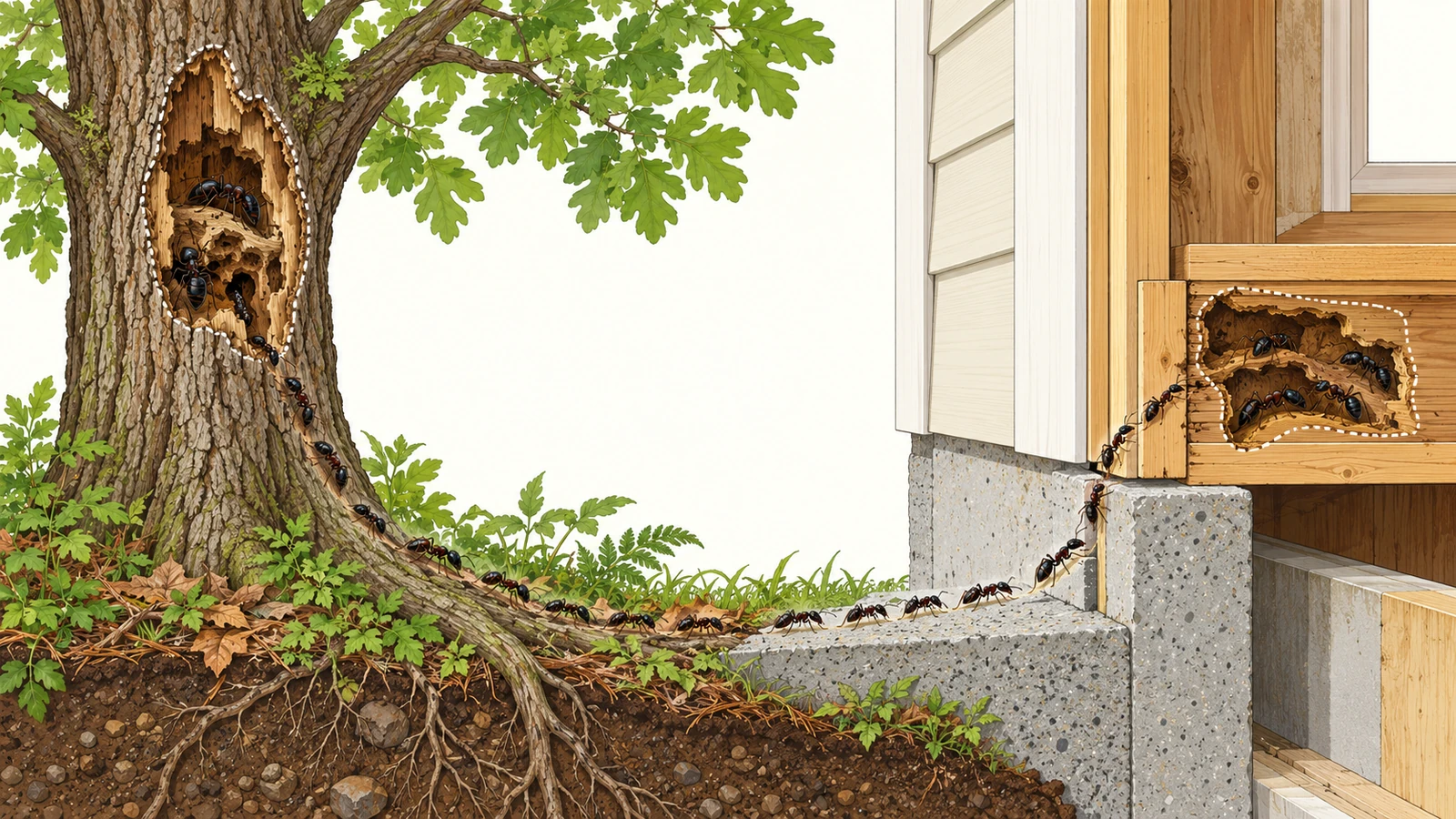
Regular traffic along one route tells you that workers are using that passage. If the path clearly continues outdoors, a colony in a tree, stump, or other outdoor wood may be involved. If workers repeatedly emerge from a concealed interior joint without a visible outdoor route, the possibility of activity in an indoor void becomes more important.
Carpenter ant colonies may include a parent nest and one or more satellite nests. The parent colony, which contains the reproductive queen or queens, is often established in moist or decaying wood outdoors. Workers move between that colony and satellite sites, some of which may be inside a building. That relationship explains why ants seen indoors can be connected to more than one location.
Determining exactly where those nests are requires a separate investigation. The detailed process of finding a carpenter ant nest goes beyond the first checks needed after a household sighting.
Carpenter ants also do not eat wood. They excavate spaces in wood or use existing cavities for nesting. If you find weakened trim or deteriorating structural material, assessing the extent of wood damage is a separate concern from determining whether ants are currently passing through the area.
The same insect can lead to different next steps depending on how it appears:
| What you observed | Most useful interpretation | Next check |
|---|---|---|
| One large ant near a window or door while ants are active outdoors | An outdoor forager is plausible | Confirm the species and inspect the accessible exterior route |
| Workers repeatedly following the same baseboard or counter edge | A regular travel route is established; the nest location is still unknown | Observe direction and where the route enters or leaves the room |
| Workers repeatedly emerging from one interior trim joint | An indoor passage or concealed nesting area deserves investigation | Record the opening and inspect nearby accessible surfaces without dismantling them |
| Numerous winged ants appearing indoors during late winter or early spring in a cold region | A nearby established colony, potentially within the structure, becomes a stronger possibility | Confirm the insects and arrange a timely assessment of the emergence area |
How Urgently Should You Investigate?
One confirmed worker found once near an accessible entry point usually calls for observation rather than immediate treatment. Check the nearby exterior, remove obvious food attractants, and watch whether the same route is used again.
Recurring traffic, repeated emergence from an interior gap, or activity alongside a moisture problem deserves a more focused assessment. Deal with visible leaks promptly. Keep track of the exact locations involved, since that information is more useful than a general estimate of how many ants may be inside the house.

Season and climate change the interpretation
In colder parts of the United States, persistent worker activity inside a heated home during winter is more suspicious than an occasional visitor during the normal outdoor foraging season. In warmer regions, outdoor carpenter ant activity may continue for much longer. Use the local climate and the observed route rather than treating one month as a nationwide warning threshold.
When professional inspection is worthwhile
If workers consistently emerge from an inaccessible wall or ceiling void, several indoor locations remain active, or you find signs of significant moisture or deteriorating wood, a qualified pest control professional can investigate the source.
A building or repair specialist may also be needed if structural wood appears compromised. Identifying an ant colony and assessing the condition of the building are related but different tasks.
For an isolated sighting without additional evidence, continued observation and ordinary maintenance are reasonable first steps.
Good to Know
An indoor satellite nest can occupy a relatively dry wall void, hollow door, or insulation, even though parent colonies often favor moist wood. Dry surfaces around a recurring emergence point do not rule out concealed activity.