Identification
Bald-faced hornets: How to identify them and their nests
Learn which markings distinguish bald-faced hornets, how queens and workers differ, what their enclosed paper nests can reveal, and when a colony’s location makes professional help appropriate.

A large black-and-white wasp in your yard may be a bald-faced hornet, especially if you have noticed a gray paper nest among the branches of a nearby tree. But a wasp visiting a flower and a colony established beside your front door present very different situations.
You can often recognize this insect from its distinctive markings and the type of nest it builds. The important thing is to use the features you can already see, without approaching a colony to get a better look.
What does a bald-faced hornet look like?
The bald-faced hornet (Dolichovespula maculata) is a native North American social wasp found widely across the United States. Despite its common name, it belongs to the aerial yellowjackets, not to the genus Vespa, which contains the true hornets.
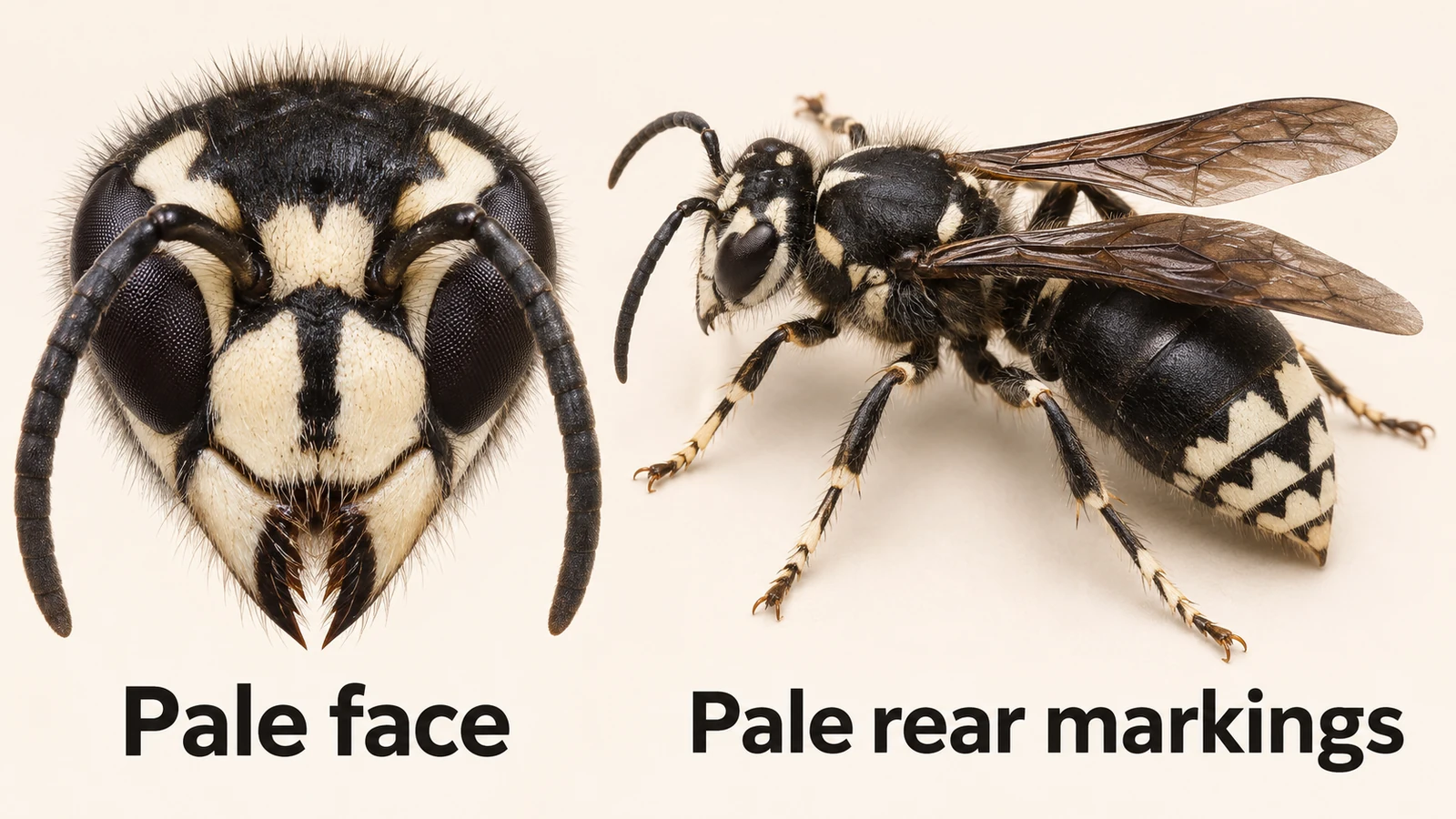
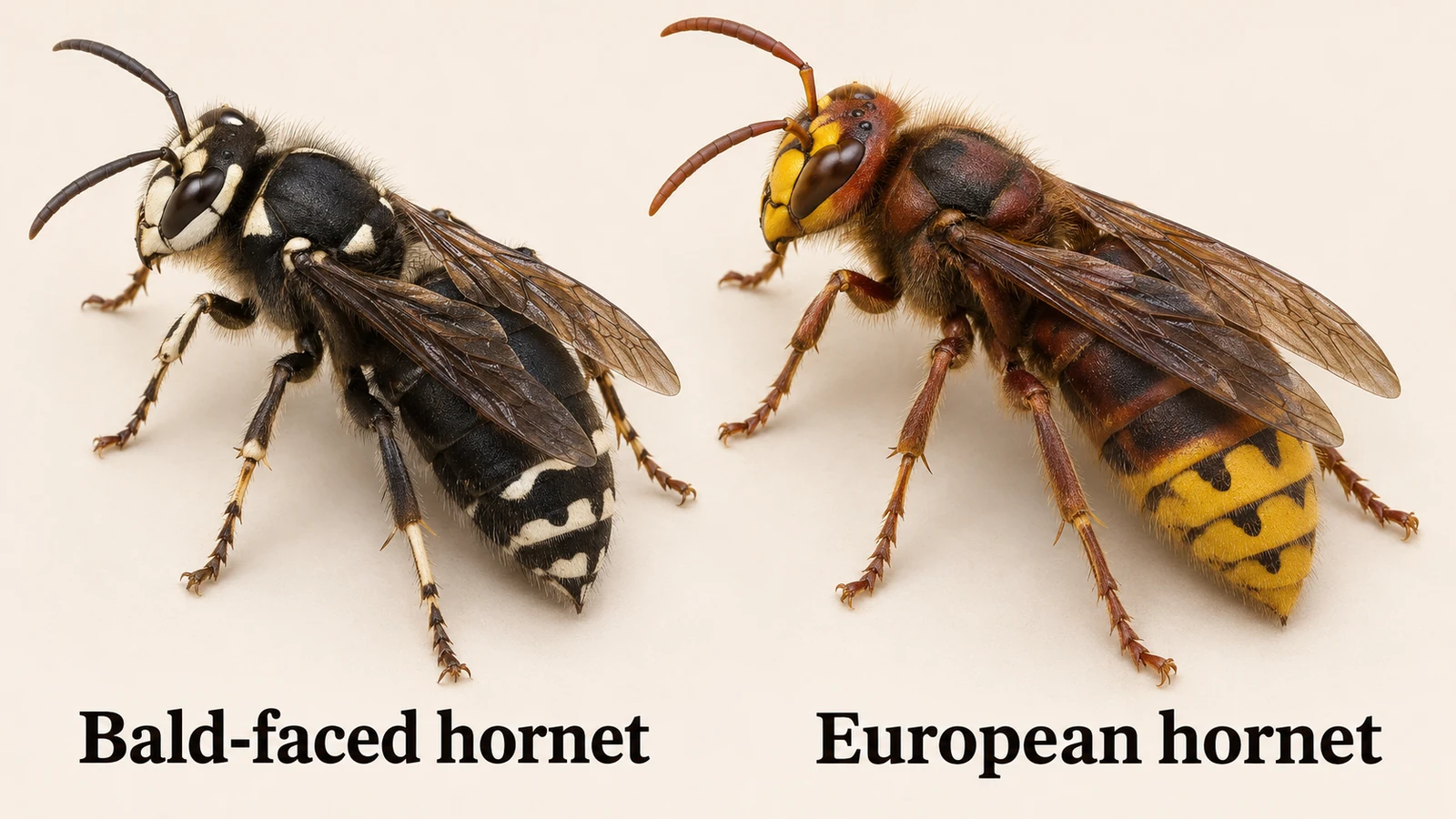
Its body is predominantly black, with a conspicuous ivory-white or cream-colored facial pattern. Pale markings also occur on the thorax and toward the rear of the abdomen. The wings are dark and translucent, and the body is relatively robust.
Identification in 30 Seconds
- A broad, pale facial pattern contrasting with the dark head.
- A mostly black abdomen with pale markings concentrated toward the rear.
- A compact wasp body, usually around 1/2 to 7/8 inch long as an adult.
- A possible association with a suspended, enclosed gray paper nest.
How to recognize a bald-faced hornet queen
Queens have the same characteristic black-and-white appearance as workers, but are generally larger. A large female seen alone in spring, when overwintered queens begin establishing new colonies, may be a founding queen.
Once the first workers mature, they take over most of the nest-building and foraging duties. New reproductive females are produced toward the end of the colony’s season.
Size and season help you interpret a sighting, but a photograph without a reliable size reference rarely establishes whether you are looking at a queen or a worker. There is no need to catch or handle the insect to resolve that question.
How to recognize a bald-faced hornet nest
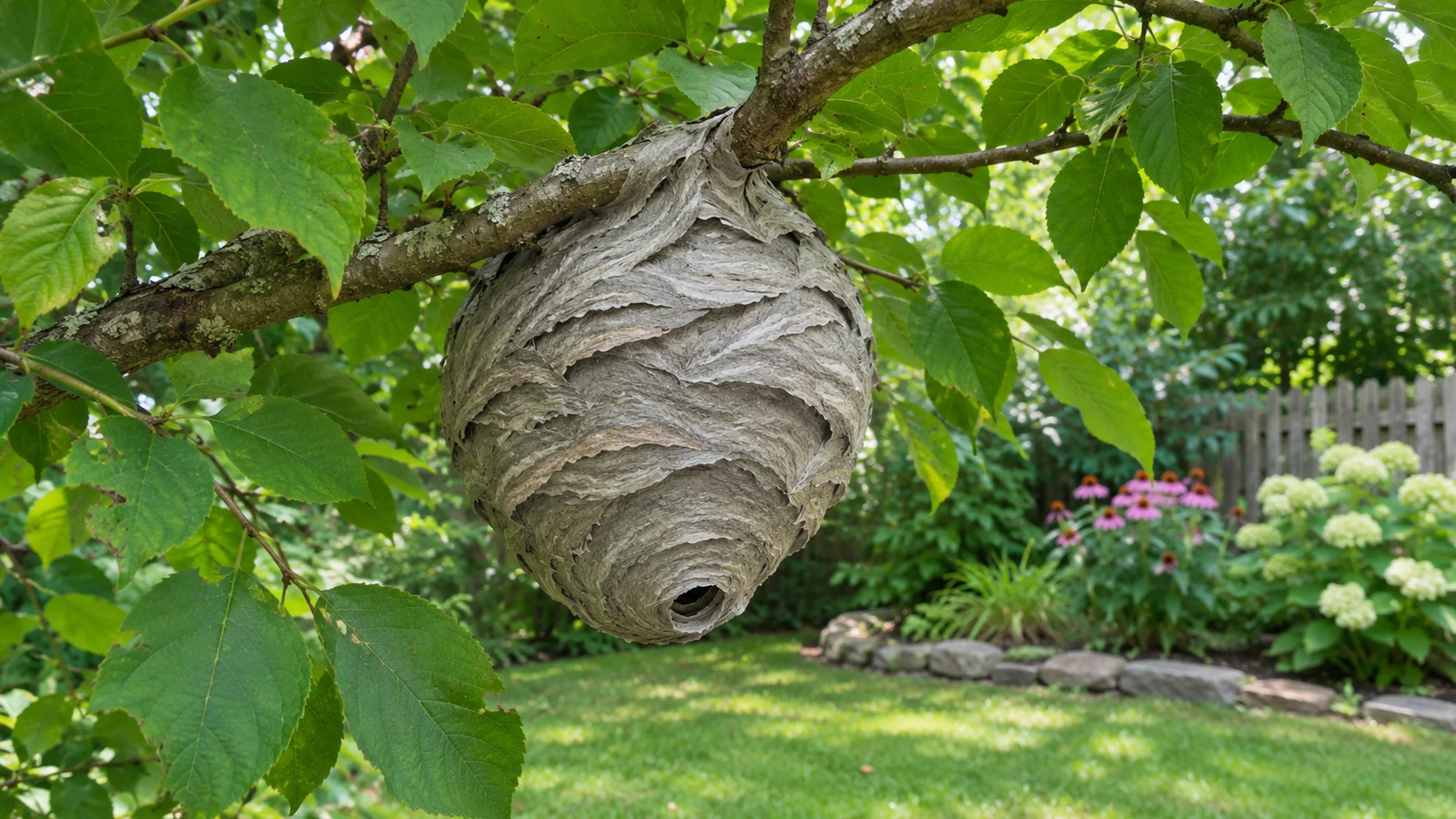
A mature nest often resembles a gray, rounded or tapered paper structure suspended from a branch, hidden among shrubs, or attached beneath an overhang. Its outer surface is made of overlapping layers of papery material. The brood cells are sheltered inside that envelope.
Look only from a position that is already safe, preferably through a window or from well outside the area of activity. If the markings on the insects are difficult to see, use an existing photo or optical zoom rather than moving closer.
Early nests can be quite small. As the colony grows during the warmer months, the outer envelope expands, sometimes reaching the size of a basketball or larger. Leaves can conceal much of the structure until later in the year.
If you can safely see repeated arrivals and departures from the same opening, you have useful evidence that the nest is occupied. Where the view is obstructed, leave it that way. Never move branches, stand underneath the nest, or climb a ladder to examine it.
The enclosed envelope is a clue to the kind of wasp that built the nest. Our guide to wasp and hornet nest types explains what other nest structures may indicate.
Identification Mistakes
- Estimating an insect’s size from a zoomed photo.
- Assuming a passing wasp belongs to the nearest nest.
- Calling every large social wasp a true hornet.
Key Clue
The combination of a broad pale face and white markings near the tip of a mostly black abdomen is more informative than size or either color alone.
What to Watch For
A bald-faced hornet feeding on flowers may ignore you completely. That behavior tells you little about how its colony would respond to a disturbance.
Is it a bald-faced hornet or another wasp?
The pale face, predominantly black abdomen, and pale rear markings together strongly suggest a bald-faced hornet. If the only thing you have seen is a hanging paper nest, keep the identification at the level of a possible aerial-nesting social wasp until you have better evidence.
Bald-faced hornet vs. European hornet
The European hornet (Vespa crabro) is a true hornet found in parts of the United States, particularly in the East. It has reddish-brown coloring on the head and thorax and a much more yellow abdomen. It is generally larger than a bald-faced hornet and often nests inside sheltered cavities such as hollow trees.
Bald-faced hornet vs. other yellowjackets
Many familiar yellowjackets have distinct yellow markings across the abdomen. However, some yellowjacket species also have black-and-white patterns, and some build aerial paper nests. Color and nest shape must therefore be considered together. If a photo does not show the relevant markings clearly, leave the species identification open.
Bald-faced hornet vs. paper wasp
Paper wasps in the genus Polistes typically have a more slender silhouette and long legs that hang beneath them in flight. Their characteristic exposed combs lack the outer paper envelope of a bald-faced hornet nest. See our paper wasp identification guide if you can see open cells beneath a sheltered surface.
How much of a risk does the nest pose?
Bald-faced hornets catch other insects, including flies and caterpillars. Away from their colony, individual foragers are often occupied with finding food rather than defending a territory. Near an occupied nest, however, these wasps can defend the colony vigorously and sting more than once.
A nest near a porch door, frequently used walkway, or low branch beside an area that needs mowing or pruning deserves much more attention than one in an isolated part of the yard. Even a colony that has caused no previous trouble may respond differently if its supporting branch or structure is disturbed.

Do not use a fixed number of feet as proof that a particular location is safe. Consider whether the area can be avoided without passing near the nest, whether children or pets use it, and whether ordinary maintenance could disturb the colony.
Regular traffic indicates an active nest, but a brief period of inactivity is inconclusive. Cool weather and the time of day can reduce visible activity. Avoid checking for occupants by touching or disturbing the structure.
Good to Know
In temperate parts of the U.S., bald-faced hornet colonies normally last one season. New mated queens overwinter elsewhere, and the old nest is not reused the following year. An old paper envelope may remain visible long after the colony has gone.